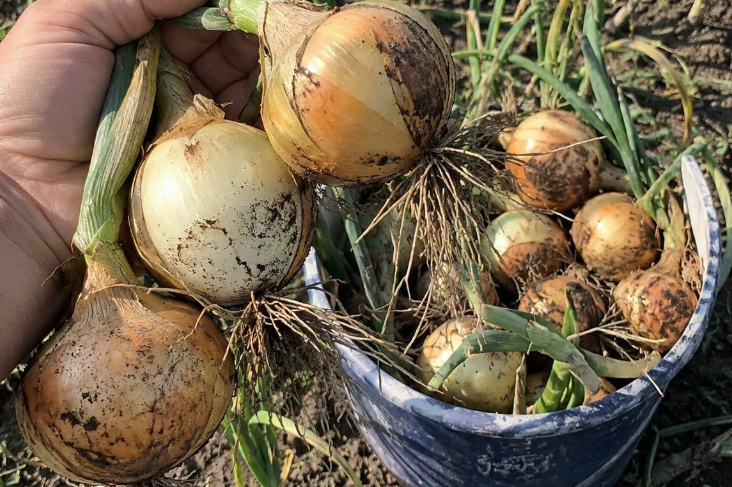
Many gardeners commit one and the same mistake — leave the onions on the bed “for a few more days”. It seems that during this time they will become larger, but in reality overripe bulbs often begin to grow roots or green leaves again. Such a harvest stores much worse.
So that the onions without problems lie until spring itself, one needs to orient not only by the calendar, but first of all by the state of the plants.
How to understand that it is already time to dig up the onions?
- The greater part of the feather has yellowed and lain on the earth in a natural way.
- The neck has become thin, soft and almost completely dried.
- On the bulbs dense dry husk has formed, characteristic for the given variety.
- If one slightly rakes the earth, the bulb looks fully formed and is covered with several layers of dry scales.
If the majority of these signs have already appeared, it is not worth delaying the collection of the harvest.
When is it better to dig up the onions?
Choose a dry sunny day. Several days before harvesting it is desirable to stop watering so that the soil has time to dry. It is better to dig the onions with a pitchfork or carefully with a shovel, and not to pull out with force — this way there is less risk of damaging the bottom.
What to do after harvesting?
Do not hurry at once to cut the tops. Spread the onions in one layer under a canopy or in a well-ventilated room for 10–14 days. During this time the neck will finally dry, and the protective husk will become stronger.
After complete drying one can cut the roots and tops, leaving a neck about 3–5 centimeters long.
How to understand that the onions are ready for storage?
The neck is completely dry, the husk pleasantly rustles, and the bulb itself remains dense and hard. Exactly such onions are capable of storing for long months without sprouting and rot.
Sometimes only a few extra days on the bed can significantly shorten the storage term of the harvest. Therefore carefully observe the plants — they themselves will prompt the most successful moment for harvesting.
This material was prepared by the editorial team using artificial intelligence tools. All information has been verified and edited before publication.