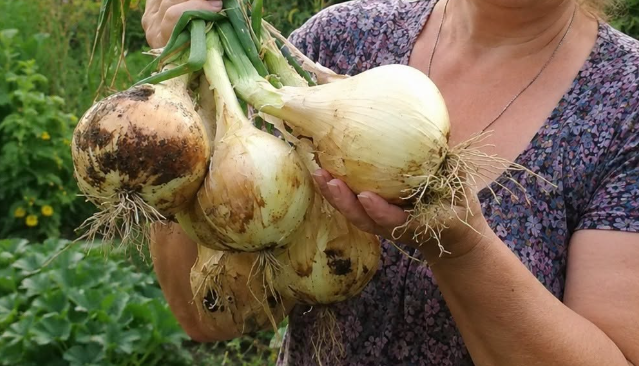
Many gardeners lose part of the harvest not because of diseases or pests, but because of one common mistake — onions are dug up either too early or too late. As a result they quickly sprout, rot or dry out even before winter. That is why it is important to determine the harvesting moment in time and correctly prepare the harvest for storage.
How to understand that the onions are already ripe?
Do not hurry to orient yourself only by the calendar. The best indicator is the plant itself.
Here are the main signs:
- most of the foliage has yellowed and lodged on the ground;
- the neck has become thin and soft;
- the outer scales have acquired a characteristic golden or brown colour;
- the bulb easily separates from the soil.
If approximately 70–80% of such plants are already on the bed — it is time to collect the harvest.
When is it better to dig?
Choose a dry, sunny day. Do not pull the onions after rain or when the ground is still wet. Moisture significantly shortens their storage period.
If the soil is dense, it is better to carefully dig with a fork rather than pull by the tops so as not to damage the base.
Be sure to dry thoroughly
After digging do not hurry to cut the leaves.
Spread the onions in one layer under a canopy, in the attic or in another well-ventilated place. Drying should last approximately 10–14 days.
Only after this cut the roots and leave a neck 3–5 cm long. If you like to braid into plaits, the leaves can be left longer.
Where to store so that they last until spring?
The best place is a dry, dark room with good ventilation.
For long-term storage the following are suitable:
- wooden or plastic boxes with holes;
- nets;
- wicker baskets;
- canvas bags.
The optimal temperature is from 0 to +5 °C or about +18…+22 °C under conditions of low humidity. The worst option is a warm and damp room where the onions quickly start to spoil.
Do not store them next to potatoes. Potatoes release a lot of moisture, because of which the bulbs rot faster.
A little advice that really works
Once a month sort through the stocks. If one bulb has started to spoil, it is better to remove it immediately. This way you will protect the entire harvest from rot.
Correctly harvested, well-dried and stored onions easily last until spring itself, remaining juicy, firm and aromatic. And exactly a few days of patience during harvesting can decide whether you will use your own harvest in winter or will have to buy a new one.
This material was prepared by the editorial team using artificial intelligence tools. All information has been verified and edited before publication.