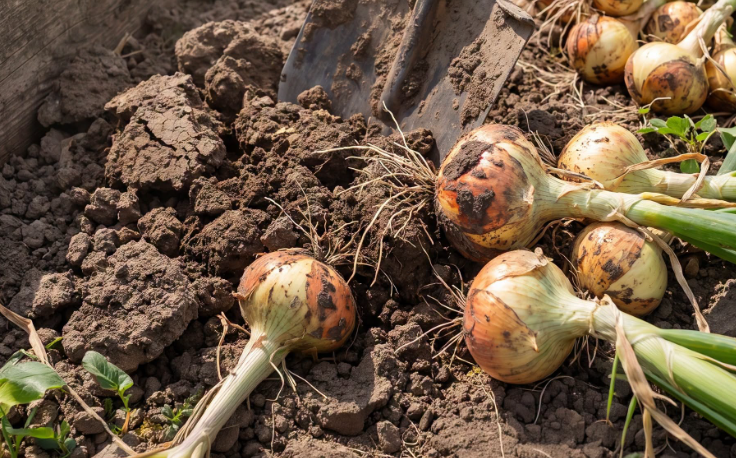
When is the time to harvest the onions?
- Most of the foliage has yellowed and lodged on the ground.
- The neck has become thin and soft.
- The scales on the heads have dried and acquired the characteristic colour for the variety.
If the summer was rainy and the greens have not yet lodged, it is not worth waiting endlessly. Overripe onions can start growing roots again, and then they will store significantly worse.
It is best to dig up the harvest in dry sunny weather. Do not pull the onions by force — it is better to carefully dig with a fork or shovel so as not to damage the base.
After collection the heads are left to dry right on the bed for several hours if the weather allows. Then they are transferred under a canopy or to a well-ventilated place for another 10–14 days. During this time the neck will completely dry, and the outer scales will become strong.
The leaves are cut only after complete drying, leaving a neck 3–5 cm long. The roots are also carefully trimmed, without touching the base.
To prevent the onions from starting to rot, follow several simple rules:
- Before putting into storage sort the harvest and set aside all damaged or soft heads — they are better to use first.
- Store the onions in nets, baskets or wooden boxes with good ventilation.
- Do not pour too thick a layer — air should circulate freely.
- The best place is a dry, dark room without sharp temperature fluctuations.
- Once every few weeks review the stocks and immediately remove the heads that have started to spoil.
Exactly proper drying and storage conditions, and not only the collection date, determine whether you will use your own firm onions in winter or throw them away because of rot.
Save these tips for yourself — they help gardeners every year to preserve the harvest until the new season.
This material was prepared by the editorial team using artificial intelligence tools. All information has been verified and edited before publication.