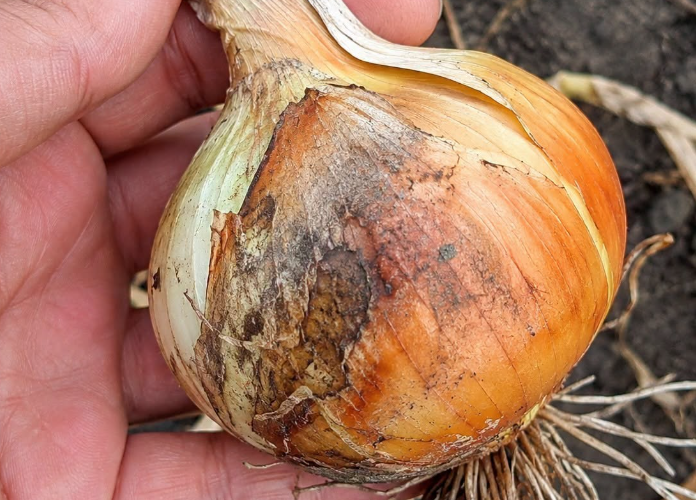
It would seem that the harvest has already been collected, the most difficult is behind. But only a few weeks pass, and some bulbs become soft, an unpleasant smell appears, and then the entire stock begins to spoil. In most cases the reason lies not in the variety of onions, but in mistakes made during harvesting and preparation for storage.
1. The onions were harvested too early
If they are dug up before full ripening, the neck remains thick and moist. Through it fungi and bacteria easily penetrate inside, which cause rotting.
It is better to collect the harvest when the greater part of the tops has yellowed and fallen, and the neck has become thin and begun to dry.
2. Insufficient drying
This is one of the most common causes of spoilage of the harvest.
After harvesting the onions must be dried for at least 10–14 days in a dry, well-ventilated place. During this time the upper scales become dense, and the neck completely dries and closes.
3. Too early trimming of the tops
Many trim the leaves immediately after digging, but this should not be done.
During drying nutrients still continue to pass from the tops into the bulb. In addition, a fresh cut becomes open gates for infection.
It is better to trim the tops only after complete drying, leaving a neck about 3–5 centimetres long.
4. Damage during harvesting
Any cuts, blows or cracks significantly shorten the storage period.
Even a small damage over time can become a focus of rot. Such bulbs are desirable to use for food first of all, not leaving them for long-term storage.
5. Absence of sorting
Before putting the onions into storage, carefully sort through the entire harvest.
Set aside separately:
- soft bulbs;
- specimens with a thick neck;
- damaged ones;
- onions with spots or signs of diseases.
One spoiled bulb is capable of infecting the entire box in a short time.
6. Unsuitable storage conditions
Onions poorly tolerate high humidity and lack of air circulation.
They store best:
- in a dry room;
- at a stable temperature;
- in wooden boxes, nets or wicker baskets where there is good ventilation.
But polyethylene bags are not suitable for long-term storage — condensation quickly forms inside, which accelerates the development of rot.
Useful advice from experienced gardeners
Do not hurry to immediately transfer the dried onions to the cellar or pantry. Leave them for a few more days in a dry room. During this time hidden damages will appear and weak bulbs will begin to spoil, which can be removed in time.
Such a simple check helps preserve a large part of the harvest healthy and strong until spring itself.
And how do you store onions — in braids, nets or wooden boxes?
This material was prepared by the editorial team using artificial intelligence tools. All information has been verified and edited before publication.