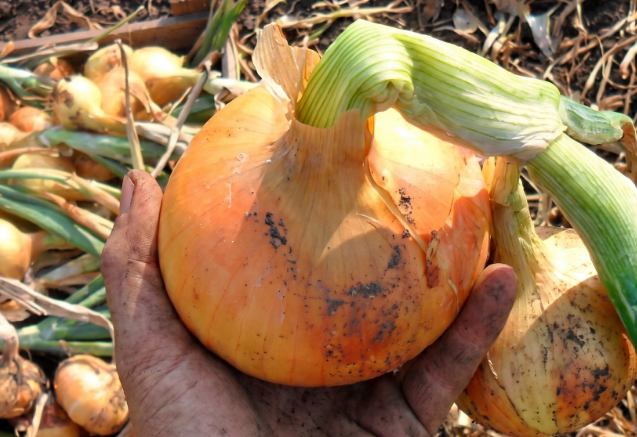
Every year the same story: the neighbour is already boasting about the harvest, and your onions are still standing as a green wall on the bed. And then the temptation appears — maybe it is time too? You grab a spade, dig them up, and in a week half of the bulbs begin to rot in the net. A familiar situation?
In reality the onions themselves give a signal when they are ready to leave the bed. The only question is whether you are able to read this signal.
What the yellowed tops actually mean
The main mistake is to orient exclusively by the calendar. “Planted in April, so dig in August” — this does not work that way, because everything depends on the variety, the weather and even on what May was like.
The real signal is different: the tops lie down on the ground exactly massively, and not one by one. If a couple of stalks from the edge of the bed have fallen — this still means nothing, it may simply be damage or disease. But when the greater part of the tops lodges simultaneously and the neck of the bulb becomes soft and thin — the bulb has completed its growth cycle and will no longer draw anything useful from the soil.
The second landmark is the colour of the husk. It must become dry, rustling, with the characteristic shade of exactly your variety: golden, bronze or violet for red varieties.
Why the date on the seed packet is only a landmark
A hot dry summer accelerates ripening by two-three weeks. A rainy and cool one, on the contrary, stretches the process — the onions continue to grow juicy mass, and the tops stand green much longer than the “passport” terms.
Therefore experienced gardeners a week or two before the approximate date simply begin to look at the bed every day, and do not wait for a specific number in the calendar.
A small trick that accelerates ripening
If you see that the season is dragging on, and the weather is spoiling — do not wait for the aesthetic perfection of the tops. 10-12 days before the planned digging carefully rake the earth away from the top of the bulb, exposing it by a third. This limits the inflow of moisture and nutrients, and the plant more quickly passes into a state of rest. The method saves the harvest when autumn comes earlier than the schedule.
The day of digging: the little things that determine everything
Choose a dry sunny day, and preferably that before this there stood at least a couple of days without rain — wet earth sticks to the bulbs and leaves micro-damages through which rot later enters.
Dig, and do not pull by the tops. It seems a trifle, but exactly sharp pulling tears the roots at the base, and this is open gates for infection during storage. Undercut a little from the side with a fork, lever and only then pull out with the hands.
Shake the earth from the roots with the hands, without striking the bulbs against each other and without knocking them against the spade — any micro-trauma on the surface will become the point from which rotting will begin already in December.
Drying — the stage that people skip to their own detriment
Immediately carrying the onions to the cellar is almost a guarantee of losing half the harvest by New Year. The bulbs must “ripen” in the air.
If the weather allows, leave the onions right on the bed for 3-5 days, covering from rain with film or a canopy. Further transfer under a canopy or to the veranda for another two-three weeks — the main thing is that it is dry, ventilated and without direct sun.
Do not trim the tops at once. While they are green or even yellow, nutrients from them still flow into the bulb, strengthening the neck. Trim only when the tops become completely dry and papery, leaving a tail of 4-5 cm.
How to understand that the onions are ready for storage
Take a bulb and rub the neck with the fingers — it must be hard, dry, without the slightest hint of juiciness. The husk rustles and easily peels off from the top. If the neck is still soft and elastic — it is early, let it lie on drying a little more, otherwise exactly from there the rot will go first.
Where and how to store so that it lasts until April
Ideal conditions are temperature from 0 to +3 degrees and air humidity not higher than 70%. A warm kitchen or a balcony with temperature fluctuations is the worst variant — the onions there will either sprout or become damp and spoil.
Lay out not in a thick layer, but better in nets, old nylon stockings or boxes with holes for ventilation. The main rule — air must freely circulate between the bulbs, a solid heap always heats and spoils first.
Once a month or a month and a half it is worth going through and removing those bulbs that have begun to soften or sprout — one spoiled bulb is capable of infecting the neighbouring ones in a matter of days.
Observing this sequence — the correct moment of digging, careful drying and a ventilated cool space — the onions will calmly last until the spring sowing of the new harvest, and will not turn into a surprise in the form of rot already a couple of weeks after collection.
This material was prepared by the editorial team using artificial intelligence tools. All information has been verified and edited before publication.