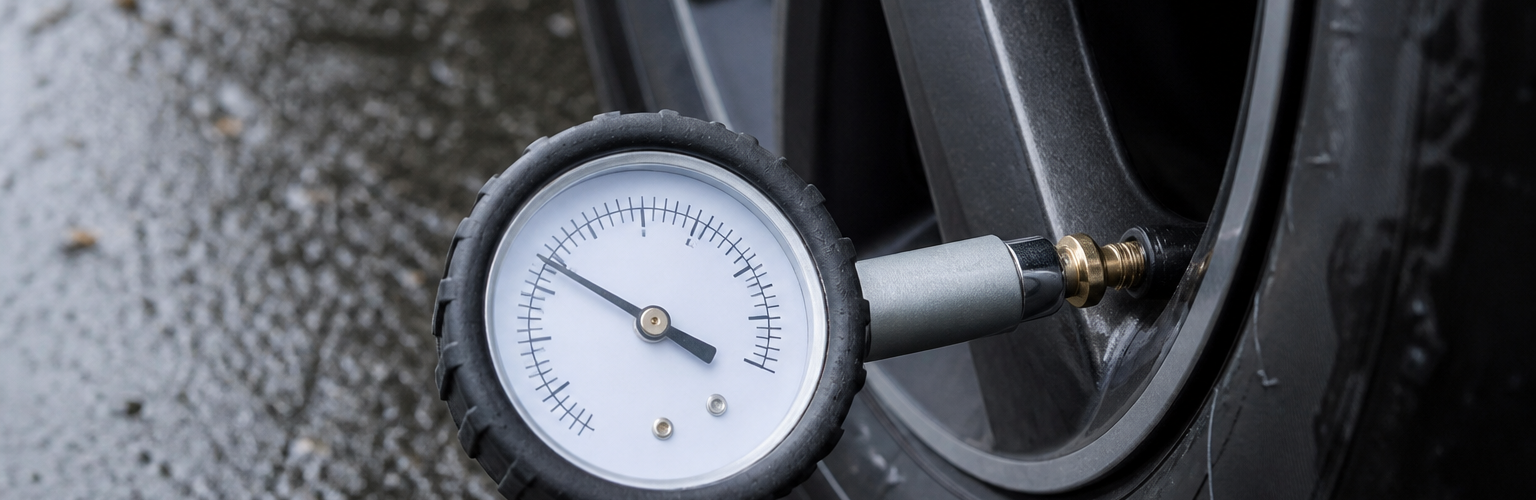
You parked on a warm afternoon. The next September morning the steering feels vague, the TPMS light is thinking about it, and the tires look slumped. Nothing is “wrong” with the rubber. The air inside got colder.
A common rule of thumb is about 1 PSI lost for every 10°F drop. That is why the first cool nights surprise people who last checked in July.
This is not a scare story. Read the door-jamb number, check tires cold, and add air. Overinflating “for winter” is not a hack. Driving low wears the outer edges, wastes fuel, and feels mushy in the rain.
The physics, without a lecture
When the air in a tire cools, pressure drops. When you drive, it rises again.
- A 30°F overnight drop can show up as roughly 3 PSI on the gauge.
- Cold mornings lie visually. Dawn slump can look “fine” after a 20-minute commute. Sidewalls always look squishier than a bike tire. Trust a gauge.
- TPMS lags. Many systems warn only after a tire is about 25% below spec. You can be several PSI low for weeks with no light. The light is a backup, not a maintenance plan.
If you drove 15 minutes to the pump, the tires are warm and the reading is high. Check at home before you drive, or add a little less than you think and recheck the next cold morning.
The number that matters is on the door jamb
Open the driver’s door. The sticker on the jamb or door edge lists the manufacturer’s recommended cold pressure for the original size—often 32, 33, or 35 PSI, sometimes different front and rear.
That is the number.
The big MAX PRESSURE on the sidewall is not your daily target. It is the maximum cold pressure the tire can handle at max load. Filling to the sidewall max “so they don’t go low” gives a harsh ride and a smaller center contact patch.
If you changed tire size, use the shop’s number for that size. Some trucks list pressures by load—use normal load unless you are packed for a trip. Do not copy a neighbor’s 40 PSI. Save the placard in your phone.
How to check and fill
Use a pocket gauge you trust more than the bent stick on a gas-station hose.
Check cold:
- Park overnight, or at least three hours without driving, out of midday sun if you can.
- Unscrew the cap. Press the gauge on until the hiss stops. Check all four, plus a real spare.
- Compare each reading to the door-jamb spec. One tire 4 PSI below the others is a leak or a bad valve, not “September.”
- Add air in small bursts and recheck. Easier to add 2 PSI than bleed off 8 from an aggressive compressor.
- Put the cap back on. Caps keep grit out of the core.
At a station compressor: know the placard. Use a preset or stop early. Keep kids clear. If the machine and your gauge disagree, believe your gauge. Stop if a tire is bulging, cut, or was run flat.
TPMS after filling: drive a few miles. The light may need a short trip to clear. If pressures are correct and it stays on, you may have a sensor issue, a monitored spare that is low, or a slow leak. That is a shop visit, not endless morning top-offs.
Spare, seasons, and what not to do
- Check the spare in September. A trunk doughnut often needs much higher pressure than the road tires. Do not fill the doughnut to 32 PSI. Do not fill the road tires to the doughnut’s 60 PSI.
- Do not overinflate for the first cold snap. If you are 3 PSI low from a 30°F drop, add about 3 PSI cold. Restore the placard. Do not invent a winter spec.
- Nitrogen still changes with temperature. Same cold-check habit.
- Do not warm a tire with a dryer to make the number prettier. Check cold. Fill to spec.
- No flammable shortcuts to seat a bead or “boost” pressure. Off the rim is a professional job.
If the same tire is down again in two days, repair the nail, valve, or rim. Repeated top-offs are not a strategy.
Safety, not scare-clickbait
Low pressure makes a tire flex more, run hotter, and wear the shoulders. Wet stopping distances grow. That is enough reason for five minutes with a gauge.
You need the door-jamb PSI, a cold reading, air in small amounts, a recheck the next cool morning, and a shop if one tire will not hold. The number that matters was printed on the car. Use it.