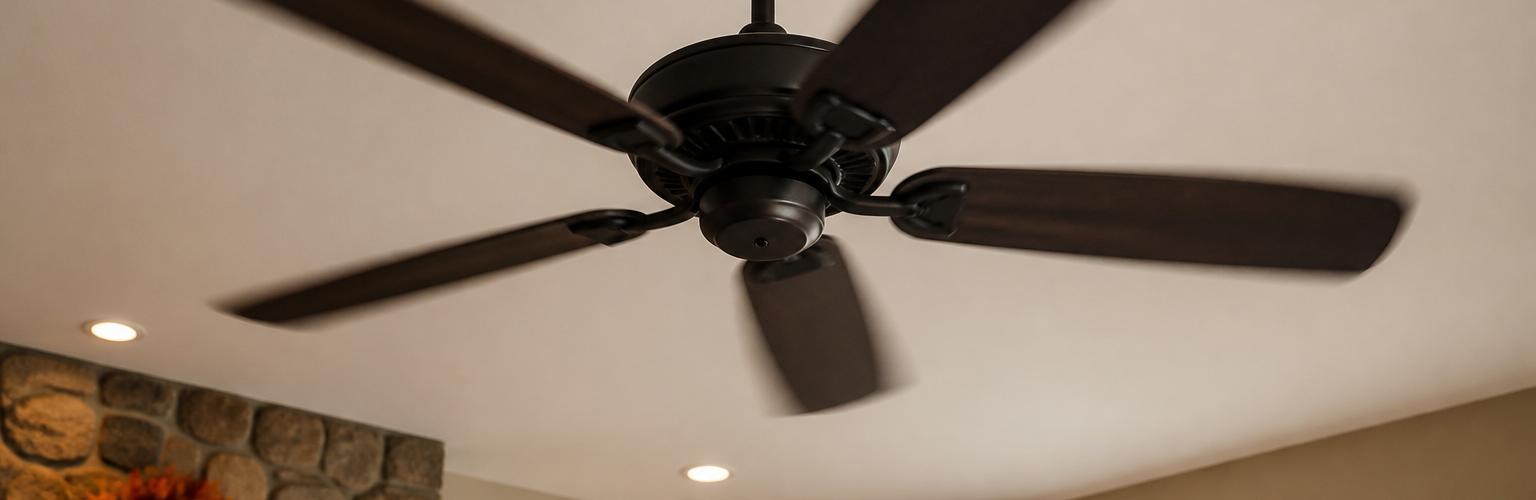
Most people treat a ceiling fan like summer-only equipment. Heat comes on in September or October, the fan stays off, and warm air parks at the ceiling while your ankles stay cool.
That is backwards.
Reverse the fan before you turn the heat on. On a standard U.S. ceiling fan, winter mode is clockwise when you look up—an updraft at low speed. You do not want a breeze on your face. You want trapped heat pushed off the ceiling and down the walls into the room you actually use.
Get the direction wrong and you will feel a chilly downdraft (summer mode in winter). Rush the control while the blades are still moving and you will wonder why nothing changed. Two minutes, right order.
The standard U.S. winter setting
Stand under the fan and look up.
- Winter (heat on): blades turn clockwise. Air is pulled up (updraft). Run it on low. You should not feel a strong breeze on your head.
- Summer (AC season): blades turn counterclockwise. Air is pushed down (downdraft). Higher speed is fine; that breeze is the point.
Clockwise from below is 12 o’clock toward 3 o’clock, same as a clock.
Why an updraft in winter: warm air rises and pools at the ceiling, especially with 8- to 10-foot rooms. Clockwise rotation sends that layer out to the walls and down into the living space. HVAC people call it destratification. You will call it even heat.
Why low speed: high speed in winter still feels like wind chill. You paid to heat that air. Do not blow it off your skin.
A few odd motors ignore the clockwise rule. Trust the air, not the housing label. After you reverse it, run low for a minute. If you feel a downward breeze, you are still in summer mode. Hold a tissue a foot below the blades: pushed to the floor is downdraft (summer); barely moving or lifting is updraft (winter).
If the reverse control will not budge, stop. Turn the fan off first. Never pry it with a tool while the fixture is on.
How to find reverse (and keep the job boring)
On most traditional fans it is a small slide or toggle on the motor housing—the bulky hub the blades attach to. Side, near a pull chain, or on top where you cannot see it from the floor.
Do this in order:
- Turn the fan off. Let the blades coast to a full stop.
- Wait a minute if it was running hard. Dry hands. Steady step stool—not a rolling chair.
- You are reaching up near a light. Skip this right after a shower.
- Move reverse once. Climb down. Turn the fan on low. Check airflow.
- If it is stiff, stop. Do not yank the housing or twist the blades to “help.”
Remote-only fans: look for Reverse, REV, Direction, or two arrows chasing each other. Smart fans hide it in the app under fan settings, not “scenes.” Follow the manual if it says to stop the blades first.
Pull-chain fans: one chain is speed, one is light. Reverse is almost never a chain. It is the little control on the housing.
Why this saves money
The fan does not make heat. The furnace or heat pump does. Winter mode moves heat you already paid for down so the thermostat in the occupied space is satisfied sooner.
- High and vaulted ceilings waste the most heat at the peak. Reverse those first.
- You can often drop the thermostat a couple of degrees and stay comfortable.
- Energy-agency style guidance often cites about 2–3°F in winter with a fan on low—seasonal savings, not a miracle night.
Turn the fan off when you leave for a long stretch. Mix air for people who are home. All-fans-on-high all winter is not a plan. Start with the living room, bedroom, and office.
If there is no reverse
- One-way decorative fans. If they only blow down, leave them off in heating season. A winter downdraft makes you colder.
- Remote button does nothing. New battery, re-pair per the manual. If the motor was never reversible, the button is leftover labeling.
- Broken control. Do not tape it or take the motor apart. A licensed electrician replaces a worn fan.
- Wobble or clicking. Balance or tighten the canopy first.
September/October checklist
- Pick the rooms you actually sit in.
- Power off, full stop, dry hands, step stool.
- Change reverse once.
- Run on low. Confirm no downdraft. Clockwise when looking up is the usual winter picture.
- Save counterclockwise and higher speed for next summer.
You are not making heat. You are stopping last winter’s warm air from living at the ceiling while you nudge the thermostat up another degree.