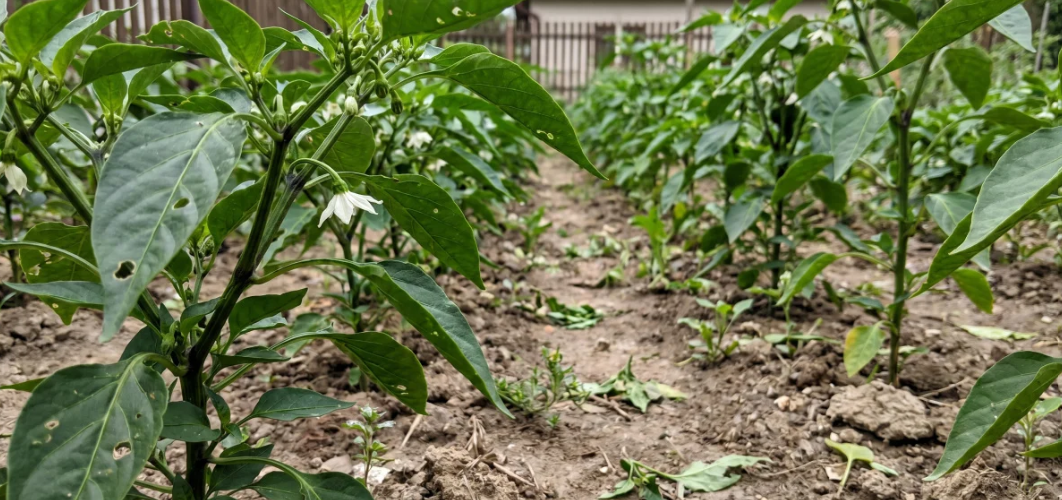
Peppers do not form fruits often precisely when they look healthy, grow vigorously, and flower abundantly at first glance. Three things decide: even soil moisture, balanced fertilization without excess nitrogen, and careful shaping that does not deprive the plant of too many leaves.
A flower is not yet a guarantee of harvest. During heatwaves, peppers can continue flowering, but pollen loses quality and fertilized flowers form only sporadically.
The plant is also weakened by drought, root waterlogging, and sudden condition changes. Therefore, all three rules must be perceived as one system, not as separate interventions.
Why peppers flower but do not form fruits
The most common cause is high temperature during flowering. With very hot days and warm nights, pollen quality decreases and flowers drop.
The problem can be worsened by low soil moisture, dry air, and weak air flow in the greenhouse. The opposite extreme is waterlogged substrate where roots do not have enough oxygen.
If the plant creates a large number of large dark green leaves and long shoots, the cause may be excess nitrogen.
Peppers do not form fruits even due to unsuitable temperature
Peppers like warmth, but extreme heatwaves do not help them. With high daytime temperatures, fertilization worsens and flowers can drop.
In the greenhouse, open doors and ventilation windows already in the morning. Hot air must have a chance to escape before the space overheats.
During a long heatwave, light shading net helps. It should not create complete shade, only reduce the strongest midday radiation.
First rule is even watering
Peppers have a relatively shallow root system and react sensitively to moisture fluctuations. Soil should remain mildly moist, not soaked.
Several dry days during flowering can cause flower drop and stopping of young fruits. Subsequent strong overwatering will not help the roots.
Water slowly and deeply. Add the next dose only after checking the soil below the surface.
How often to water peppers
A fixed interval every two or three days does not work in every garden. Water need depends on temperature, wind, soil, mulch, and plant size.
In a bed, thorough watering several times a week may suffice. During heatwaves or in sandy soil, moisture needs to be checked more often.
Peppers in containers may need water daily during hot weather. Add the second watering only when the substrate really dries.
Check soil, not only leaves
The surface may be moist while deeper at the roots the soil is dry. Insert a finger or narrow trowel several centimeters below the surface.
Cool and moist soil means you can postpone the next watering. Dry crumbly soil signals the need for water.
Drooping of leaves at noon does not have to be proof of drought. The condition early in the morning is more important.
Direct water to the roots
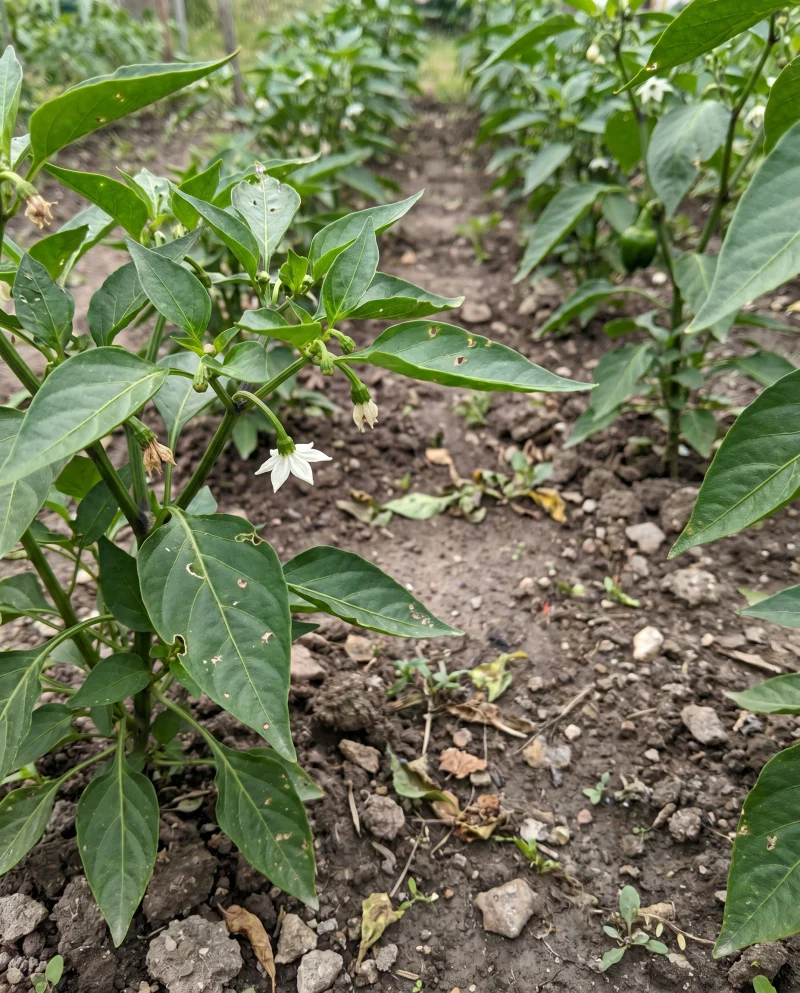
Water the soil, not leaves, flowers, and fruits. Long-term wet crown increases the risk of spots and fungal diseases.
Direct the water stream into a wider circle around the plant. Do not pour everything right at the stem.
Drip hose or drippers supply water slowly and limit leaf wetting. However, check the system regularly because outlets can clog.
Mulch protects roots from moisture fluctuations
A layer of straw, dried grass, or mature compost slows evaporation and overheating of soil. Roots then absorb water more evenly.
Place mulch in an appropriate layer and leave free space at the stem. A thick layer of wet fresh grass can heat and rot.
Before watering, check soil under mulch. Covered surface dries more slowly than a bare bed.
Second rule is balanced fertilization
After setting first fruits, peppers need enough potassium, appropriate phosphorus, and still also a smaller amount of nitrogen. Complete omission of nitrogen is not the goal.
Potassium supports water regime, sugar transport, and fruit quality. Phosphorus participates in energy processes and root development.
Calcium helps maintain tissue firmness, but reaches fruits only with a functioning root system and stable water.
Excess nitrogen creates leaves instead of peppers
Strong nitrogen fertilization supports large leaves, soft shoots, and later ripening. The plant may look excellent, but form few fruits.
If the bush is very dark green and lush, skip further nitrogen fertilizer. Check also light, temperature, and watering.
Excess nitrogen cannot be immediately corrected with a high dose of potassium. Further salts could damage roots.
What fertilizer to choose during fruiting
A practical choice is fertilizer intended for peppers or fruit vegetables. It should contain balanced nutrients and appropriate potassium share.
Dose according to the label and plant condition. Always apply fertilizer to already moist soil.
In containers, nutrients are available in limited substrate volume, but salts also accumulate faster. Weaker regular doses are safer than occasional strong solution.
Use comfrey infusion only as a supplement
Comfrey leaves contain mineral substances and fermented infusion is used as a potassium source. Its exact composition, however, is unknown.
Dilute the infusion and apply only to moist soil. Start with weaker concentration and do not rely on it as the only nutrition.
If the plant already receives complete fertilizer, additional infusion may not be needed.
Dry blossom end rot is not a contagious disease
On the bottom of peppers, a watery spot forms that later darkens and sinks. It is a physiological disorder associated with insufficient calcium supply to the fruit.
The soil may contain enough calcium. Drought, root damage, salinization, or waterlogging disrupt its transport.
Even moisture, healthy roots, and non-overfertilized soil are therefore most important. Remove damaged fruits and stabilize watering.
Third rule is careful shaping
Peppers do not need to be trained the same as tall tomatoes. Many varieties naturally create a branched bush and do not need regular pinching of all side shoots.
It makes sense to remove weak shoots at the ground, damaged leaves, and parts that strongly thicken the inside of the bush. The goal is better air and light access.
Radical pruning, however, reduces leaf area and can expose fruits to sunscald.
Which shoots to remove
Cut out shoots touching the ground, broken parts, and leaves with clear disease symptoms. You can also remove very weak thickened branches inside the bush.
Use sharp and clean scissors. Prune on a dry day so wounds dry quickly.
Do not remove a lot of greenery at once. Monitor the plant for several days and make the next intervention only if needed.
Why too much defoliation harms
Leaves produce sugars needed for fruit growth. At the same time, they shade peppers from strong sun.
Strongly exposed fruits can overheat and create pale, later papery spots. This is sunscald, not nutrient deficiency.
An airy bush does not mean bare stems. Keep enough healthy leaves around each fruit.
Should the crown fruit be removed?
The first fruit in the fork of the main stem is often called the crown fruit. Its removal can help a very small or weak plant continue vegetative growth.
A strong well-rooted pepper, however, can leave it without problems. Universal removal of every first fruit is not necessary.
Decide according to bush size, planting time, weather, and length of remaining season.
Gentle movement helps pollination
Peppers have self-pollinating flowers, but mild movement helps release pollen. In the greenhouse, you can gently shake the support or branch during a dry forenoon.
Do not do it during extreme heat when pollen is less viable. A mildly warm and dry day is most suitable.
Strong shaking can damage flowers and young fruits. Gentle movement is enough.
Ventilation decides in the greenhouse
A closed greenhouse overheats quickly during a sunny day. High temperature causes flower drop even with well-watered soil.
Ventilate early and create air flow between doors and windows. During heatwaves, do not leave the space closed even for a short time.
Too high air humidity worsens pollen release. Morning watering and regular ventilation help maintain better conditions.
Peppers in containers need more attention
Small substrate volume dries and overheats quickly. A large bush in a small container therefore often drops flowers.
The container must have sufficient volume and reliable drainage holes. Water must not stand long in the saucer.
Protect a dark pot from strong sun with a light cover or shading. Overheated roots absorb water and nutrients worse.
How to recognize overwatering of peppers
Waterlogged pepper can wilt similarly to a dry plant. Roots without oxygen cannot properly accept water.
Leaves yellow, growth slows, and soil remains wet for a long time. In a container, a musty smell can be felt.
Interrupt watering, improve drainage, and do not fertilize until the root system recovers.
Check pests and diseases
Aphids, thrips, and mites damage young leaves and flowers. With strong infestation, the plant can drop flowers.
Check the undersides of leaves, shoot tops, and flower interiors. Sticky leaves, spotting, or deformations are not a fertilizing problem.
Treat confirmed infestation in time with a suitable permitted method. Do not overfertilize a heavily damaged plant.
Most common mistakes when supporting harvest
- Daily shallow surface watering.
- Alternation of drought with sudden flooding of roots.
- Strong nitrogen fertilization during flowering.
- Adding calcium without checking moisture and pH.
- Radical removal of side shoots and leaves.
- Closed unventilated greenhouse during heatwaves.
- Leaving a large plant in a too small container.
A mistake is also expecting that one intervention will immediately renew all flowers. The plant needs several days of stable conditions to start setting fruits again.
Simple plan for the end of June and July
Every morning, check soil below the surface and water slowly at the roots if needed. Mulch the bed and ventilate the greenhouse early.
Fertilize mildly with balanced preparation for fruit vegetables. With lush dark green bushes, limit nitrogen.
Remove only damaged and clearly interfering shoots. Leave healthy leaves as an energy source and protection from sun.
Large harvest arises from balance
Peppers do not form fruits especially when heat, irregular water, or excess nitrogen disrupt flowering and pollination. Careful shaping helps only when it does not deprive the plant of needed leaf area.
Stable moisture, appropriate nutrition, and good ventilation create conditions in which peppers maintain more flowers. When these three rules work together, bushes have a much greater chance to bring healthy and gradually ripening harvest.