What not to put in compost is a question that decides whether you get fragrant dark humus or a smelly mass full of pests. The biggest problem is cooked food, fatty leftovers, sauces, meat, and used fat, because they decompose slowly, stifle the compost, and attract rodents and martens.
Compost seems like a simple thing. Just collect organic waste, let it decompose, and in a few months you have nutrition for the garden.
But this is where the most common mistake arises. Many people throw everything that looks natural into the compost and then wonder about the smell, flies, rats, or a greasy sticky layer.
What not to put in compost and why it matters
What not to put in compost should be known by everyone who wants to compost without problems. Compost is not a trash bin for all kitchen waste, but a living system that needs air, moisture, and the right composition of materials.
If you put peels, leaves, mown grass, and small twigs into it, the decomposition proceeds naturally. But when you add cooked food, sauce, or fat, the smell, structure, and behavior of the whole compost change.
The worst is that the problem often does not show immediately. First it just smells a bit, then flies appear, and finally animals you do not want find the compost.
Why cooked food does not belong in compost
Cooked food may have originated from natural ingredients, but it is no longer the same as raw vegetable peels. It contains salt, spices, fats, sauces, and often also meat or dairy leftovers.
These components decompose worse in a normal garden compost. Instead of even rotting, they can start to rot, smell, and attract pests.
If you have a small open compost bin near the house, cooked leftovers are an even greater risk. The smell spreads faster and animals can reach them more easily.
Fats create an impermeable layer
Used oil, lard, greasy sauces, and fried leftovers are very unsuitable for compost. Fat does not decompose like grass or peels.
In compost, it can create a sticky impermeable layer that prevents air access. Without air, decomposition turns into rotting and an unpleasant smell begins to form.
Fat also coats small parts of material, so microorganisms work more slowly. The result is not quality compost, but a heavy smelly mass.
Meat and bones are an invitation for pests
Meat leftovers, fish, broths, smoked meats, and bones belong among the most risky materials. Their smell is very strong for animals and can attract them from a greater distance.
Rodents, mice, martens, foxes, or stray cats can then come to the compost. Once they find out there is food, they will return.
In addition, meat rots differently than plant waste. In a small garden compost, it usually does not decompose as safely and quickly as you would need.
Dairy products and sauces – better not to risk
Yogurts, cheeses, cream, butter sauces, or pasta leftovers with cheese do not belong in ordinary compost. They contain fats, proteins, and salt, which complicate decomposition.
They quickly sour, smell, and attract flies and rodents. In a closed or poorly ventilated compost, they can worsen the whole process.
If you want to keep the compost clean, solve such leftovers in another way. The best is to prevent their creation and cook in quantities you really consume.
Salt and spices do not benefit compost
A small accidental amount of salt from one peel will not cause a problem. Cooked foods, however, often contain a lot of salt and spices.
Salt can worsen the environment for soil organisms and in finished compost you do not want leftovers that would harm sensitive plants. Especially in a small composter, unsuitable material can concentrate.
Spices, hot sauces, and strongly seasoned foods also change the smell of the compost. For some animals they can be paradoxically even more interesting.
What belongs in compost without worries
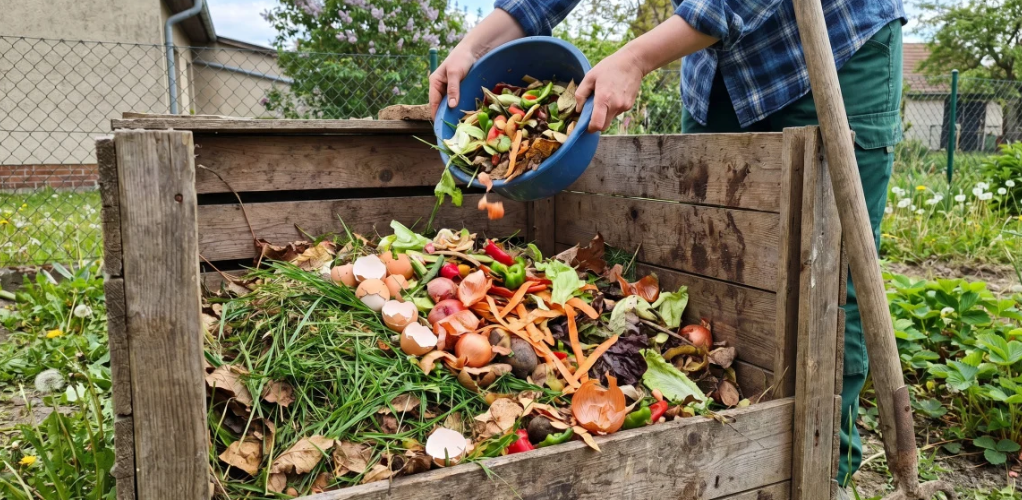
Put mainly plant material in compost. Excellent are peels from vegetables and fruit, coffee grounds, tea leaves without plastic bags, wilted flowers, leaves, and mown grass in reasonable amount.
Small crushed wood, thin twigs, straw, sawdust from untreated wood, and garden plant leftovers are also suitable. However, do not put diseased plants into a normal cold compost.
The best compost arises from a diverse mixture. Alternate green moist materials with dry brown ones so the compost has air and correct moisture.
Green and brown materials must be in balance
Green materials supply nitrogen and moisture. This includes fresh grass, vegetable peels, young weeds without seeds, and green plant leftovers.
Brown materials supply carbon and help aerate the compost. This includes dry leaves, straw, crushed twigs, cardboard without print, and dry stalks.
If there is too much green material in the compost, it starts to stick and smell. If there is too much dry material, decomposition slows down.
How to recognize that compost has a problem
Healthy compost smells more like forest and earth. It should not smell like spoiled food, cesspool, or rot.
If you smell a sharp odor, the compost has too little air, too much moisture, or unsuitable leftovers. Mixing and adding dry material (e.g., leaves or crushed twigs) helps.
If you see greasy spots, food leftovers, or traces of animal digging, solve the problem immediately. The longer pests visit the compost, the harder it is to deter them.
What to do if you have already put cooked food in compost
If it was a small amount, remove it if possible. Cover the place with dry leaves, soil, or finished compost and mix the compost.
If the leftovers have already decomposed and the compost smells, add more dry carbon material. Straw, crushed twigs, dry leaves, or cardboard without glossy print work well.
Let the compost aerate and monitor it for several days. If rodents appear, secure the composter with mesh from below and on the sides.
How to protect compost from animals
The best protection is not putting anything that strongly smells like food into the compost. Animals are not attracted to dry leaves, but to greasy leftovers from lunch.
A closable composter, solid lid, and fine mesh in the bottom part also help. With an open compost, the risk of visits is higher.
Always cover fresh kitchen plant leftovers with a layer of dry material or soil. You reduce the smell and at the same time support decomposition.
Where to put used oil and fats
Do not pour used cooking oil into compost, soil, or waste without thinking. It can clog pipes and disrupt soil life in the garden.
Let it cool, pour it into a closable container, and hand it over according to municipal possibilities at a collection point or in a container intended for used oils. Many towns and villages allow such collection.
Greasy paper towels, heavily soiled packaging, and sauce leftovers do not belong in quality compost. It is better to throw them away according to local sorting rules.
Most common mistakes when composting
- Putting cooked food, sauces, meat, or dairy products in compost.
- Pouring used oil or greasy leftovers into compost.
- Adding too much fresh grass at once and the compost suffocates.
- Not covering kitchen leftovers with dry material.
- Compost is constantly waterlogged and lacks air.
- Putting diseased plants in compost, which may not decompose safely in cold compost.
Simple rule for kitchen waste
If the waste is raw, plant-based, and without fat, it mostly belongs in compost. If it is cooked, fatty, salty, meaty, or dairy, rather do not put it in compost.
Peels from potatoes, carrots, apples, or cucumbers are good material. Leftovers from goulash, fried schnitzel, pasta with cream, or oil from the pan are a problem.
In case of doubt, choose caution. One unsuitable leftover may not destroy the compost, but regular repetition changes the whole process.
Healthy compost needs simplicity
What not to put in compost is as important as what you add to it. Cooked food, fats, meat, sauces, and dairy products attract pests, worsen aeration, and slow decomposition.
If you feed the compost mainly with plant leftovers, leaves, grass, twigs, and cover it with dry material, it will reward you with dark, earthy, and nutritious matter. Compost benefits from simplicity, diversity, and a clean plant base.