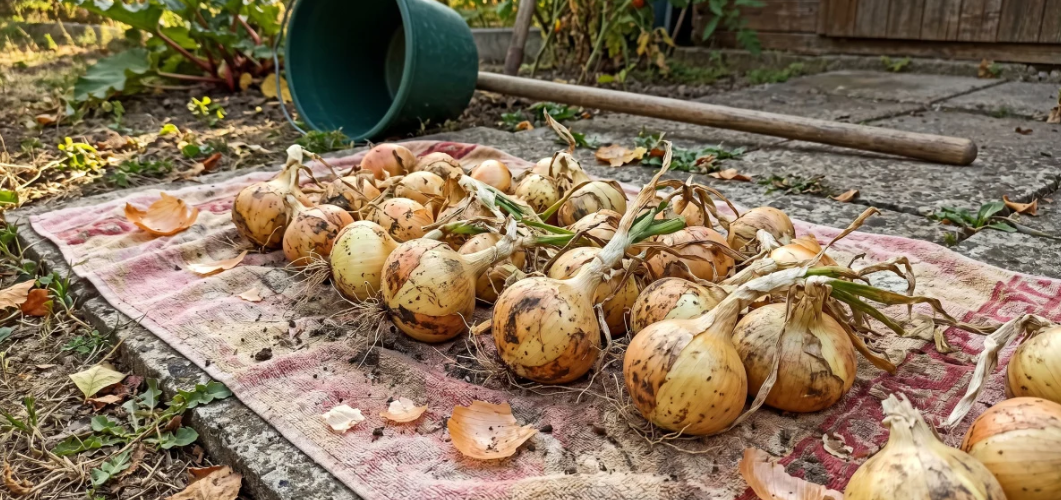
Onion harvest determines whether your crop will stay firm through winter or start softening shortly after storage. The biggest mistakes happen not in the cellar, but already during premature pulling, neck damage, and insufficient drying.
Onions intended for storage need to ripen directly in the bed. During the final growth phase, they stop enlarging, the foliage loses its green color, and the outer layers turn into dry protective skins.
If you interrupt this process too early, the neck remains thick and moist. Such onions close poorly and are more prone to rot in storage.
Onion harvest begins with observing the foliage
The most reliable signal is the natural yellowing and lodging of most of the foliage. You don’t have to wait until every leaf is completely dry, but most plants should clearly show the end of growth.
The neck of the onion gradually narrows and softens. Outer skins acquire the color typical of the variety and no longer feel fleshy to the gentle touch.
Individual plants may ripen unevenly. On a smaller bed, you can first harvest the ripe ones and give the rest a few more dry days.
Do not forcibly break or trample the foliage
Old advice recommends bending or trampling the foliage before harvest to make the onions ripen faster. Such intervention can damage the neck and create an entry point for rot.
The plant should finish vegetation naturally. Lodging is a result of ripening, not a step that needs to be forcibly induced.
If the foliage stays green for a long time due to excess nitrogen or water, stop further fertilization. Gradually reduce watering before the planned harvest according to the weather and soil condition.
A dry day is the best choice for harvest
Harvest onions in dry weather, ideally after several days without heavy rain. The soil releases more easily and less wet dirt remains on the skins.
Wet onions need longer drying and are more sensitive to damage. If a long period of rains is approaching, it is better to harvest the ripe crop and dry it under cover.
During a hot day, do not leave freshly pulled onions for hours in direct sun. Strong radiation can cause burned and softened spots on the exposed skin.
How to pull onions without damage
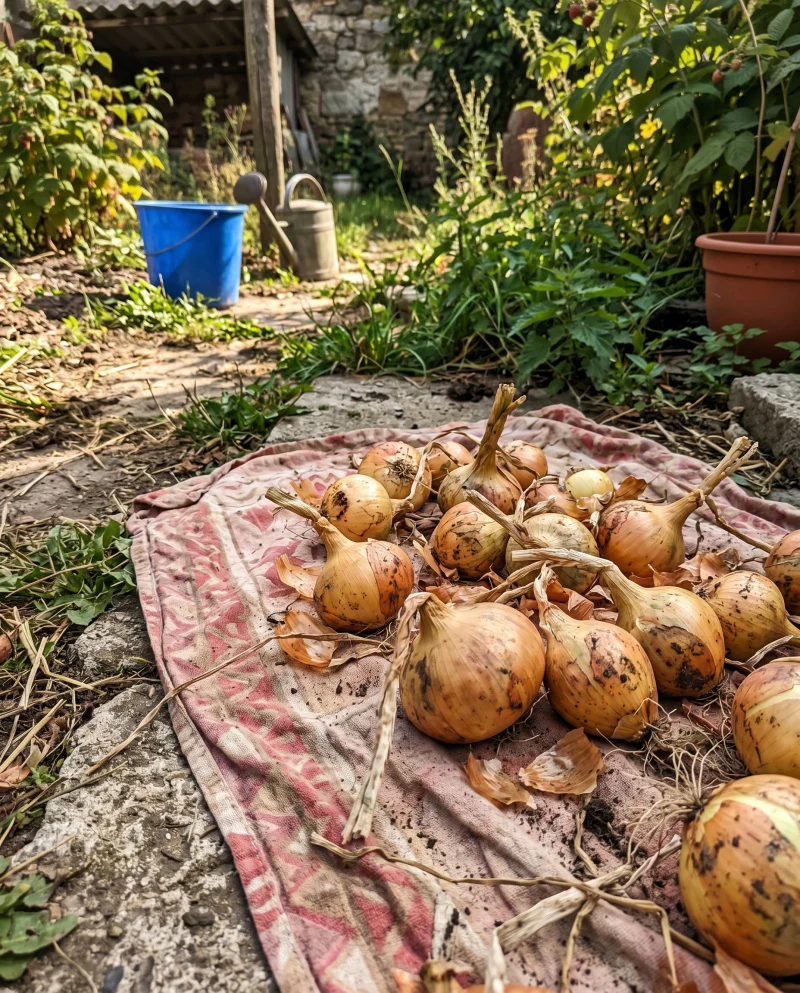
In light soil, you can gently grasp the ripe onion at the base of the foliage and pull it out. If it holds firmly, do not pull with force, as you could tear the neck or damage the bottom part.
In heavier or dried soil, use a digging fork. Insert it farther from the onion and carefully lift the entire row without piercing the fruits.
Every wound reduces storability. Set aside cut, bruised, or abraded pieces and use them first.
Do not knock off soil against the ground or yourself
After harvest, remove only larger clumps that come off easily. Do not bang onions against the ground, crate, or each other.
Let moist stuck soil dry and then gently wipe it off by hand. Hard cleaning can pull off protective skins and expose juicy layers.
Do not wash onions intended for storage. Water can get under the skins and into the neck, prolonging drying and promoting spoilage.
Do not remove the foliage right after harvest
Do not cut fresh foliage immediately in the bed. During drying, it helps evaporate remaining moisture and the neck closes naturally.
Breaking it off can create an open wound. The onion may look neat, but its inner layers remain less protected.
Shorten the foliage only when it is completely dry, rustling, and the neck is firmly closed. When braiding into wreaths, you can leave it whole.
Drying in direct sun has its limits
A short pre-drying in the bed during mild dry weather can be useful. However, onions should not remain long on hot soil or in strong sun.
The safest is drying under cover, in the shade, and in a well-ventilated space. A suitable place is a shed, airy terrace, open barn, or dry attic without extreme overheating.
Air flow is more important than high temperature. Without ventilation, moisture remains between the onions and drying slows down significantly.
Spread onions in a single layer only
Do not put freshly harvested crop into a deep crate or pile. The bottom pieces would stay moist and the pressure of the upper onions could damage their skins.
Spread them on a sieve, rack, dry wooden slats, or low trays. Leave space between individual pieces for air flow.
If you have little space, use multiple shallow layers on separate shelves. Check the onions occasionally during drying and turn them if needed.
How long onions should dry
The length of drying depends on the weather, variety, and moisture at harvest. In good conditions, it can take about two to three weeks, sometimes longer.
Do not rely only on the calendar. Onions are ready for storage when the outer skins are dry, the neck is closed, and the foliage rustles.
Roots at the bottom must be dry and brittle. If the neck is still soft or juicy, continue drying.
When to shorten foliage and roots
After complete drying, you can cut the foliage a few centimeters above the onion. Do not cut right at the neck to avoid damaging the closed protective layer.
Gently rub off or shorten dry roots. Do not interfere with the firm bottom of the onion and do not cut it out.
For wreaths, leave longer foliage. Braid only onions with firm dry necks, because a moist piece can spoil the entire bunch.
Thoroughly sort the crop before storage
For long storage, select only firm, healthy, and well-dried onions. Pieces with thick necks, soft spots, green foliage, or injuries set aside for early use.
Also separate onions that are already sprouting or have damaged skins. Such fruits may not be spoiled, but their shelf life will be shorter.
One rotten onion can moisten the surroundings and spread infection. Sorting is therefore not an aesthetic task, but the basis for protecting the entire crop.
Not every variety lasts the same
Yellow varieties intended for storage usually have firmer skins and longer shelf life. Sweet large onions contain more water and often need to be used sooner.
Red or white onions can last very well if it is a storable variety. Color itself is therefore not the only indicator.
When buying seeds or sets, check the storability information. Label the crop by variety when storing and use the more sensitive pieces first.
The best containers allow air flow
Store onions in shallow crates, wire baskets, mesh bags, or hang them in wreaths. The container must allow air flow from all sides.
Full plastic bags and closed containers are not suitable. They retain moisture and even a small drop of condensation can start rot.
Do not overfill crates. A high layer makes checking difficult and increases pressure on the bottom onions.
What temperature is suitable for storage
Onions can be stored in a cool space just above freezing or in a drier room at moderate temperature. Long-term humid conditions and frequent fluctuations are the worst.
A home cellar may be suitable only if it is not humid. Many cellars suit potatoes, but have too high air humidity for onions.
When storing around a few degrees above zero, prevent freezing. Frozen onions soften after thawing and spoil quickly.
Do not store onions close to potatoes
Potatoes need higher humidity than onions. If stored in close proximity, conditions suitable for one crop can harm the other.
Potatoes also release moisture and, when spoiling, strong odors. Therefore store onions separately or at least in another part of a well-ventilated room.
Do not place them directly on a concrete floor or against a cold damp wall. Place crates on supports and leave space around them for air.
Winter checks save the rest of the crop
Sort stored onions at least once every few weeks. Look for soft spots, wet skins, mold, unpleasant odor, and starting sprouting.
Remove suspicious pieces immediately. If they are only slightly soft without rot, process and heat-treat them as soon as possible.
After finding rot, check neighboring onions too and clean the container. Replace wet substrate and improve air flow.
Fresh foliage from stored onions
You can use healthy sprouting onions for growing green foliage. However, there is no need to cut off the bottom, as roots grow from it.
Place the onion with the root part just above the water level or plant it in a pot with substrate. The entire bottom part should not be submerged long-term, otherwise it will start to rot.
When growing in water, change it regularly and clean the container. Substrate is usually more stable and reduces the risk of odor and softening of the onion.