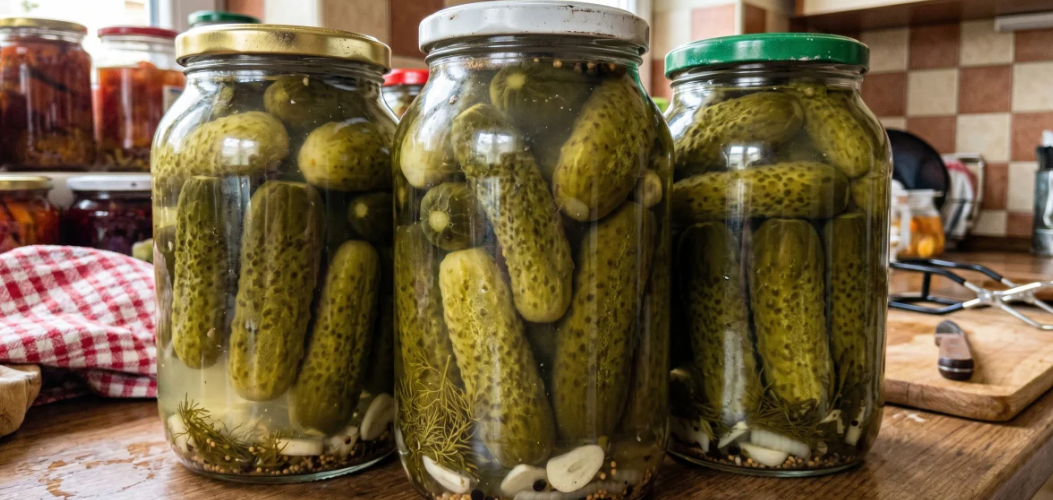
Pickling cucumbers may seem simple, but the result often depends on a detail you don’t even notice when the table is full of jars. A mistake when pickling cucumbers may not show immediately, but after a few days it can appear as cloudy brine, a loose lid, or an unpleasant odor.
The biggest problem is usually not a single “secret” mistake, but a combination of several small things. Damaged fruits, wrong vinegar ratio, dirty jar rim, or too short processing can devalue even a carefully prepared harvest.
With home preserves, it therefore does not pay to rely only on habit. It is safer to stick to a proven recipe, exact ratios, and the procedure intended for the specific jar size.
The biggest mistake when pickling cucumbers comes from improvising
Cucumbers belong to acidic preserves, but safety depends on the correct acidity of the brine. If you arbitrarily reduce the amount of vinegar, add more water, or change the recipe without recalculating, the resulting brine may not have the necessary properties.
Use a recipe from a trustworthy source and maintain the stated ratio of water, vinegar, and vegetables. You can change spices, garlic, or dill carefully, but do not solve the basic ratio of the acidic component by guesswork.
Vinegar should have the acidity indicated on the label. If the recipe counts on a specific concentration, do not replace it with a weaker product just because it tastes milder.
Only firm and healthy cucumbers belong in the jars
The best are fresh, firm, and roughly equally sized pickling cucumbers. Soft, bruised, overripe, or rotten fruits spoil faster and can worsen the quality of the whole jar.
Thoroughly wash cucumbers under running water before processing. Remove soil, flower remnants, and damaged ends, but do not use detergent.
If the recipe recommends cutting off the blossom end, do not skip this step. This part can contain enzymes that promote softening of pickled cucumbers.
Cleanliness is important, but jars do not need to resemble an operating room
Hands, work surface, ladle, and tongs must be clean. Wash jars in hot water with detergent, rinse thoroughly, and keep them warm until filling.
If the filled jars will be processed for ten minutes or longer according to a proven recipe, separate boiling of empty jars is usually not necessary. For shorter processing, follow the exact instructions.
Do not underestimate cleanliness even when tasting the brine. Do not return a spoon that was in your mouth to the pot and do not use it for filling other jars.
Do not wash lids with alcohol and follow the manufacturer’s instructions
Lids must be undamaged, clean, and suitable for the type of jar used. Rusty, dented, or deformed pieces cannot create a reliable seal.
Alcohol is not a common part of the recommended procedure. Prepare lids according to the manufacturer’s instructions, because modern sealing layers often do not require long boiling.
Check reusable jars for cracks and chipped necks. Even a small unevenness can prevent tight lid adhesion.
The jar rim must remain perfectly clean
When pouring brine, a drop easily runs onto the jar neck. Residue of spices, grease, or a piece of dill between the glass and lid then disrupts the seal.
Before closing, wipe the rim with a clean damp cloth or paper towel. Check the entire circumference and remove even small seeds or pieces of vegetables.
Place the lid straight and tighten the closure according to the jar type. Too strong tightening may not be an advantage, because air must escape from the container during processing.
Do not pack cucumbers all the way to the lid
The jar should be filled economically but not overfilled. Place cucumbers firmly so they do not move unnecessarily, but leave space for the brine and its expansion.
In many proven recipes for pickled cucumbers, approximately 1.3 centimeters of headspace is left below the rim. Always take the exact value from the specific recipe.
Too little space can lead to brine overflowing. Too much space makes it difficult to create suitable vacuum and can worsen the quality of the content.
Air bubbles need to be released before closing
Air gets trapped between the cucumbers after pouring. Gently run a plastic or wooden tool along the inner wall of the jar and release the bubbles.
Do not use a sharp metal knife that could scratch or damage the glass. After releasing the bubbles, check the brine level again and top it up if needed.
Cucumbers must remain submerged according to the recipe. Parts sticking high above the brine can change color, dry out, or lose quality.
Temperature alone is not enough, the entire processing time decides
The advice “can at least at 80 degrees” is too general. Safe time and temperature depend on the recipe, jar size, canning method, and altitude.
Some proven recipes use a boiling water bath, others precisely controlled low-temperature pasteurization. These procedures cannot be arbitrarily interchanged or shortened.
Start measuring time only at the moment specified in the recipe, for example when the water reaches the required temperature or starts boiling again. If the temperature drops, adjust the procedure according to the instructions.
Why you should not turn jars upside down after canning
Turning jars lid down belongs among old home habits, but with modern canning it is not necessary. It can cause hot brine to penetrate the sealing part and disrupt proper sealing.
After removal, place jars upright on a towel or mat. Leave space between them and do not move them until they cool completely.
Do not retighten or press the lids during cooling. Vacuum forms naturally when a properly processed and closed jar cools.
Check the seal only after complete cooling
Let jars cool undisturbed for approximately twelve to twenty-four hours. Only then check whether the lid holds and its center does not flex when gently pressed.
For screw closures, follow the design of the specific lid. If the jar does not seal, do not store the content at room temperature.
You can put a non-sealing jar in the refrigerator and consume it quickly, or reprocess it according to a safe procedure. Never assume that the lid will “catch” later in the pantry.
Cloudy brine does not always mean the same thing
Mild cloudiness can be caused by spices, minerals in water, or the use of salt with additives. However, if the brine foams, bubbles escape from it, and the lid rises, the content may be fermenting or spoiling.
An unnatural odor, slime, mold, or liquid squirting out after opening is also a warning sign. Do not taste such content.
Safely discard a suspicious jar so that children or animals cannot access the content. Tasting is not a reliable way to verify the safety of preserves.
Crispness is influenced by freshness and processing
Pickle cucumbers as soon as possible after harvest. Long storage at room temperature causes loss of water and firmness even before placing in the jar.
You will appreciate the same size of fruits for even heating. Large and small cucumbers in one jar can acquire different consistency after processing.
Do not prolong the procedure “just in case” without reason, because too long heating can soften the cucumbers. At the same time, never shorten it below the time stated in the proven recipe.
Storage in darkness and coolness will extend quality
Label closed jars with the date and type of brine. Store them in a dry, dark, and cooler place without sharp temperature changes.
Direct sun accelerates color change and worsens quality. Heat can weaken the seal and shorten the period during which the cucumbers remain tasty.
Always check the lid, brine, and content before opening. After opening, store the jar in the refrigerator and take out cucumbers only with a clean fork.
Do not exaggerate health effects
Pickled cucumbers can be a tasty part of the menu, but they cannot be labeled as a cure for the liver, diabetes, or depression. Ordinary vinegar pickles do not have such effects by themselves.
They contain little energy, but the brine can have a lot of salt and sometimes sugar. People who watch sodium intake should monitor the portion and recipe composition.
Classic sterilized cucumbers also differ from naturally fermented vegetables. Heat-processed preserves cannot be automatically considered a significant source of live probiotic cultures.