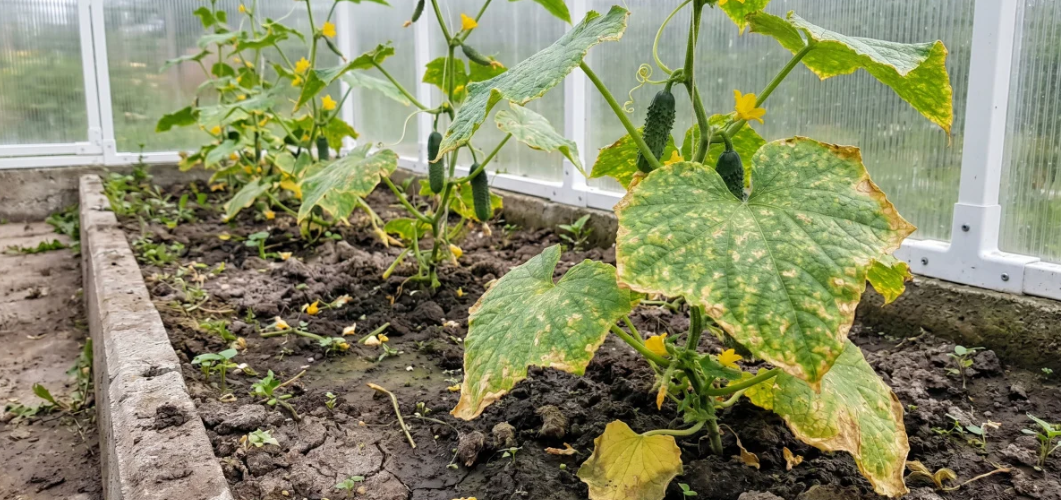
Hydrogen peroxide on cucumbers is often mentioned as quick first aid for yellowing leaves, but by itself it does not solve every cause of the problem. Yellow leaves can signal nutrient deficiency, faulty watering, waterlogged roots, pests, powdery mildew, and sudden weather changes.
First find out what is happening with the plant. Only then does it make sense to reach for a weak solution from the pharmacy, adjust watering, or supplement nutrition.
Why cucumber leaves yellow
The green color of leaves is created by chlorophyll. When the plant produces less of it or the leaf is damaged, yellowing appears.
Cucumbers react to stress very quickly. A few days of drought, overwatering, or cold night is enough and a color change appears on the leaves.
Therefore, do not consider yellowing immediately as one specific disease. It is a signal that the plant needs control of roots, soil, leaves, and the underside of shoots.
Most common causes of yellow leaves
- Nitrogen or potassium deficiency.
- Waterlogged soil and poor air access to roots.
- Uneven watering during heatwaves.
- Lack of light in a dense stand.
- Pests, especially aphids, whiteflies, and mites.
- Powdery mildew, cucumber downy mildew, or other diseases.
- Cold nights, heatwaves, or sudden weather change.
The correct solution depends on the cause. If you blindly add fertilizers and sprays, you can burden the weakened plant even more.
How to recognize nitrogen deficiency
With nitrogen deficiency, older lower leaves pale especially. The plant grows more slowly and new shoots are smaller.
The whole stand looks light green to yellowish, but leaves are not usually dotted with sharp spots. The problem often appears in poor soil or after a long period of rains.
A weak dose of suitable cucumber fertilizer or diluted compost infusion helps. However, a strong nitrogen dose can promote leaves at the expense of fruits.
When potassium is lacking
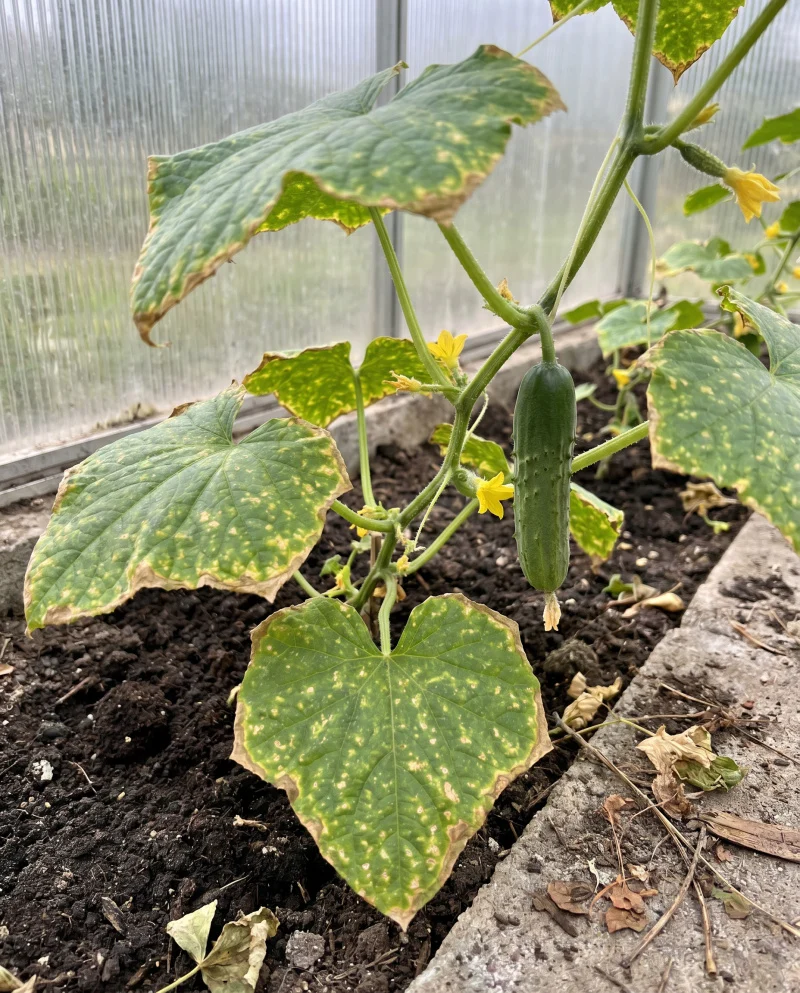
Potassium is important during flowering and fruit formation. With its deficiency, edges of older leaves can yellow and brown.
Fruits may develop worse and the plant handles drought more poorly. Similar symptoms are also caused by root damage or soil salinization.
Before fertilizing, check moisture and the last nutrition doses. If you have already fertilized often, further fertilizer may not be the solution.
Watering decides more than spray
Cucumbers need evenly moist soil. They do not tolerate long drying or constant waterlogging.
In drought, leaves wilt, edges can curl, and fruit growth slows. In overwatering, roots lack oxygen and leaves yellow despite moist soil.
Water in the morning at the roots and deeper. Short surface watering every day promotes shallow roots and the plant is more sensitive to heat.
Why not wet leaves during watering
Wet leaves during the night support the spread of fungal diseases. Water droplets can also carry soil particles with pathogens.
Root drip irrigation or slow watering directly at the roots works best. The soil should be moist in the root zone, not only on the surface.
If you have to water from above, do it early in the morning. Leaves will dry during the day.
Waterlogging is recognized by the soil
If the ground is constantly wet, heavy, and cold, roots may suffer from lack of air. Leaves then yellow even though the plant receives a lot of water.
In containers, check drainage holes. In the bed, find out if water after rain stays at the roots too long.
In waterlogging, do not add fertilizer or peroxide to leaves as the first solution. First reduce watering, improve water drainage, and let the soil aerate.
Pests often hide on the underside of leaves
Aphids, whiteflies, and mites suck juices from leaves. Damaged spots pale, yellow, or deform.
Therefore, do not look at leaves only from above. Turn them over and check the underside, young shoots, and places at veins.
For small occurrence, rinsing with water, removal of the most affected leaves, or gentle soap solution intended for plants helps. For heavy infestation, choose a suitable approved preparation.
What powdery mildew looks like on cucumbers
Powdery mildew creates a white to grayish-white powdery coating on the leaf surface. Small spots appear first, which later merge.
Affected leaves gradually yellow, dry out, and the plant weakens. Powdery mildew often appears in the second half of the season, especially in dense stands.
Remove individual heavily affected leaves. Improve air flow and water at the roots, not on leaves.
Cucumber downy mildew has a different appearance
Cucumber downy mildew often manifests as yellow angular spots bounded by veins. On the underside of the leaf, a grayish to purplish coating may appear.
For this disease, ordinary home spray is usually not enough. It spreads quickly during humid weather and can destroy the stand in a short time.
If you suspect cucumber downy mildew, remove affected leaves and use a preparation intended for the given disease. Observe the waiting period.
Hydrogen peroxide on cucumbers as first aid
Hydrogen peroxide is an oxidizing substance. In low concentration, it can help mechanically clean the leaf surface and temporarily reduce the amount of some microorganisms.
However, it does not penetrate the plant like a systemic remedy. If the leaf yellows due to nutrient deficiency, damaged roots, or advanced disease, peroxide alone will not solve the cause.
Use it only weak and carefully. A stronger solution can cause light spots, burning of leaf edges, and further stress.
Safer peroxide ratio
The recipe of 50 milliliters of 3% peroxide per 150 milliliters of water is too strong for ordinary leaf spraying of cucumbers. Such a solution can damage sensitive leaves.
A safer start is 1 teaspoon of 3% hydrogen peroxide per 1 liter of water. For older and firmer leaves, you can try at most 1 tablespoon per 1 liter of water.
- mild solution: 1 teaspoon of 3% peroxide per 1 liter of water
- stronger test solution: 1 tablespoon of 3% peroxide per 1 liter of water
- always first test on one leaf
- use in the morning or evening outside direct sun
First do a test on one leaf
Cucumbers have sensitive leaves and different varieties can react differently. Treat one lower but still living leaf and wait 24 hours.
If whitish spots, browning, or wilting appear, do not use the solution. Next time dilute it significantly or choose another method.
The test is important especially in hot weather, with young plants, and with plants that have already received another spray.
How to apply peroxide correctly
Spray only in the morning or evening when leaves are not overheated. The plant should not be wilted or freshly watered on leaves.
Gently moisten especially places where you see the problem. The solution should not run off leaves or accumulate in plant axils.
Do not spray during strong sun and heat. The oxidizing effect together with sun stress can damage leaves.
How often to repeat peroxide
For supportive use, one application and subsequent observation of the plant is enough. If the condition does not worsen, the next intervention may not be needed.
For first small spots, a mild solution can be repeated after 5 to 7 days. Do not use it every day.
If yellowing continues, look for another cause. Repeated peroxide spraying with water or nutrient deficiency will not bring benefit.
When not to use peroxide
- On wilted plants during heat.
- On young seedlings with fine leaves without testing.
- On leaves heavily damaged by mold or burned by sun.
- Shortly after another chemical or home spray.
- With yellowing caused by waterlogged roots.
- As a replacement for fertilizer with clear nutrient deficiency.
Use yeast fertilizer in moderation
Yeast can support the activity of soil microorganisms, but does not contain balanced nutrition for cucumbers. It cannot be taken as complete fertilizer.
If you want to prepare a mild solution, mix 20 to 40 grams of fresh yeast in 10 liters of lukewarm water. Use it after short standing at the roots.
One hundred grams of yeast per 10 liters of water is a stronger dose. Do not use it often, especially not in pots or in waterlogged soil.
Nutrition for green and fruiting cucumbers
After rooting, cucumbers need mild nitrogen for leaf growth. During flowering and fruiting, the importance of potassium increases.
Suitable is compost, fertilizer for fruit vegetables, or diluted comfrey infusion during fruit formation. Limit strong nitrogen fertilizers later.
If leaves are dark green and the plant has few flowers, there may be too much nutrition. Further fertilization would worsen the problem.
Simple procedure for yellowing leaves
- Check soil moisture with a finger at a depth of several centimeters.
- Look at the underside of leaves and look for pests.
- Distinguish powdery coating from angular spots of cucumber downy mildew.
- Remove heavily damaged or lying leaves.
- Adjust root watering and add mulch.
- Use peroxide only weak and after testing on one leaf.
Prevention is stronger than rescue spray
Plant cucumbers in a sunny and airy place. Too dense stand remains wet longer and diseases spread faster.
Water regularly at the roots and cover the soil with mulch. This reduces drought stress and soil splashing on leaves.
Check plants several times a week. First small changes are solved much more easily than a whole yellowing stand.
Yellow leaves are a signal, not a reason for panic
Hydrogen peroxide on cucumbers can be supportive first aid for a surface problem on leaves, but only in a weak solution and outside heat. The most important is first to recognize whether the plant lacks nutrition, water, air at the roots, or protection against disease.
When you adjust watering, check pests, and use appropriate nutrition, cucumbers have a much better chance to continue growing and fruiting. Take the pharmacy spray as a supplement, not as the only remedy for yellowing.