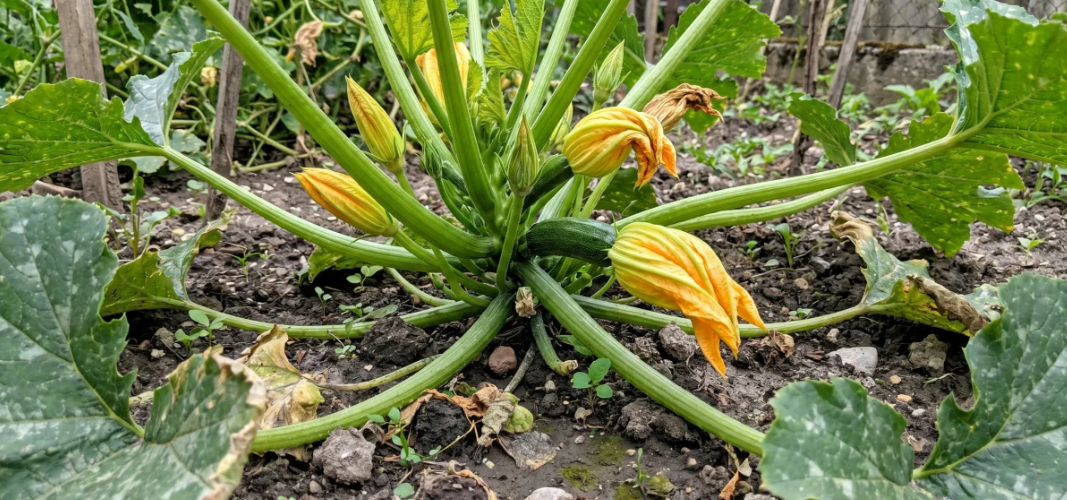
Caring for zucchini in July and August decides whether the bush will fruit the whole summer or suddenly stop after the first fruits. The most common mistake is aggressive removal of large healthy leaves that protect flower buds and produce energy for the growing harvest.
Zucchini can look overgrown and unclear, but lush foliage is natural for it. Instead of broad thinning, it needs regular harvest, stable moisture, enough pollinators, and only careful removal of damaged lower leaves.
Why zucchini suddenly stops fruiting in summer
Stopping fruiting usually does not have only one cause. The plant can be weakened by strong pruning, overgrown fruit, drought, nitrogen overfertilization, or weak pollination during heatwaves.
First check whether zucchini is forming flowers. Then notice whether male flowers predominate, small fruits yellow and drop, or new buds do not appear at all.
Leaves also tell a lot. Healthy green foliage with several flowers indicates a different problem than a wilting bush with powdery mildew or damaged roots.
Why zucchini needs its large leaves
Leaves capture sunlight and create sugars through photosynthesis. The plant uses these for root growth, flower formation, and nourishment of fruits.
The more healthy leaves you remove, the less energy zucchini has left. The plant may interrupt the formation of female flowers and focus on renewing foliage.
Large leaves also protect the soil from overheating. They partially shade the root zone and slow water evaporation.
Female flowers can hide at large leaves
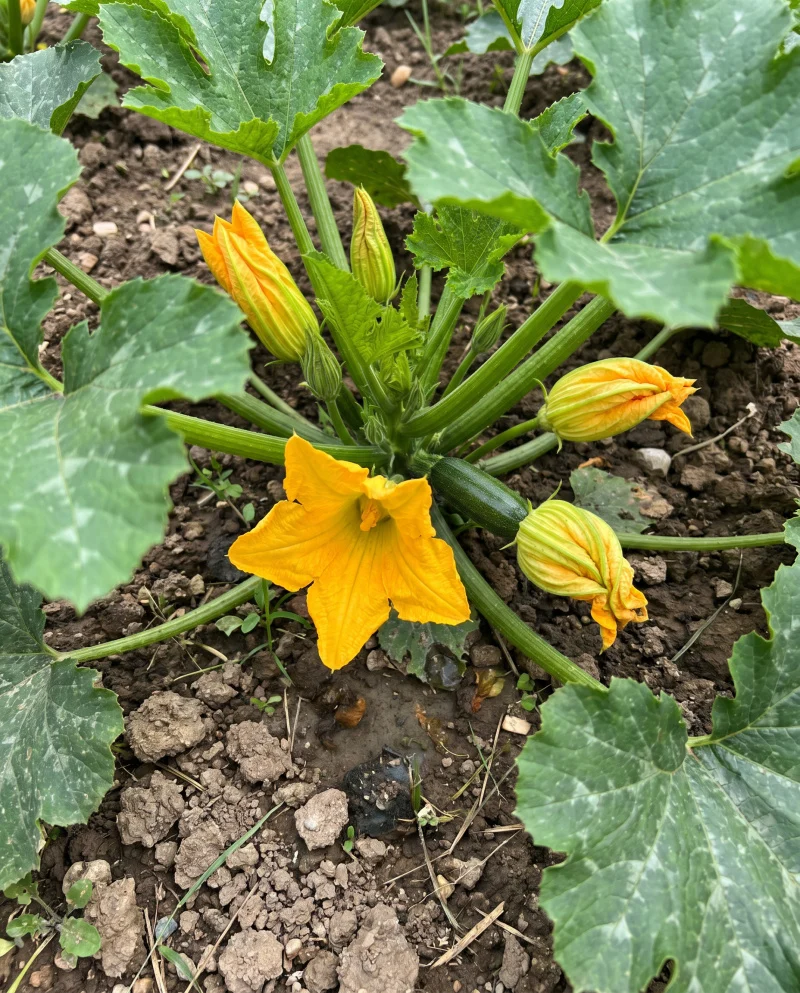
Zucchini forms male and female flowers on one bush. You recognize the female flower by the small zucchini that is located directly under the flower.
Flower buds often grow in leaf axils and at the main stem. With careless pruning, you can damage a young bud or fruit embryo together with the leaf stalk.
Therefore, do not remove healthy upper leaves just because the plant looks dense. First check what is at their base.
Aggressive pruning stresses the plant
Strong thinning represents a sudden loss of photosynthetic area for zucchini. The plant reacts by forming new leaves instead of further fruits.
Large wounds also increase the risk of infection. After rain or leaf watering, damaged places can start to rot.
Therefore, do not remove a large part of the foliage at once. It is safer to cut one to three damaged lower leaves and postpone the next intervention.
Which zucchini leaves can be safely removed
Cut leaves that are yellow, broken, dying, or lying directly on wet soil. They already bring little benefit to the plant and can retain moisture.
You can also remove leaves heavily attacked by powdery mildew if there are not too few left on the plant. Prune gradually, not at once.
Leave healthy upper leaves, leaves at female flowers, and young leaves in the center of the plant. It is these that ensure the continuation of growth and fruiting.
The correct rule: clean the bottom, protect the top
The lower part of the bush should remain airy and without decomposing leaves. The upper part, however, needs enough healthy foliage.
If a leaf interferes with harvest, try to gently move it or support it. Use pruning only when it is damaged or lying on the soil.
Such an approach improves air flow without zucchini losing too much energy.
When and how to prune leaves
Prune on a dry day, ideally later in the morning when dew has already dried. Avoid rain, midday heat, and evening before a humid night.
Use clean and sharp scissors. Cut the stalk close to the main stem, but do not damage its surface.
Do not tear leaves by hand. A frayed wound heals more slowly and is more easily attacked by microorganisms.
How often to do summer pruning
Check the plant approximately once a week. Prune only when a damaged or dying leaf appears.
There is no need to follow a fixed calendar and remove leaves every two weeks regardless of condition. A healthy zucchini may need only minimal intervention for the whole period.
After pruning, monitor new growth and flowers for a few days. If the plant stops forming buds, do not remove any more leaves.
Regular harvest is the best stimulus for further fruits
Harvest zucchini young when they are still tender and easy to process. For most varieties, a practical length is approximately 15 to 25 centimeters.
In the main season, check plants every day or every other day. Fruit can grow very quickly during warm weather.
Frequent harvest signals to the plant that it can continue forming new flowers. Leaving large fruits has the opposite effect.
Why overgrown zucchini stops further fruiting
A large fruit consumes a lot of water, sugars, and minerals. The plant simultaneously directs energy to seed ripening.
When you leave one or more overgrown zucchinis on the bush, new female flowers can decrease. The bush behaves as if it has already fulfilled the reproduction task.
Therefore, remove overgrown fruits as soon as possible. Even if you do not want to eat them, do not leave them on the plant until full maturity.
Weak pollination causes yellowing of small fruits
If a small zucchini behind the flower starts to yellow, soften, and drop, it was often not sufficiently pollinated. The problem is more pronounced with rain, heat, or low number of pollinators.
The female flower is open only for a short time. If the insect does not visit it during that time, the fruit does not develop further.
Hand pollination can help. Gently transfer pollen from a male flower to the stigma of an open female flower.
How to hand-pollinate zucchini
In the morning, pick a freshly opened male flower without a small zucchini under the flower. Remove petals so the anthers remain exposed.
Gently touch the center of the female flower with the anthers. One male flower can pollinate more female flowers.
Work only with dry flowers. After rain or heavy dew, pollen may be poorly transferable.
Heat changes the ratio of male and female flowers
During stress, zucchini can form more male flowers. This happens with high temperatures, drought, and shortly after transplanting.
Male flowers often appear before female ones. If the plant is healthy, the ratio usually adjusts after stabilizing conditions.
Do not prune the plant strongly or overfertilize it during this period. Provide it with water, mulch, and time.
Regular watering decides about harvest size
Zucchini has large leaves and fleshy fruits, so it consumes a lot of water. The soil should remain evenly moist, not alternately completely dry and waterlogged.
Water at the roots and deeper. Surface watering promotes shallow roots that will let the plant wilt quickly during heat.
Adjust frequency to soil and weather. Light sandy soil dries faster than loamy soil with compost.
Why not wet leaves
Wet leaves remain more susceptible to fungal diseases, especially if water remains on them overnight. Droplets can also carry soil and pathogens.
Pour water slowly to the root zone. For several plants, drip hose or irrigation pot sunk into the soil helps.
If you have to water from above, do it in the morning. Leaves will then dry during the day.
Mulching protects roots and lower leaves
Mulch slows evaporation and maintains more stable soil temperature. At the same time, it limits weeds that would take water and nutrients from zucchini.
You can use straw, dried cut grass, leaves, or compost. Place the material in an appropriate layer and do not apply it directly at the stem.
Mulch also reduces soil splashing on lower leaves. This helps limit the spread of some diseases.
What to fertilize zucchini with in July and August
During fruiting, zucchini needs balanced nutrition with enough potassium. It supports water management and fruit growth.
Mature compost or mild fertilizer intended for fruit vegetables is suitable. For home nutrition, you can use diluted comfrey infusion.
Limit strong nitrogen fertilizer in this phase. It would promote further leaves at the expense of flowers and fruits.
Simple comfrey fertilizer
For one kilogram of chopped comfrey leaves, use ten liters of water. Let the mixture ferment for approximately two to three weeks.
Strain the finished concentrate and dilute in a ratio of 1:10. Water zucchini once every 10 to 14 days on pre-moistened soil.
If you are already using other fertilizer for fruit vegetables, do not add comfrey at the same time. Excess nutrients can damage the plant.
Too much nitrogen creates leaves without fruits
Overfertilized zucchini has very dark green leaves, thick stalks, and rapid growth. However, there are few flowers or male ones predominate.
With such appearance, stop using nettle infusion, liquid manure, and other nitrogen preparations. Only water the plant regularly and harvest fruits.
Do not remove excess leaves at once. Growth should gradually balance, not receive additional stress.
Powdery mildew does not have to mean an immediate end
A white powdery coating often appears on older leaves in the second half of summer. You can remove individual affected leaves, but keep as much healthy foliage as possible.
Improve air flow, water at the roots, and do not leave diseased leaves lying at the plant. Clean scissors after pruning.
With rapid spread, use a preparation intended against powdery mildew on zucchini and observe the waiting period. Home sprays have rather supportive effect.
When zucchini can no longer be propagated again
A very weakened bush with extensive leaf damage, stem rot, or diseased roots may not renew the harvest. In that case, further fertilization will not help.
Remove damaged parts and monitor the center of the plant. If it does not form new healthy leaves or flowers, it is better to remove the plant from the stand.
Do not put diseased remains in ordinary home compost if you are not sure of the origin of the problem.
Model care for zucchini in July
- Check fruits every day or every other day.
- Harvest young zucchinis before they overgrow.
- Water deeply at the roots according to weather.
- Add mulch and remove only damaged lower leaves.
- With weak pollination, transfer pollen by hand.
- After setting fruits, use mild nutrition with potassium.
Model care for zucchini in August
- Continue with frequent harvest and do not let giant fruits ripen.
- Regularly check powdery mildew and remove heavily damaged leaves.
- During heatwaves, keep the soil evenly moist.
- Limit nitrogen and do not overfertilize weakened plants.
- Protect healthy upper leaves and young flower buds.
- With cooling, reduce watering according to real soil moisture.
What to do when zucchini stopped fruiting
First remove all overgrown fruits and interrupt strong pruning. Check soil moisture, leaf condition, and ratio of male and female flowers.
If there are flowers, help with hand pollination. If the plant forms only leaves, limit nitrogen and provide mild nutrition with potassium.
After correcting conditions, zucchini can start flowering again within several days to weeks. The condition of the plant and the remaining warm period decide.
Healthy leaves and frequent harvest keep zucchini in production
Caring for zucchini in July and August does not stand on strong pruning. The most important is to protect healthy upper leaves, harvest young fruits, and maintain even soil moisture.
Remove only damaged lower leaves, monitor pollination, and during fruiting limit nitrogen. This way, zucchini has the greatest chance to continue harvest until the end of summer.