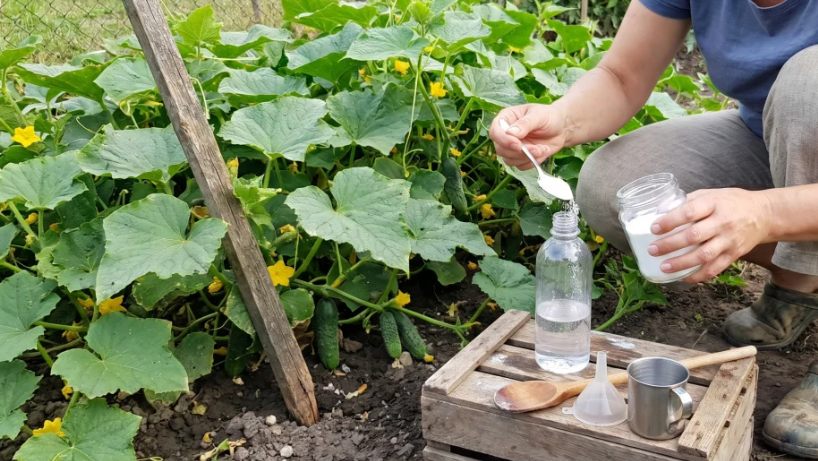
Baking soda spray on cucumbers can help limit the surface spread of powdery mildew, but only with the correct ratio and careful application. Too concentrated solution, hot sun, or treatment of wilted plants can damage leaves before any benefit appears.
Baking soda does not turn a diseased plant into a healthy one overnight. It works best at the first spots or as part of prevention when cucumbers grow in conditions favorable for powdery mildew.
What baking soda can help with on cucumbers
Baking soda changes the environment on the leaf surface. Powdery mildew spreads harder in such conditions, so the spray can slow the growth of the white coating.
However, it is not a universal cure for all cucumber diseases. Baking soda will not help with most bacterial problems, viruses, or strongly developed infections inside the tissues.
Homemade solution has the greatest importance when the first small spots appear. With heavily affected leaves, it can only temporarily slow further spread.
How to recognize powdery mildew on cucumbers
Powdery mildew manifests as white to grayish-white spots that look like flour sprinkled on the leaf. The coating can be partially wiped off with a finger at the initial infestation.
Individual round spots appear first on the upper side of leaves. Later they merge, cover a larger area, and the leaf starts to yellow or dry out.
A heavily affected plant has a smaller area of healthy leaves. It nourishes fruits worse, weakens, and can stop fruiting sooner.
Powdery mildew and cucumber downy mildew are not the same
Cucumber downy mildew usually creates yellow angular spots bounded by veins. On the underside of the leaf, a gray to purplish coating may appear.
With powdery mildew, a white powdery coating on the leaf surface dominates. With downy mildew, leaf tissue yellows, browns, and dies faster.
Baking soda is not a reliable solution against cucumber downy mildew. If you suspect this disease, remove heavily damaged leaves and use a preparation intended for the given problem.
Recipe for mild preventive spray
For preventive or very mild spray, dissolve 1 level teaspoon of baking soda in 2 liters of water. Add approximately 2 to 3 drops of gentle liquid soap or wetting agent.
Soap does not serve as the main active substance. It helps the solution cover the leaf evenly and not run off immediately to the ground.
Use unscented soap without disinfectant additives, bleaches, and strong degreasers. Too much soap can damage the protective layer of the leaf.
- 2 liters of clean water
- 1 level teaspoon of baking soda
- 2 to 3 drops of gentle liquid soap or suitable wetting agent
Stronger intervention solution at first spots
With the first visible manifestations, you can use 1 level teaspoon of soda per 1 liter of water. Add only 1 to 2 drops of gentle soap.
This solution is more concentrated and the risk of leaf damage increases. Before treating the whole plant, always test it on one healthy and one mildly affected leaf.
If light, brown, or dry spots appear by the next day, do not use the solution further. Dilute it with water or switch to a milder version.
Why more soda does not mean better effect
Concentrated solution increases the amount of salts on the leaf surface. They can draw water from cells and cause edge browning, spots, or drying.
Younger leaves, plants in containers, and cucumbers weakened by drought are more sensitive. Damage can be emphasized during heat or with repeated applications.
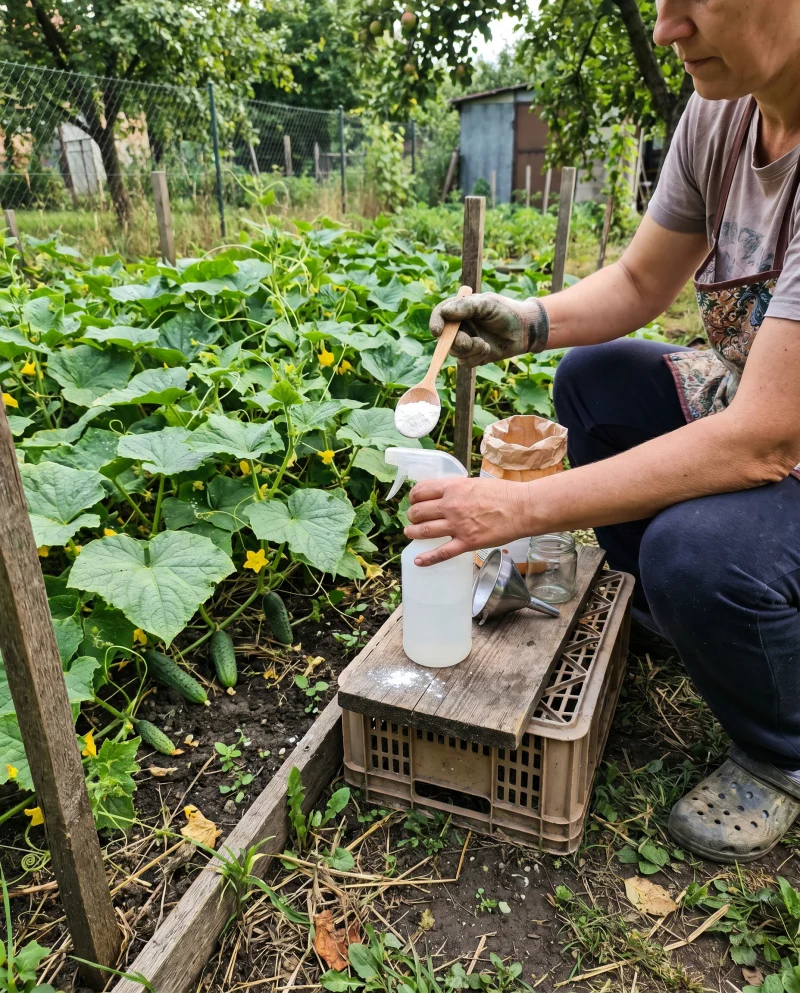
Do not add soda by eye. Always use a level teaspoon and maintain the water volume.
How to prepare baking soda spray on cucumbers
Pour part of lukewarm water into a smaller container and thoroughly dissolve soda in it. Then supplement the solution with the rest of the water.
Add wetting agent or soap at the end and gently mix. Vigorous shaking creates a lot of foam, which makes even spraying difficult.
Use the finished solution as soon as possible. Do not store it for long days in a sprayer and slightly mix the container before each use.
First do a test on one leaf
Each variety and each plant can react a little differently. Treat a small part of the plant and wait approximately 24 hours.
Monitor paling, brown dots, dried edges, and change in leaf resilience. If none of this appears, you can continue on the whole plant.
The test is important especially when you add soap, use hard water, or have recently fertilized or treated cucumbers with another preparation.
When to apply the spray correctly
The best time is early morning after dew dries or evening when leaves are not overheated. After treatment, there should be several hours without rain.
Do not spray during midday sun. Solution droplets evaporate quickly and a higher concentration of salts remains on leaves.
Avoid application also just before a cold night with long humidity. Leaves should dry adequately before night.
Treat both sides of leaves
Apply the spray in a fine layer on the upper and lower side of leaves. The surface should be evenly moistened, but liquid should not run off it significantly.
Focus also on the vicinity of the first spots. Do not forget younger healthy leaves that you want to protect from spread.
Wash fruits thoroughly with clean water before consumption. Do not pour spray unnecessarily on flowers or on soil at the roots.
Do not use spray on wilted plants
Cucumbers suffering from drought have weaker ability to cope with salts on the leaf surface. First renew even soil moisture and let the plant recover.
Do not treat freshly transplanted, damaged, or heavily overfertilized plants either. Stresses can add up and cause rapid leaf yellowing.
If the plant wilts in wet soil, check roots and water drainage. Further spray will not solve such a problem.
How often to repeat the spray
For preventive use, treatment approximately once every 7 to 10 days is sufficient. After heavy rain, it may be necessary to renew the spray.
With first spots, you can repeat the application after 5 to 7 days. Between treatments, monitor whether the coating has stopped spreading and whether leaves do not react with damage.
If the condition does not improve after two to three applications, do not continue endlessly. Verify the diagnosis and choose another method.
During what weather to skip the spray
Do not apply it during heatwaves when temperature rises significantly and cucumbers wilt. Strong wind is also unsuitable, as it carries the solution to surrounding plants.
The spray has no meaning just before rain. Water will wash it off before it dries evenly on the leaf surface.
During a long humid period, ensure especially air flow and remove damaged leaves. Repeated spraying alone can keep the stand too wet.
Most common mistakes when using soda
- More soda is added to the solution in the belief that it will be more effective.
- Spray is applied to overheated leaves during noon.
- Plants are wilted or dry before treatment.
- Too much soap or aggressive cleaning agent is used.
- Solution is applied every day without monitoring leaf reaction.
- Spray is used to solve cucumber downy mildew or viral damage.
A mistake is also mixing soda with other homemade preparations without testing. A combination of vinegar, peroxide, strong soap, or other substances can change the effect and damage tissues.
When baking soda will no longer help
With advanced powdery mildew that covers most of the leaf area, damaged tissue will not recover. Remove heavily affected leaves if there are not too many on the plant.
Soda will not help even when leaves brown from cucumber downy mildew or die from root damage. First you must correctly determine the cause.
A plant with pronounced viral dwarfing, mosaic, or deformations cannot be cured with homemade spray. Separate such a plant from healthy stand.
What to alternate with soda
One option is milk spray prepared from one part milk and nine parts water. Test that too on a small part of the plant first.
You can use biological preparations intended against powdery mildew that contain beneficial microorganisms or their products. Always follow the label and do not mix them with soda without manufacturer’s recommendation.
With stronger or repeated infestation, reach for a permitted plant protection preparation intended for cucumbers. Observe the dose, number of applications, and waiting period.
Prevention works better than frequent spraying
Plant cucumbers with sufficient spacing and train them so air flows between leaves. Dense stand remains wet longer and diseases spread faster in it.
Water at the roots and, if possible, in the morning. Do not wet leaves unnecessarily, especially when they do not have time to dry before night.
Remove old, yellow, and heavily affected leaves. Clean scissors after work and do not leave diseased remains lying at the plants.
Check cucumbers regularly. One small spot is solved more easily than a coating spread over the entire structure.
Safe procedure in five steps
- Verify that it is a white coating typical for powdery mildew.
- Prepare a mild solution and measure soda and water precisely.
- Test the spray on one leaf and wait 24 hours.
- Apply in the morning or evening on both sides of dry leaves.
- After 5 to 10 days, evaluate the effect and possibly choose another method.
Correct ratio protects more than strong solution
Baking soda spray on cucumbers can, at the first manifestations of powdery mildew, slow the formation of white coating. For prevention, use one teaspoon per two liters of water, with careful intervention at most one teaspoon per liter.
More important than high concentration is the correct time, tolerance test, and even application. If infection continues to spread or leaves yellow in another way, replace soda with a more suitable solution.