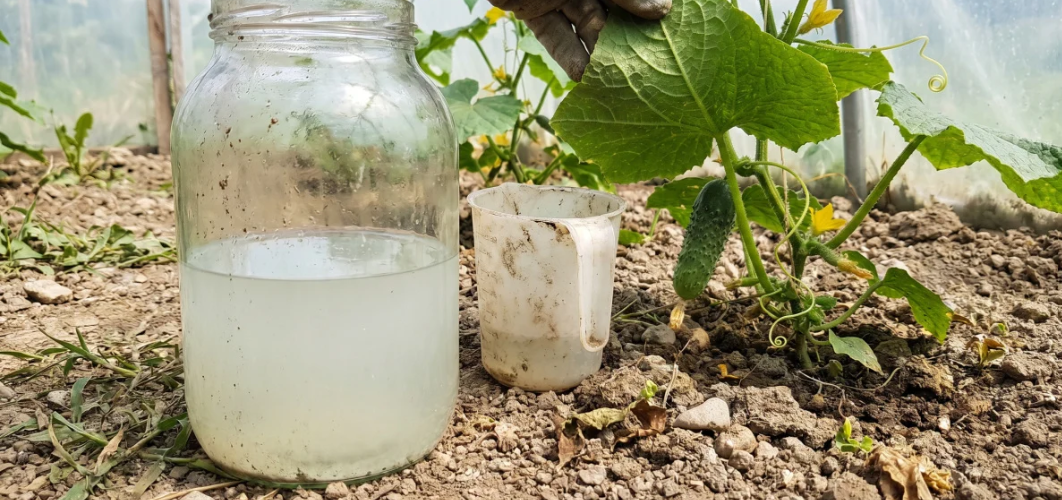
Homemade fertilizer for cucumbers in June can decide whether the plants will continue to produce firm, juicy, and straight fruits, or start to yellow, weaken, and form stunted cucumbers. At the end of June, cucumbers no longer need mainly leaf growth, but nutrition focused on fruiting, water, and resistance to heatwaves.
The end of June is a turning point for cucumbers. The plants already have the rapid growth phase behind them and a large part of the energy is directed to flowers and fruits.
If nutrition or water fluctuates in this period, you will see it very quickly. Fruits can become crooked, bitter, remain small, or the plant starts to drop part of the set.
Why homemade fertilizer for cucumbers in June helps
Homemade fertilizer for cucumbers in June has the greatest importance when the plant is actively fruiting. In this period, it consumes a lot of potassium and water, because every fruit is essentially a reservoir of juice and nutrients.
Nitrogen was important after planting, when the cucumber built leaves and shoots. During fruiting, however, there should not be too much of it, otherwise the plant forms a lot of greenery and fewer quality fruits.
Correct nutrition should support fruits, healthy leaves, firm tissues, and resistance to stress. That is why it pays in June to reach for potassium, magnesium, calcium, and gentle homemade supplements.
What cucumbers need most at the end of June
Potassium is the most important. It helps the plant manage water, supports fruit formation, and affects their firmness, taste, and even growth.
Magnesium is important for green leaves and photosynthesis. If older leaves yellow between veins, the plant may have a problem with its uptake.
Calcium strengthens cell walls and helps the plant better tolerate stress. With cucumbers, however, it still holds that nutrients work only when the soil has stable moisture.
Ash watering for fruiting cucumbers
Wood ash is a known natural source of potassium, calcium, and phosphorus. With cucumbers, it is suitable especially during the fruiting period, when we no longer want to support only leaves.
Pour one glass of sifted ash from clean untreated wood into ten liters of water. Mix the solution and let it stand for at least a while.
Water at the roots, not on leaves. The soil should be mildly moist before application so the roots do not get a sudden hit with a more concentrated solution.
Be careful with ash
Do not use ash from coal, briquettes, painted wood, chipboard, or waste. Such material can contain substances that do not belong in a vegetable bed.
Ash increases soil pH, so do not apply it too often. If you have rather alkaline soil, reduce the dose or replace it with another potassium nutrition.
Once every seven to ten days is the upper limit for plants that are really intensively fruiting. If the cucumbers are healthy and the soil is nutritious, a longer interval is enough.
Yeast fertilizer as a gentle boost
Yeast fertilizer can support soil life and gently stimulate the root system. It is not a complete fertilizer, but it can be a useful supplement.
Dissolve one hundred grams of fresh yeast and fifty grams of sugar in five liters of lukewarm water. Let it work for several hours, then dilute with the same amount of water.
Use this prepared watering at the roots a maximum of once every two to three weeks. Do not use it on a dry bed or on plants that are already overfertilized with nitrogen.
Iodine only as careful prevention
Iodine is used among gardeners as a very careful preventive supplement. With cucumbers, it is mentioned especially in connection with resistance to some diseases.
With homemade recipes, however, great caution is needed. A strong solution can damage leaves, disrupt soil life, or unnecessarily stress the plant.
If you use iodine, stick to a very weak dilution, apply it away from the sun, and first test a small part of the stand. Do not use it as a replacement for ventilation, bed hygiene, and correct watering.
Do not mix individual fertilizers at once
The biggest mistake is giving cucumbers ash, yeast, iodine, and another fertilizer at once. The plant does not need shock, but regular and balanced support.
Choose one nutrition according to the state of the stand. If fruits weaken and leaves are healthy, potassium from ash or other potassium fertilizer is more suitable.
If the plant looks tired after heatwaves, water, mulch, and shading first help. Only then solve the next watering with nutrition.
Watering decides about fruit bitterness
Cucumbers have high water content, so they react very sensitively to drought. When the plant once dries and then gets a lot of water at once, fruits can be bitter or deformed.
Water regularly at the roots, ideally in the morning or evening. Do not unnecessarily wet the leaves, especially if the stand is dense and the weather is humid.
Mulch from straw or dried grass helps maintain soil evenly moist. Roots do not overheat and the plant better handles weather fluctuations.
Yellow leaves do not always mean hunger
When cucumbers have yellow leaves, many growers immediately add fertilizer. The cause, however, can also be waterlogging, cold water, disease, pests, or damaged roots.
First look at which leaves are yellowing. Older lower leaves naturally weaken, but young yellow leaves may already signal a problem with nutrition or roots.
If leaves yellow between veins, magnesium may be missing. If they yellow and also wilt, check especially the soil and root zone.
Fruits reveal potassium deficiency
With potassium deficiency, cucumbers can be smaller, grow worse, and the plant tolerates drought more poorly. Fruits may be less firm and taste worse.
Deformations, however, do not always mean only missing nutrients. Crooked cucumbers arise also with insufficient pollination, irregular water, or sudden cooling.
Therefore, monitor the whole stand. Nutrition makes sense when you also adjust water, harvest, and airiness of the plant.
Harvest supports further fruiting
Harvest cucumbers regularly, ideally every day or every other day. Overgrown fruits take energy from the plant and slow the formation of new ones.
Smaller and younger cucumbers are tastier, more tender, and less bitter. After their removal, the plant quickly goes to further fruiting.
When harvesting, do not pull sharply at the shoots. Use scissors or gently break off the fruit so you do not damage the plant.
Most common mistakes when fertilizing cucumbers
- Continuing strong nitrogen fertilization even though the plant is already fruiting.
- Using too much ash and unnecessarily changing soil pH.
- Applying fertilizer to dry soil without previous watering.
- Mixing several homemade recipes at once and overloading the plant.
- Watering leaves in dense planting and promoting diseases.
- Not harvesting fruits regularly, so the plant stops setting new ones.
Simple plan for the end of June
First check soil moisture and leaf condition. If the soil is dry, water the cucumbers thoroughly with clean water and only then consider nutrition.
With active fruiting, use a mild ash watering or other potassium fertilizer. Leave yeast fertilizer as an occasional supplement and iodine only as careful prevention.
Mulch, ventilate the stand, remove diseased leaves, and harvest cucumbers continuously. These steps together will do more than one strong homemade solution.
Beautiful harvest arises from balance
Homemade fertilizer for cucumbers in June can help significantly if the plants get mainly potassium, stable water, and gentle care without exaggeration. Ash, yeast, and careful preventive supplements have their place, but not all at once.
If at the end of June you stop supporting only leaves and focus on fruits, roots, and regular harvest, cucumbers will fruit longer and with higher quality. The most beautiful harvest in the neighborhood does not arise by chance, but from precise timing and reasonable nutrition.