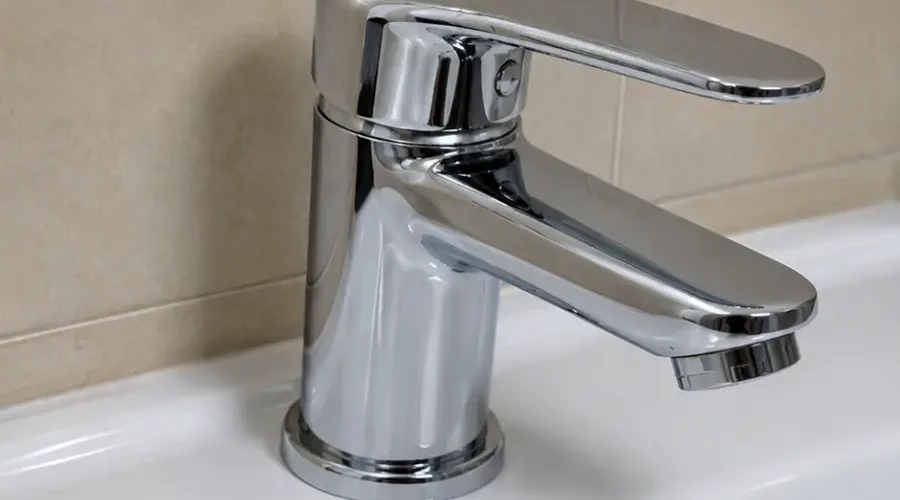
Limescale forms when water drops dry and leave mineral deposits stuck to the metal.
At first it appears as a whitish film, but over time it can become a rough layer that dulls the faucet and accumulates at the base, joints, and water outlet. To remove it without scratching the surface, you first need to soften it and then remove it with gentle tools.
Materials
- 2 tablespoons of citric acid
- 250 ml of warm water
- Dish detergent
- Paper towels or cotton cloth
- A small bag
- An elastic band
- A soft-bristled toothbrush
- A wooden toothpick
- A microfiber cloth
- Gloves
Procedure
- Put on gloves and clean the faucet with warm water and a few drops of detergent. This removes soap residues, grease, and surface dirt, allowing the treatment to act directly on the mineral deposits.
- Rinse with a damp cloth and dry slightly. Pay special attention to the base, the area around the handle, joints, and the aerator at the water outlet.
- Dissolve the citric acid in warm water. Stir until there are no crystals left at the bottom of the container.
- Soak paper towels or a cotton cloth with the solution. It should be well moistened, but not dripping excessively.
- Wrap the limescale-covered parts with the paper. Press it against the surface so it maintains even contact with the stains.
- Let it act for 15 minutes. For significant accumulations, it can extend up to 25 minutes, always monitoring the surface.
- Remove the paper and gently rub with the toothbrush. Make short movements, without pressing too hard, mainly around the joints and in hard-to-reach areas.
- If hard deposits still remain, re-moisten the area and let it act for another 10 minutes. It is better not to try to remove everything at once with strong scraping.
- To clean the water outlet, place part of the solution inside a small bag. Insert the end of the faucet and secure the bag with an elastic band.
- Leave the aerator submerged for about 20 minutes. Then remove the bag and brush the edge of the outlet.
- When the aerator can be unscrewed, carefully remove it. Leave it to soak for 20 minutes and brush the grille to remove accumulated remains.
- Use a wooden toothpick to remove small particles lodged in the holes. Do not use needles, knives, or metal tools because they could damage the piece.
- Rinse the entire faucet thoroughly with a clean cloth and plenty of water. It is important to remove any remains of the solution.
- Open the faucet for a few seconds to expel loose residues that may have remained inside the aerator.
- Dry the entire surface with a microfiber cloth until the shine is restored. Drying also prevents new drops from forming stains again.
Tips and advice
- Test the solution first on a little visible area, especially if the faucet is black, gold, copper, matte, or painted.
- Do not apply citric acid on marble, travertine, sensitive granite, or other natural stones. Protect the countertop before starting.
- Avoid metal sponges, steel wool, knives, and abrasive cleaners. Although they remove limescale, they can leave permanent scratches.
- Do not leave the solution acting for hours. It is preferable to repeat a short application rather than expose the finish for too long.
- If the limescale is concentrated around the base, use narrow strips of moistened paper to cover that area well.
- Once clean, drying the faucet after use significantly reduces the reappearance of stains.
- Performing gentle cleaning once a week prevents minerals from turning into a thick layer again.
With this procedure, mineral deposits soften gradually and can be removed without mistreating the metal.
The result will be a cleaner, shinier faucet with a free water outlet from obstructions.