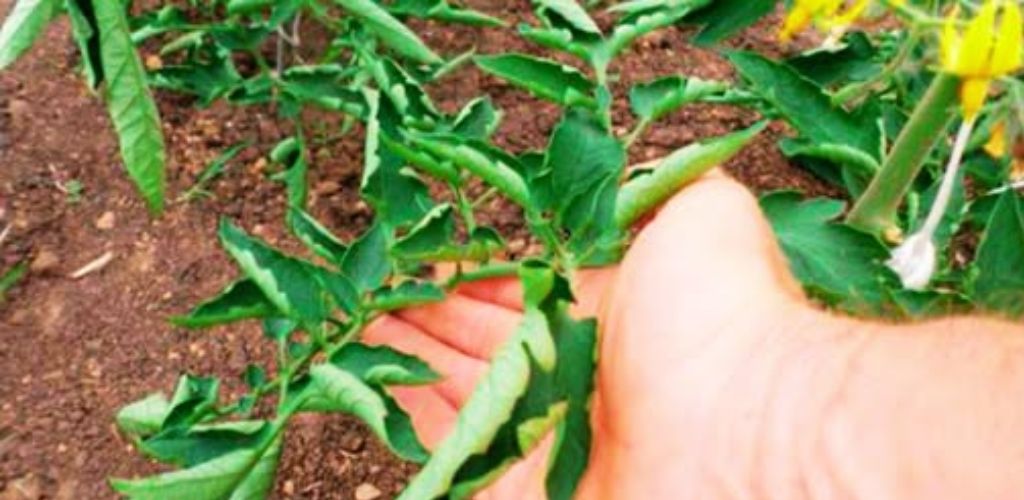
Tomatoes can be finicky plants, with problems often resulting in leaf curl.

But you don’t always need to resort to chemicals right away! By the nature of the leaf curling, you can determine the cause of the problem and take the right measures.
Curling the leaves upwards into a “boat” shape :

Pest: Potato aphid, which feeds on plant sap, causing leaves to curl.
Solution: treating tomatoes with insecticides (for example, “Tanreg”, “Confidor”, “Iskra”).
However, you should be careful when using chemicals. Also, hot weather and lack of moisture can provoke this phenomenon.
In this case, it is recommended to mulch the soil and spray the plants with microelements.
Curling leaves down :

Disease: bacterial cancer, manifested by curling, curling and drying of the lower leaves.
Solution: Immediate removal of infected plants to prevent the spread of the disease.
Also, curling of leaves downwards can be caused by a deficiency of phosphorus, boron or other microelements. In this case, it is recommended to feed tomatoes with complex fertilizers with microelements.
Other reasons :

- Calcium deficiency: manifested by upward curling of leaves and apical rot of fruits. Solution: fertilize with calcium nitrate.
- Too much manganese: Young tomato foliage wrinkles and becomes “chewed.” Solution: Use manganese in moderation.
- Potassium deficiency: leaf edges curl and turn brown. Solution: fertilize with potassium fertilizer.
Remember that leaf curling in some tomato varieties may be a varietal feature and does not require treatment.
Observe your tomatoes, analyze the symptoms and take timely measures!