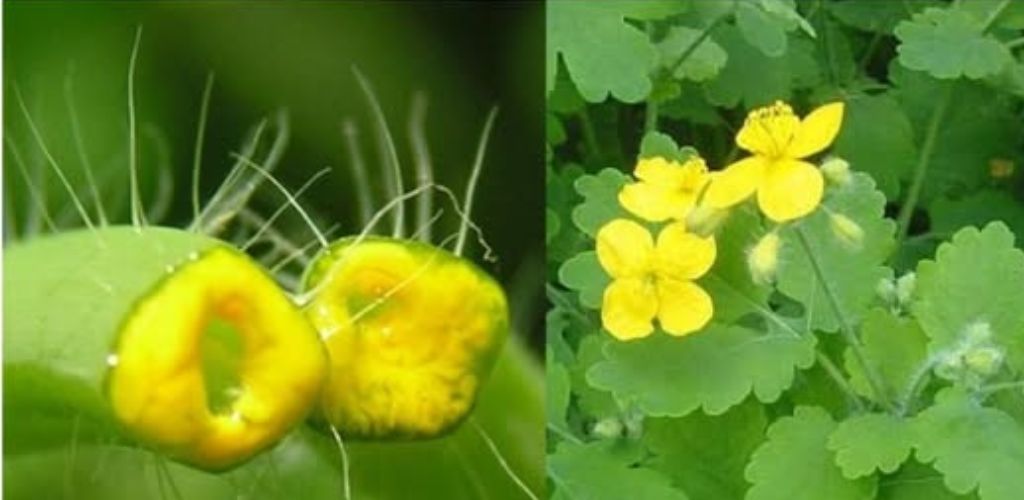
If you are tired of fighting celandine on your plot, then this article will be useful to you! After all, this plant may be able to solve other problems in your garden or vegetable garden. Let’s look at the beneficial properties of this sunny plant.

Celandine and its properties
Celandine, known in the scientific world as yellow milkweed, secretes an orange milky substance when the stem is damaged.
This milky substance has unique properties that can be useful in gardening.
Pest control
Celandine milk is a natural contact poison that is safe for plants.
This property can be used to combat various pests such as aphids, crucifer flea beetles, cutworms, thrips, leaf rollers, leafhoppers, flea beetles, spider mites, sawflies and whiteflies.

One treatment is enough to get rid of entire colonies of pests, without causing harm to plants.
To prepare the solution, finely chop the above-ground part of two large celandine bushes, pour 10 liters of water and leave for 3 hours.
Then spray the plantings with this solution. Don’t forget to use gloves!
Celandine mulch
The mass remaining after preparing the solution can be used as mulch. Plants under such protection do not suffer from soil drying out and attacks by mole crickets and other pests.
Moreover, decomposing, celandine serves as an organic fertilizer.
Fertilizer from celandine
You can make quality fertilizers from celandine. To do this, place 2-4 buckets of celandine without roots in a 200-liter barrel, add a ladle of cow manure and a bag of dry yeast.
Fill the remaining volume with water. After 3 days, drain the liquid and water the plants with it, using 0.5 liters per root.

Ash from celandine
After burning celandine, its beneficial substances do not disappear. If you have a lot of this plant, try burning it and use the resulting ash to sprinkle pest accumulation areas.
Cabbage care
To protect cabbage from caterpillars and butterflies, it is enough to spray the plants with a celandine solution prepared according to the recipe for pest control.

Important Notes
All recipes recommend removing the roots of celandine.
This is because the roots contain a high concentration of poisons, which makes working with them dangerous.
Now you know how to use celandine for the benefit of your garden and vegetable garden. Don’t throw it away, but use it wisely and usefully!