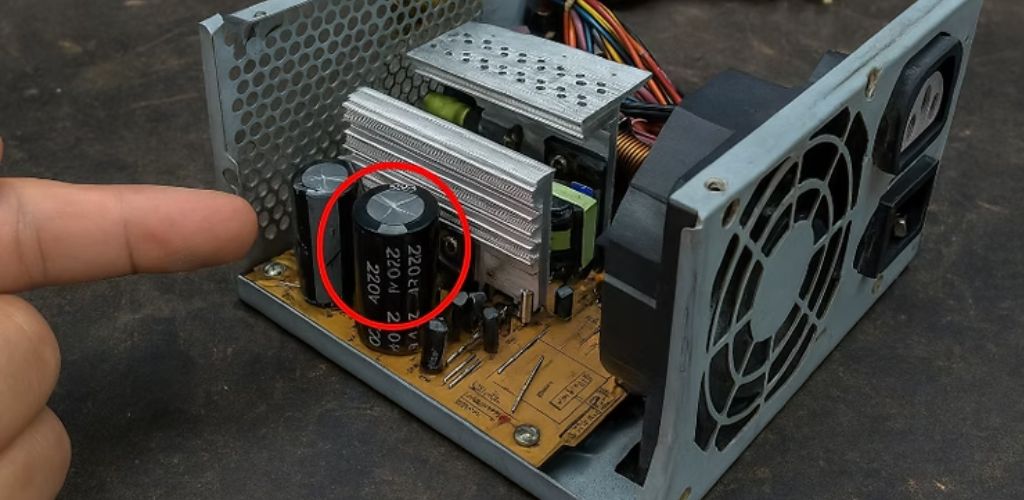
Most people see a broken PC power supply as electronic waste, but in reality, its case and some of its internal components can serve as a platform for creating a small audio amplification system .
1. Operating principle
In this project, the original power supply no longer fulfills its function of converting AC 220/110 V to DC 3.3 V, 5 V and 12 V, but its metal housing and connections serve to mount an audio amplifier module (usually based on integrated circuits such as the TDA2030, TDA7297 or LM386).
- Audio input: Comes from the phone’s headphone output.
- Amplification: The amplifier module increases the low voltage signal (from the cell phone) to a level sufficient to move the speaker coil.
- Output: Connects directly to a 4 Ω or 8 Ω speaker.
2. Energy source
Instead of mains power, a 12V battery (as shown in the picture) is used to power the amplifier module.
- A 7 Ah sealed lead-acid battery can operate the system for several hours.
- Power consumption depends on the type of amplifier and the output volume.
3. Technical advantages
- Electrical noise isolation: By using a battery, the “hum” that normally occurs when powered by alternating current is avoided.
- Portability: Does not depend on plugs, ideal for outdoor use.
- Recycling electronic scrap: The power supply housing not only provides protection, but also dissipates heat thanks to its metal structure and ventilation slots.
4. Typical reused components
Even if the power supply is no longer suitable for powering a PC, you can still use it:
- Internal fan: for additional cooling if the amplifier gets hot.
- Molex/SATA cables and connectors: for quick connections.
- Switch: the power supply’s own switch to turn the system on/off.
5. Precautions
- If the power supply still contains charged capacitors, discharge them before handling (they may store dangerous energy).
- Respect the battery polarity when connecting the amplifier.
- Use a fuse on the positive line to avoid short circuits.
This type of repurposing is not only a DIY exercise, but also a practical way to understand audio circuits, portable power, and electronic recycling. A project like this transforms waste into a useful device, demonstrating that electronics don’t always die when a device stops working.