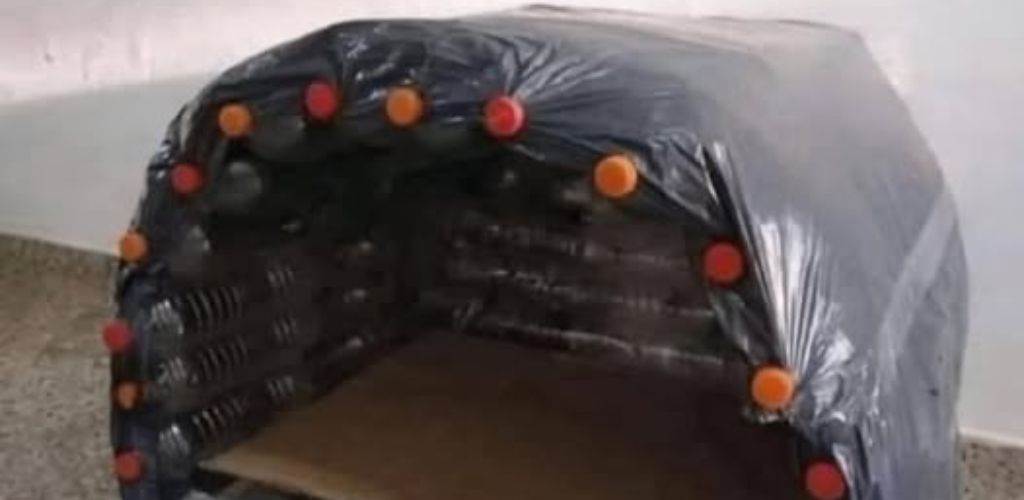
When it gets cold outside, I often think not only about people, but also about those who face the cold outdoors – about stray cats and dogs.

They can’t tell us they’re cold, they can’t ask for help. And every time I see animals huddled against warm pipes or trying to hide under cars, I realize: if you can help, you should .
So I started making simple shelters with my own hands to give them a little warmth and a chance to survive the winter.
Where did the idea come from?
I came across the idea by chance—someone shared a photo of a homemade house made from plastic bottles.
I was inspired by the fact that this doesn’t require money or complex tools – just the desire to help.
Since then, every autumn I make several of these shelters in the yard, near the entrance or garages.
They can be built in just an hour, and the benefits are enormous – for an animal, they can mean the difference between survival and death in the cold .
How to Make a Warm Pet House: Step-by-Step Instructions
1. Preparation of materials
You will need:
- 20–30 plastic bottles (one-liter or one-and-a-half-liter);
- thick cardboard or a piece of plywood for the base;
- a large garbage bag (120–150 l) or plastic film;
- wide tape or electrical tape;
- old things (jacket, blanket, scarf).
Tip: Don’t use paper or cotton wool—they absorb moisture and become cold. Synthetic fabrics, fleece, or wool are better.
Plastic bottles retain heat very well, trapping air between them, creating a natural layer of insulation.

2. Assembling the frame
Place the bottles in two rows to create a sturdy base and secure them with tape.
Next, gradually build up the walls, connecting the bottles in rows, and complete the “roof” so that there is some space left inside.
The result is a light but strong structure, similar to a mini-tunnel. Tip: If you live in a region with severe frosts, make the house in two layers – you can leave some air between the layers or add insulation (old newspaper, pieces of fabric).
3. Insulation of the bottom
Place thick cardboard, a piece of foam, or an old board on the bottom to insulate the cold from the ground.
Place a warm cloth or rug on top.
Animals often catch cold from the cold coming from below, so insulating the floor is crucial.
Tip: You can raise the house slightly off the ground—for example, by placing it on bricks or wooden blocks. This will prevent dampness inside.
4. Moisture protection
Once the frame is ready, wrap it in a garbage bag or plastic.
This not only provides protection from rain and snow, but also additional insulation.
It is especially good to use black material – it heats up in the sun and retains heat longer.
Tip: Make a small hole (1–2 cm) at the bottom for ventilation and condensation to escape—otherwise, moisture may form inside.
5. Comfort inside
Line the inside with old sweaters, pieces of fleece, or wool scarves.
Do not use down, synthetic padding or feathers – they absorb moisture.
It’s better to lay down several thin layers of fabric rather than one thick one. This will retain heat and allow you to change the bedding as needed.
Tip: If you have an old synthetic fiber pillow, you can cut it up and use the filling as insulation.
6. Shelter placement
Place the house in a quiet, safe place—under a staircase, near a wall, under a balcony, or near trash cans where you often see animals.
It’s important that the shelter isn’t in a draft or exposed to rainwater. Tip: Point the entrance not to the north, but to the south or east, so that the wind does not blow in.
If possible, place a bowl of water and some dry food nearby .
In winter, animals often lack not only food, but also water—snow doesn’t quench their thirst, and meltwater is difficult to find.
A little care goes a long way
Every time I pass by and see a cat curled up in my house, I realize that my time was not wasted.
For an animal, this is not just a shelter – it is a home, warmth and a chance to survive .
Sometimes it seems like one person can’t make a difference, but if everyone does at least one good deed, the world will become a warmer place.
Even a simple shelter made from bottles can be a real lifesaver. And you don’t have to be a volunteer to help—all you need to do is be kind.
Helpful tips from volunteers
- Check the houses once a week: if the bedding is wet, replace it.
- Do not place shelters too close to roads.
- You can stick a sign that says, “Do not break! House for homeless animals.” People are usually more understanding.
- If you have any food left, give it to homeless cats – even a little porridge or food can save their lives.
Do good not for gratitude, but because you can.
Even a small, homemade shelter is an expression of love that truly warms you during the cold winter.