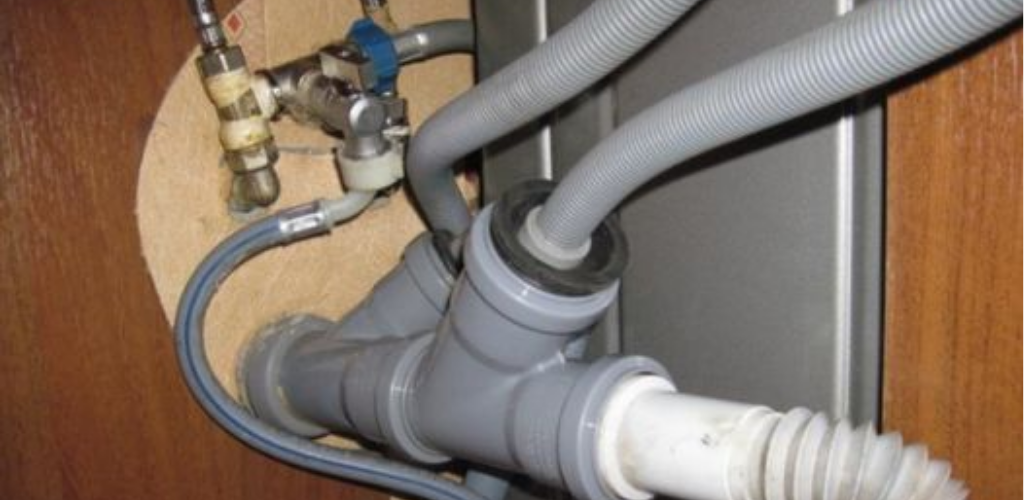
Nowadays, everyone has a helper – a washing machine. Mine is in the bathroom.

There have often been cases where a drain hose breaks, sending water flowing straight to your neighbors. It’s a good thing if you live in a private home (you won’t flood anyone), but it’s bad when this happens in an apartment building.

How to properly connect the drain to avoid problems?
There are three connection methods: through a siphon, through a sanitary drain, and through a sewer. The first method is the best. A special siphon for connecting a drain hose is available. It has a check valve.

If it is not possible to connect to a siphon (the machine is located more than 1.5 m from the sink), the connection goes directly to the sewer.
The end of the hose can be secured to a semicircular plastic holder and placed over the edge of the bathtub or sink (the drain into the bathtub or sink). This is more suitable for a temporary solution.
It’s better to connect the hose directly to the trap or sewer line. This is where inexperienced plumbers often make mistakes.
The connection is made through a special rubber seal (a reduction or drain cuff). It is used to connect the washing machine and dishwasher.
The cuff’s diameter should be equal to the pipe’s diameter. If it doesn’t fit tightly, heat the cuff in hot water and leave it for 20 minutes.
It happens that such drainage organization becomes a problem.

The plumber arrives, removes the plug from the pipe, inserts a collar, and plugs the washing machine hose into it. At a certain point, the drain hose pops out of the collar.

The problem is that the rubber seal dries out over time, causing unpleasant odors. Furthermore, the water pressure during flushing can cause flooding.
Secure connection
This can be done using a check valve. It prevents sewer odors from entering. It’s made of chrome-plated polypropylene.
A convenient connection for those with a drain below the water level. A check valve also prevents wastewater from flowing through if the drain is clogged.
There’s a more reliable and simpler connection. You’ll need to purchase two parts: a sewer pipe adapter (if needed) and an angled or straight drain adapter.

The connection point between the hose and the adapter is tightened with a clamp.