Building a concrete staircase seems simple, but in practice it’s one of the structural elements most prone to errors in new homes and renovations. Incorrect measurements, an uneven slope, or a poorly executed pour can lead to daily discomfort, premature cracking, or even safety hazards.
What few people know is that there is an orderly, precise and proven method, used by experienced master builders, that allows you to build a solid, comfortable and durable staircase from scratch, even if you are just starting out in the world of construction.
🧱 Why a concrete staircase is NOT just any job
Unlike other elements, the staircase:
- Withstands constant loads
- Is used every day
- Must meet exact ergonomic proportions
- It forms part of the permanent structure of the house
A mistake here is not easily corrected afterwards.
📐 Step 1: Correct calculation (the secret many ignore)
Before mixing concrete, three key points must be defined:
- Total height between levels
- Number of steps
- Riser height and tread depth
👉 The right balance between these values ensures a comfortable, safe, and professional staircase. Oscar Dardon explains how to calculate it with a ruler, level, and pencil, without complicated formulas.
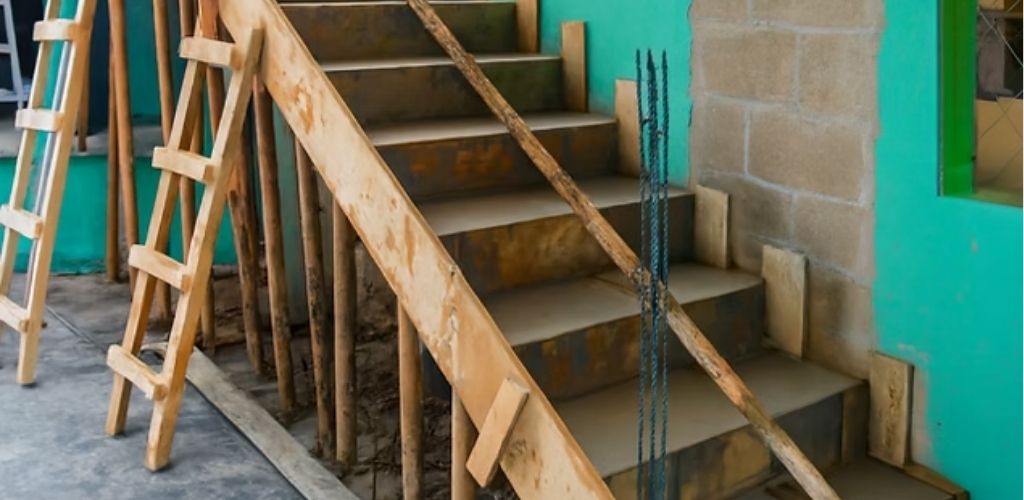
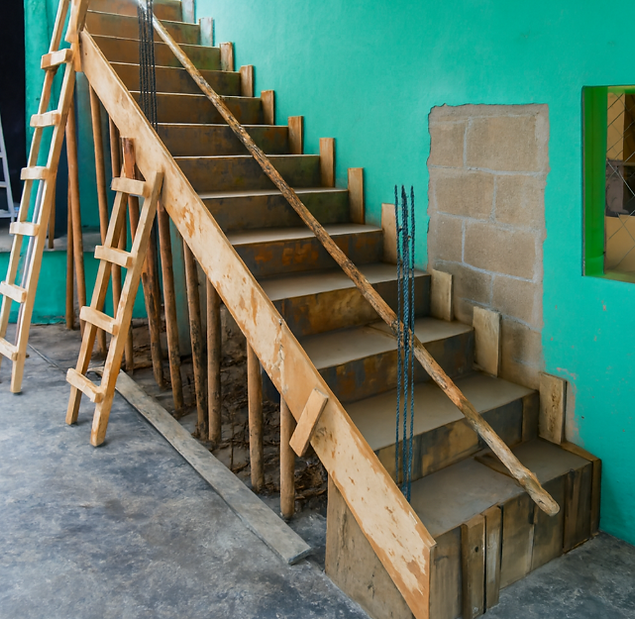
🪵 Step 2: Precise formwork (most failures originate here)
The formwork is the “mold” of the staircase. Poor formwork leads to:
❌ Crooked steps
❌ Weak edges
❌ Excessive concrete consumption
The method shown uses:
- Properly aligned wood
- Strategic reinforcements
- Supports to prevent deformation during excavation
📌 Little-known fact: The pressure of fresh concrete can deform wood if it is not properly supported.
🔩 Step 3: Reinforcing steel (what you don’t see, but holds everything together)
A staircase without proper reinforcement will eventually crack.
The process is detailed below:
- Where to place the rods
- How to tie them correctly
- Why steel shouldn’t touch the ground or formwork
This step is key to the lifespan of the ladder.
🧪 Step 4: Preparing the concrete (it’s not all “mix and play”)
Not just any mixture will do.
It explains:
- Correct proportions of cement, sand, and gravel
- Adequate amount of water
- Ideal consistency for stairs
⚠️ Very watery concrete seems easy to pour, but it loses strength over time.
🪣 Step 5: Emptying and Vibrating (Professional Level Detail)
The emptying is done from the bottom up, taking care to:
- Proper compaction
- Removal of air bubbles
- Leveling of each step
Here you can see the difference between an improvised job and a well-executed one.
⏳ Step 6: Curing and waiting time (the most common error)
Many people climb the ladder too soon.
The correct process includes:
- Keep humid for several days
- Avoid early loads
- Respect setting times
📌 This can double the final strength of the concrete
🏠 Added value: Why is this method ideal for beginners?
✔ No sophisticated tools required
✔ Avoid costly mistakes
✔ Teaches real structural principles
✔ Works for both new homes and extensions
That’s why this content has over a million views: it solves a real problem with total clarity.
Conclusion
A concrete staircase is not just a set of steps; it is a structure that accompanies the daily life of a home for decades
Following a proven method, explained step by step and with a didactic approach — like Oscar Dardon’s — makes the difference between a job that “looks good” and one that is truly safe, durable, and professional.