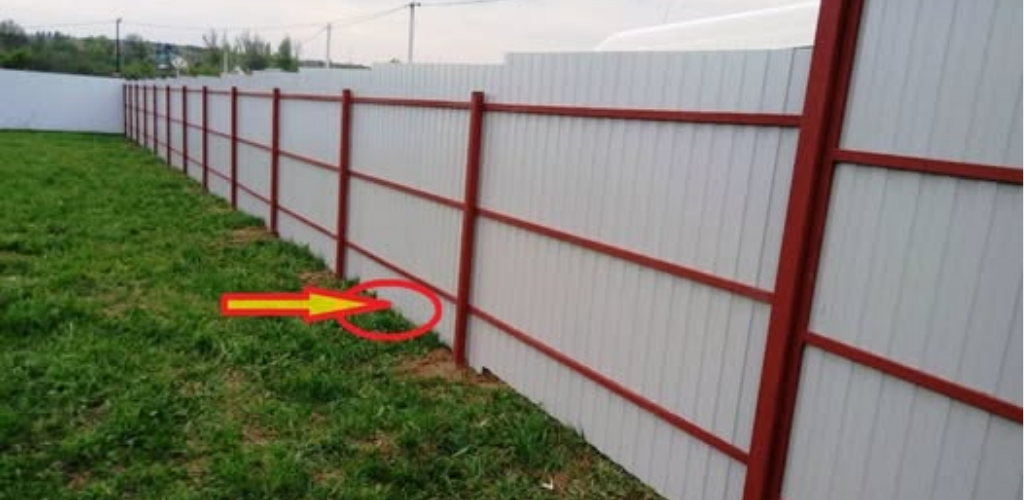
The most popular material for building a fence on a property is corrugated sheet metal. Log fences have long gone out of fashion, as their practicality leaves much to be desired: logs rot quickly.

Stone fences are expensive, so most people prefer corrugated sheets.
I wouldn’t say it’s an unsuitable material. Corrugated sheets have decent qualities, as long as the sheets are at least 0.45 mm thick.
For a 2-meter-high fence, at least three guides are required. 40×20 mm profile pipe is ideal for this purpose.

However, 50% of builders forget one important detail. Look at the photo above. What do you notice?
I understand that when it’s summer, you want to hide in the shade as quickly as possible. But here you need to put up a fence.
When all thoughts are occupied with the upcoming vacation in a cool place, many do not think about where and how to drill.
In our gardening community, every other fence doesn’t have a bottom gap. Let me clarify: the bottom edge of the fence should be 7-10 centimeters above the ground. I’d also like to point out that this edge should be smooth, while the top edge should be rough.

Another improper fence installation. The consequences are inevitable in the spring.
While the error isn’t particularly critical in summer, it makes a significant impact in winter. Snow is cleared from the driveway “down to the asphalt.” This means snow accumulates on the area, eventually reaching a depth of 70 centimeters.
When warmer weather arrives, the snow begins to melt during the day and refreezes at night. As a result, it becomes heavier, putting pressure on the corrugated sheet, causing it to bend outward.
And in the spring, an unpleasant surprise awaits the owners of the plots.

Even a small 5-centimeter gap can help avoid this situation. Consider this: animals won’t be able to squeeze through such a gap, but the corrugated sheets will remain straight. Furthermore, air will flow through the gap, circulating throughout the area.