⚡ What principles does this antenna use?
1. Metal elements such as radiators
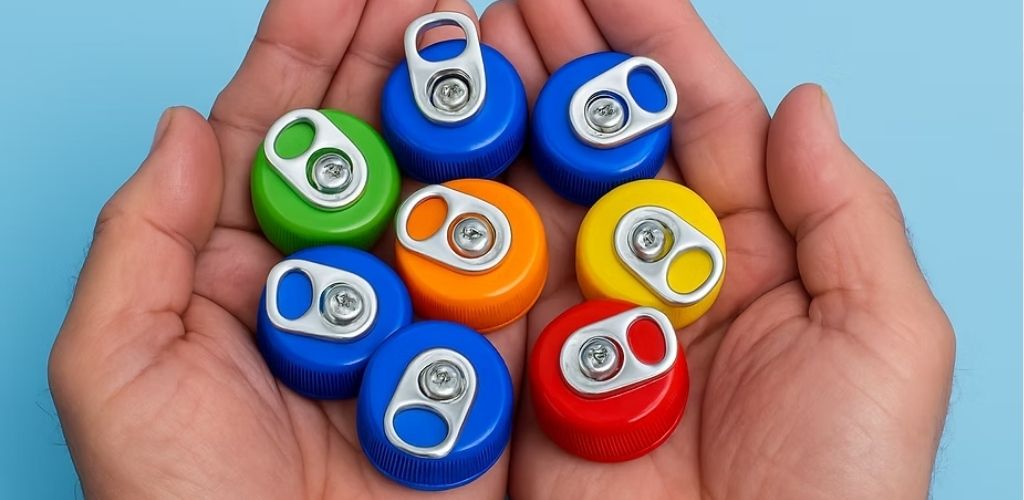
Tin can tabs (rings) are conductors. When connected with wires to a signal input point, they become radiating or receiving elements, like in a dipole antenna.
2. Radial arrangement
The design appears to use a radial or “beam” pattern with several plates, which increases the capture or emission by covering more directions (omnidirectionality).
3. Physical separation
The plastic acts as a dielectric insulator, preventing the metal elements from short-circuiting each other.
4. Terminal block connector
This suggests a signal distribution. It is possible that:
- A conductor (e.g., coaxial cable) carries the signal to one or more metal plates.
- The other pole is connected to other plates or even to the metal hook (as a ground plane or counterweight).
📡 Does it work as an antenna?
Yes, and here’s why:
- The plates are shaped like loops or metal plates: this gives them the ability to interact with electromagnetic waves.
- The cables distribute the signal to these elements.
- Because they are elevated and separated from the conducting body (as in a radial antenna), they can emit or receive signals in multiple directions.
🔌 What type of signal does it support?
This antenna is probably designed for signals from:
- FM Radio (88–108 MHz): where elements of ~75 cm can be used.
- UHF/VHF TV: although it would need greater precision in design.
- WiFi 2.4 GHz or 5 GHz: but in that case, the elements should be much smaller (6–12 cm), so this design seems more geared towards lower frequencies.
✅ Advantages
- Recycled materials.
- Economical design.
- Omnidirectional, ideal for ambient reception of weak signals.
- Suitable for experimentation and learning.
❌ Limitations
- It is difficult to know the resonant frequency precisely.
- Low gain compared to commercial antennas.
- Susceptible to interference if not properly insulated or connected.
- It is not suitable for transmitting high-power signals without impedance matching.
🛠️ How to improve it?
- Measure and adjust the length of each sheet according to the desired frequency.
- Use a coaxial cable properly connected to the center and ground.
- Add a metal reflector behind the container to direct the signal.
- Protect the connections with insulating or heat-shrink tape.