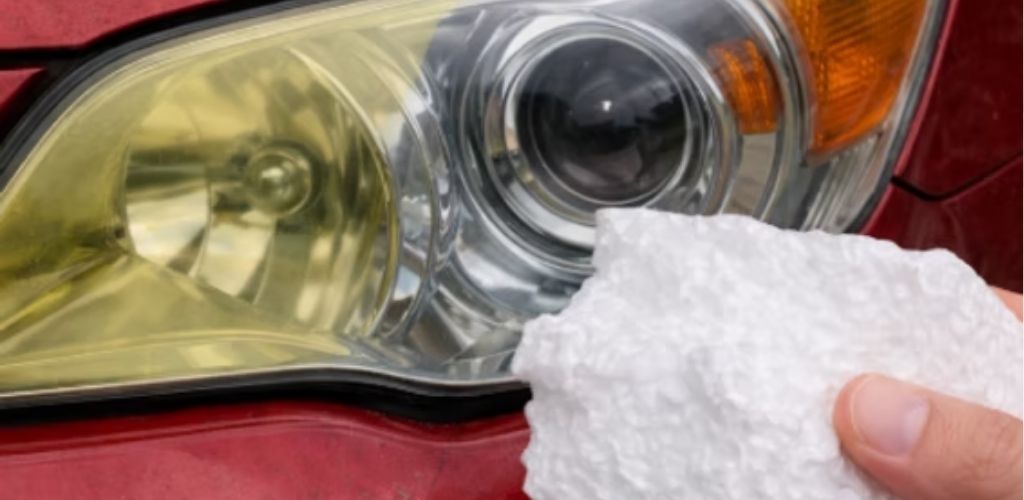
Now, let’s get to the experiment.
Phase 1: Understanding the material (the real protagonist)
Modern headlights are made of polycarbonate, an impact-resistant polymer but sensitive to:
- Ultraviolet radiation
- Organic solvents
- High temperatures
- Constant microabrasion
When the headlight turns yellow, what happens is:
- Degradation of the protective UV layer
- Surface oxidation
- Formation of microscopic microcracks
- Irregular dispersion of light
It is a chemical and physical problem at the same time.
Phase 2: What does the “steam” actually do?
The principle behind the experiment is as follows:
When polycarbonate is exposed to vapors of certain solvents:
- The surface layer softens.
- The micro-stripes “merge”.
- The surface becomes smoother.
- Transparency improves the visual experience.
In technical terms, a surface reflux of the polymer occurs.
But here’s the crucial detail:
Polycarbonate can also:
- Warp
- Crack
- Loss of structural stability
- Being left without UV protection
And that’s not always immediately noticeable.
Phase 3: What I observed in the analysis
When the environment is controlled (temperature, concentration and exposure time), the visual effect is real.
The lighthouse is noticeably improved.
But I also noticed three important things:
- The improvement is superficial.
- Without subsequent sealing, the yellowing returns.
- The margin between “it improved” and “I damaged it” is extremely small.
A few extra seconds can ruin the lighthouse.
The Risk That Many Don’t Consider
The solvents used in these methods:
- They are highly flammable.
- They generate combustible vapors.
- They can cause a fire with a single spark.
- They are irritants to the respiratory tract.
- They require eye protection and suitable gloves.
In addition, heating solvents in improvised containers can cause:
- Pressure buildup.
- Sudden ignition.
- Hot material projection.
This ceases to be a “homemade trick” and enters the territory of chemical risk.
Was the experiment worth it?
From a technical point of view, yes: It allowed me to verify that the effect has a real chemical basis.
From a practical point of view: It is not the safest or most recommended method for most people.
Progressive sanding + polishing + UV protection achieves equally good results, with much less risk.
The Part That Almost Nobody Explains
The shine you see after the steam clears does not mean the headlight is protected.
In fact, many times:
- The original UV layer disappears.
- The polycarbonate is exposed.
- Deterioration can accelerate if it is not sealed.
That’s why some “restored” headlights turn yellow again in just a few months.
Conclusion: Curiosity Yes, Recklessness No
The experiment demonstrates that:
✔ The visual effect is real.
✔ It has a chemical explanation.
✔ It can temporarily improve transparency.
But it also confirms that:
✖ It is not an innocent procedure.
✖ Requires technical knowledge.
✖ It involves serious risks if done without supervision.
If your goal is to improve nighttime lighting, maintain road safety, and protect your vehicle investment, the smartest approach remains:
- Controlled mechanical restoration.
- Professional UV protection.
- Safe procedures.
Curiosity drives discovery. Safety ensures that discovery doesn’t end in an accident.