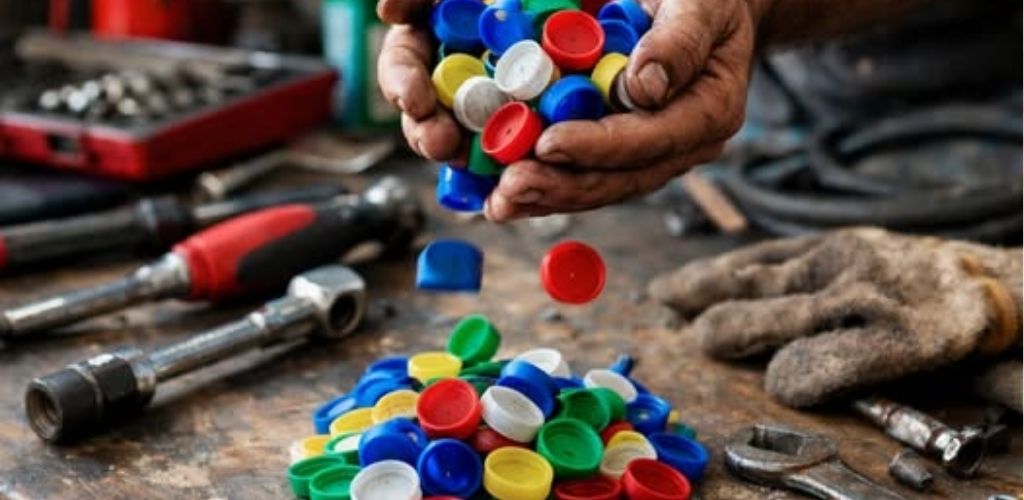
Bottle caps are usually made of high-density polyethylene (HDPE, type 2) or polypropylene (type 5), two recyclable and relatively durable plastics. They are small, long-lasting, colorful… and paradoxically difficult to recycle efficiently in many municipal systems.
Because?
Because their small size makes them easily lost on waste sorting lines. Many recycling plants recommend leaving them on the bottle or disposing of them separately according to local regulations. The result: millions of caps end up in landfills or, worse, in natural ecosystems.
According to data from environmental organizations, small plastics are among the most common items found in beach cleanups. And while a single bottle cap may seem insignificant, its massive accumulation represents a tangible problem.
So when someone proposes reusing them, they’re not reinventing the wheel. They’re challenging a throwaway culture.
Why does the video resonate with so many people?
The success of this type of content isn’t solely due to the trick itself. It’s due to three emotional factors:
- Surprise: Nobody expects something so small to have a “second act”.
- Accessibility: No industrial tools are needed.
- Visual satisfaction: Seeing plastic melted or assembled into something solid generates a feeling of immediate accomplishment.
But there’s something deeper: we live in an age of material saturation. Transforming waste into useful objects offers a small sense of control in the face of environmental chaos.
The DIY invention: more than a trick
Many projects using bottle caps follow a similar pattern:
- Collection and sorting by color.
- Cleaning.
- Crushed or cut.
- Heat-controlled melting.
- Molding into a new shape (sheets, blocks, decorative pieces).
Some people create small boards, coasters, tool handles, buttons, tokens, or even solid surfaces.
This is where it’s appropriate to pause critically.
Melting plastic at home is not trivial. It can release fumes if done incorrectly. It requires adequate ventilation and temperature control. Creative enthusiasm must be accompanied by technical responsibility.
Creativity should not put health at risk.
Is it really “a gold mine”?
If we’re talking in direct economic terms, no.
The market value of recycled plastic is low and depends on volume and purity. A handful of bottle caps won’t change your household budget.
But if we talk about:
- Savings on small items.
- Waste reduction.
- Environmental education at home.
- Development of manual skills.
- Change of mindset.
So yes: there is real value.
The metaphor of “gold” works better as a symbol than as a financial promise.
Comparison: throwing away vs reusing
Let’s imagine two scenarios:
Scenario A: Automatic Discard
You open a bottle. The cap goes in the trash. End of story.
Scenario B: Conscious Harvesting
You save the bottle caps in a container. Over time, you collect enough for a small project. Your children participate. They learn about different types of plastic. They understand the environmental impact. They see how something “useless” becomes something tangible.
In the second scenario, the object is the same. What changes is the narrative.
Global context: the plastic problem
Hundreds of millions of tons of plastic are produced worldwide each year. A significant portion of this is single-use packaging. Lids are just one piece of a larger system that prioritizes convenience over durability.
In some European countries, regulations already exist that require caps to remain attached to the bottle to facilitate recycling and prevent environmental dispersion.
This seemingly technical detail reveals something important: the problem isn’t just with the consumer. It’s with industrial design.
The educational value of creative recycling
If you have children —and here I speak from the experience of many parents who discover recycling as a family activity— this type of project can become a powerful educational tool.
Instead of saying “take care of the planet”, you can show:
- How materials are classified.
- What does density mean?
- How heat transforms polymers.
- What is the difference between reusing and recycling?
That concrete experience is worth more than a thousand speeches.
Real-world examples of reuse
- Communities that collect bottle caps to manufacture street furniture.
- Artists who create murals with bottle caps sorted by color.
- Makers who manufacture functional parts for workshops.
- Schools that use bottle caps to teach counting and sorting.
It’s not an isolated trend. It’s part of a broader circular economy movement.
Practical recommendations (without romanticizing it)
If you want to try something similar, consider:
- Sort by type of plastic. Not all plastics melt the same way.
- Ventilation is mandatory. Never use plastic covers in enclosed spaces without airflow.
- Temperature controlled. Prevents overheating.
- Start small. Try decorative pieces before attempting structural objects.
- Evaluate whether it’s really worth it. Sometimes reusing directly (as decorative tiles or lids) is safer than melting.
And an important point to consider: not everything needs to be turned into a project. Sustainability also involves reducing consumption, not just transforming waste.
What the video doesn’t say (but we should think about)
This type of content can be inspiring, but it also runs the risk of oversimplifying a structural problem.
We won’t solve the plastic crisis by melting down bottle caps at home. However, these gestures have cultural value: they take us out of autopilot.
Real change happens when:
- We buy fewer packages.
- We chose reusable options.
- We demand better industrial design.
- We support efficient recycling systems.
DIY does not replace public policy, but it can change mindsets.
Short storytelling: the box in the kitchen
Imagine a box in your kitchen. It’s not elegant. It’s filled with colorful lids. Each one represents a drink, a gathering, an outing.
One day you decide to use them to create something small: a board, a stand, an ornament.
It’s not perfect. It doesn’t look professional. But you did it. And you did it with something that would have otherwise been forgotten.
That small act redefines your relationship with consumption.
Is it an exaggeration to call it a “gold mine”?
Yes… and no.
It’s not financial gold. It’s gold in terms of consciousness.
We live in a culture that turns resources into waste in a matter of minutes. If a bottle cap can spark a conversation about sustainability, it already has more value than we ever imagined.
Final reflection: the true invention is not the object
The real invention is not the recycled part.
It’s the idea that waste isn’t inevitable. It’s the decision to look twice before throwing something away. It’s curiosity that transforms habits.
Perhaps bottle caps aren’t a gold mine.
But they are a mirror.
A mirror that reflects how we treat the small, the everyday, the seemingly insignificant.
And if we learn to see value in the smallest things, perhaps we will also learn to take better care of the big things.