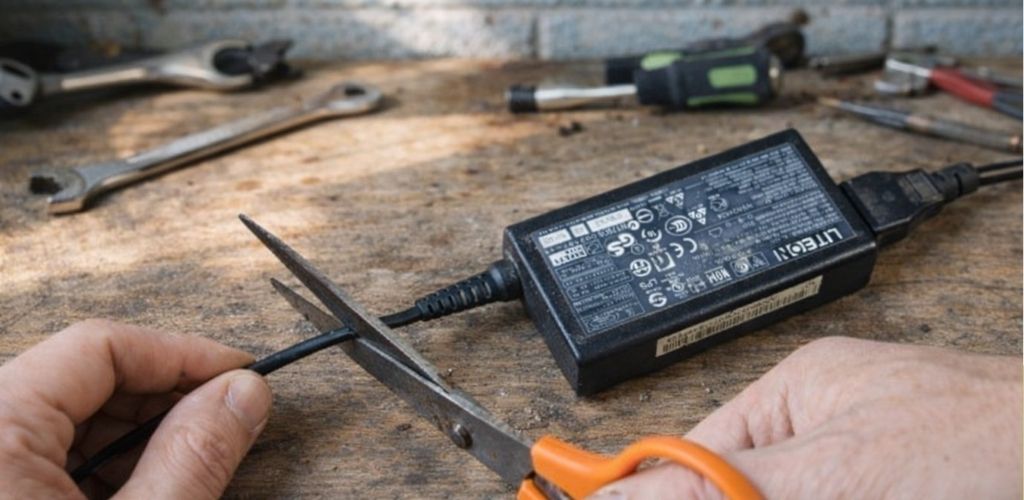
Meta Description: Don’t throw away your old laptop charger! Discover how to repurpose e-waste into powerful DIY tools and learn the science of converting old electronics into functional workshop gear.
The Throwaway Culture: When a Charger is No Longer “Useful”
In almost every home, there is a “drawer of doom” filled with chargers we no longer use. We upgrade our laptops, cables get frayed, or the devices simply die. What most people ignore is that a laptop charger is, in essence, a very potent power source. A typical charger delivers around 19V and 3 to 5 Amps, meaning it can provide between 60 and 90 Watts of power. To put that in perspective, a standard mobile phone charger only offers 10–25W, while a small electric soldering iron operates at 30–60W. Power-wise, your old laptop charger is in the same league as professional power tools.
From E-Waste to Utility: The Concept of Repurposing
The logic behind repurposing a charger into a tool, such as a DIY soldering iron or a heating element, is simple physics. Any electric soldering iron follows a basic path: Electricity → Resistance → Heat → Solder. While a laptop charger wasn’t designed for this specific task, it possesses more than enough energy to generate heat if connected to a metallic resistance. This isn’t secret engineering; it’s a reinterpretation of a tool that already exists. This shift from a “broken-replace” mentality to a “broken-reinvent” mindset is a cornerstone of modern sustainable living.
Why Creative Recycling is Going Viral
Experiments involving old chargers have become a global internet sensation for several reasons. They use items everyone already owns, promise to reduce electronic waste (e-waste), and produce immediate, visual results. According to the Global E-waste Statistics Partnership, the world generates over 50 million tons of electronic waste annually. By finding a second life for even a single power adapter, hobbyists are challenging the “planned obsolescence” of the tech industry and fostering a global “Maker Culture” focused on self-sufficiency and curiosity.
| Device | Approx. Power (Watts) | Potential DIY Use |
| Phone Charger | 10–25 W | Low-power LED projects |
| Laptop Charger | 45–90 W | Mini-drills, Soldering, Motors |
| Small Soldering Iron | 30–60 W | Electronics repair |
| LED Strip (5 meters) | 24–60 W | Home mood lighting |
The Educational Value of DIY Experiments
Beyond the “hack” itself, these projects serve as excellent practical lessons in basic electronics. When you experiment with a power source, you learn the fundamental relationships between voltage, current, and resistance—specifically the Joule heating effect. This hands-on experience is often more valuable than hours of theoretical study. It encourages people to look at a piece of “trash” and see it as a component, an energy source, or an opportunity to build something new.
Understanding the Limits and Safety Risks
While the idea is ingenious, it is important to be honest about the limitations. An improvised tool made from a charger lacks the temperature control, thermal insulation, and electrical stability of professional equipment. There are real risks to consider:
- Charger Overload: Forcing a charger to act as a pure heating resistance can cause it to overheat or burn out.
- Short Circuits: Poor connections can lead to sparks or damage to the adapter’s internal circuitry.
- Inconsistent Results: Without a regulated tip, soldering quality may be poor, leading to fragile electrical connections.These projects are best viewed as educational experiments rather than permanent tool replacements.
Practical and Safe Alternatives for Old Chargers
If you have a stack of old chargers, there are several safer ways to integrate them into your workshop. They make excellent power supplies for 12V–19V DIY projects, such as powering LED strips, small robotics, or home-made audio amplifiers. By using a “buck converter” (a small, inexpensive voltage regulator), you can even turn an old laptop charger into a high-quality, adjustable lab power supply or a universal USB charging station. This allows you to harness the power safely and precisely.
Did you find this guide to recycling electronics helpful? We believe that the tools of the future are often hidden in the trash of the past. If you enjoyed this deep dive into DIY engineering, please subscribe to our page, give this post a like, and share it with your friends. Your support helps us promote a more sustainable and creative world!
What’s the oldest piece of tech in your “junk drawer” that you’d love to bring back to life? Let us know in the comments below!