Meta Description: Discover the science of knife sharpening and whether viral hacks like the “nut trick” actually work. Learn professional techniques to maintain a razor-sharp edge safely and efficiently.
The Edge of a Knife: More Science Than Magic
Before diving into quick fixes, it’s essential to understand a basic truth. Sharpening a knife isn’t just about rubbing it against something hard. True sharpening involves removing a tiny amount of metal, reforming the edge angle, and realigning the microscopic “teeth” of the steel. Under a microscope, a blade looks like a series of jagged saws. With use, these structures bend or break, causing the knife to feel dull. Sharpening is the act of rebuilding that specific geometry.
The Viral “Nut Trick”: Does It Actually Work?
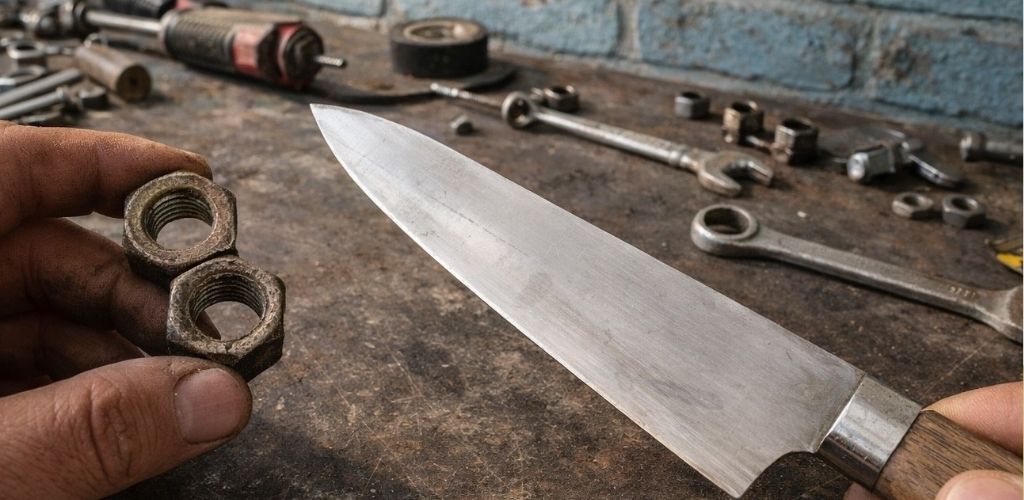
You may have seen videos showing someone holding two metal nuts and passing a blade between them. The logic is that the hard metal edges of the nuts act as an abrasive surface, while the V-shape created by the two nuts serves as an improvised sharpening guide. While this might produce a temporary improvement, it faces significant hurdles. First, the angle is never consistent when held by hand. Second, industrial nuts aren’t designed to be controlled abrasives; they often have irregular edges that can cause micro-damage to your high-quality steel.
5 Common Quick-Sharpening Hacks Evaluated
Internet tutorials often repeat the same few methods. Here is how they stack up when put to the test:
- The Bottom of a Ceramic Mug: This is surprisingly effective. The unglazed ring on the bottom of most mugs is a mild abrasive, similar to a sharpening stone. It’s a favorite trick for chefs in a pinch.
- Sandpaper: This is actually a legitimate technique. Using progressive grits (from 600 to 2000) on a flat surface can produce a professional-grade edge if your technique is steady.
- Two Knives Facing Each Other: Often mistaken for sharpening, rubbing two blades together is actually a poor attempt at “honing.” It usually does more harm than good, risking nicks in both blades.
- Natural Stones: Mankind’s oldest method. While effective, the wrong stone—one too smooth or too gritty—can ruin a blade’s finish.
- The Metal Nut Technique: Visually striking for video content, but rarely provides a long-lasting or precise edge for daily kitchen use.
How Professional Chefs Maintain Their Blades
The gap between a viral “hack” and professional technique is massive. Most chefs rely on Japanese whetstones, moving through a series of grits to achieve a “scary sharp” edge. This process focuses on three pillars: a constant angle, the right abrasive material, and patience. A professional might spend 20 minutes sharpening a single knife, whereas a viral trick promises results in seconds. In a high-pressure kitchen, a dull knife isn’t just a nuisance; it’s a safety hazard that leads to slips and uneven cuts.
| Method | Consistency | Safety | Best For |
| Whetstone | Excellent | High | Professional Maintenance |
| Ceramic Mug | Moderate | Moderate | Emergency Situations |
| Sandpaper | High | Moderate | DIY Sharpening |
| Nut Hack | Low | Low | Viral Demonstrations |
Why We Love “Secret Hacks”
There is something deeply satisfying about finding a simple solution to a common problem. Our brains love that “Why didn’t I think of that?” moment. However, many of these demonstrations are optimized for the camera, not for the longevity of your kitchen tools. A quick fix might help you finish dinner tonight, but it won’t replace the need for regular, high-quality maintenance. Paradoxically, the sharpest knives are the safest, as they require less pressure and offer more control.
Final Thoughts: Ingenuity Meets Tradition
From prehistoric stones to modern ceramic mugs, the act of sharpening connects us to an ancient craft. While the “nut trick” might be more of a curiosity than a masterclass, it highlights human creativity in solving problems with whatever is at hand. Understanding why a tool works is always more valuable than just following a shortcut. The next time you see a viral sharpening video, remember: the best edge comes from understanding the metal, not just the trick.
Did you find these sharpening insights helpful for your kitchen? We love exploring the intersection of traditional skills and modern hacks. If you enjoyed this guide, please subscribe to our page, give this post a like, and share it with your fellow home cooks. Your support helps us keep the tips coming!
What’s the weirdest thing you’ve ever used to sharpen a knife? Tell us your stories—the successes and the disasters—in the comments below!