The Hidden Budget Killer: Master Your Refrigerator Settings to Slash Energy Bills
Many households struggle with rising electricity costs, often overlooking the silent culprit sitting right in the heart of their kitchen. Unlike a television, coffee maker, or washing machine, your refrigerator never rests. It operates twenty-four hours a day, 365 days a year, making it the single largest energy consumer in your home. However, by mastering the correct refrigerator settings and changing a few simple habits, you can stop throwing money out the window and significantly extend the lifespan of your most important appliance.
The physics of cooling is unforgiving. When a fridge has to fight external factors—like poor placement or improper internal organization—its efficiency plummets. Your operating costs rise in direct proportion to every extra degree the compressor has to fight. Understanding how to optimize this machine is not just about home maintenance; it is a vital strategy for long-term financial savings.
The Magic of Occupied Space: Why Empty Fridges Cost More
There is a widespread myth that an empty refrigerator consumes less electricity because there is “nothing to cool.” In reality, the truth is quite the opposite. Air has a very low thermal capacity, meaning it loses its cold temperature almost instantly the moment you open the door. When the cold air “falls out,” the compressor must work overtime to cool down the new volume of warm kitchen air that rushes in.
Foods—especially liquids and solids—act as thermal accumulators. Once chilled, they help maintain a stable microclimate inside the appliance, preventing sharp temperature spikes. This thermal mass is your best friend when it comes to energy efficiency.
| Factor | Impact on Efficiency | Saving Tip |
| Internal Volume | Full fridges retain cold better | Use water bottles to fill gaps |
| Temperature | Every degree lower adds 5-10% cost | Set fridge to 5°C – 7°C |
| Seal Quality | Leaks force the motor to run 24/7 | Clean seals with warm soapy water |
Water Bottles: Your Secret Weapon for Energy Savings
If your fridge isn’t constantly stocked, you don’t need to run to the store and buy unnecessary groceries. Simple plastic bottles filled with tap water can do the job just as well. Placing these bottles in the back of your shelves creates a solid thermal mass that stabilizes the internal environment.
This trick is particularly effective at night when the fridge is rarely opened. The water retains its chill, allowing the cooling unit to cycle on much less frequently. This not only saves electricity but also reduces wear and tear on the motor’s mechanical components. It’s a simple, zero-cost hack that yields immediate results on your monthly statement.
Optimizing Temperature and Strategic Placement
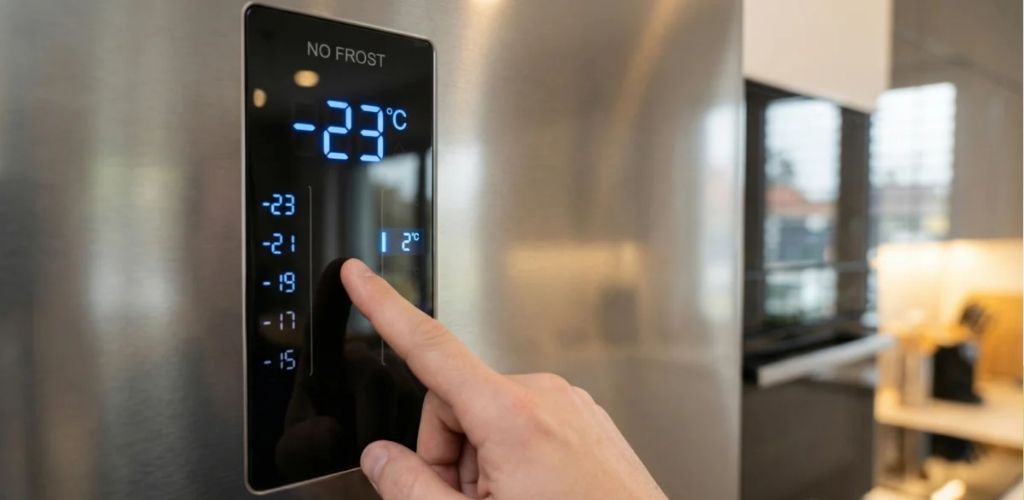
Many users set their thermostat to the maximum setting, believing that “colder is better.” However, setting the temperature too low provides no real benefit for food freshness while drastically increasing your bill. Experts agree that the optimal refrigerator setting is between 5°C and 7°C (41°F – 45°F). For the freezer, -18°C (0°F) is the safe and sufficient standard for long-term storage.
Placement is equally critical. If your fridge is positioned next to an oven, dishwasher, or radiator, it has to work exponentially harder to shed heat. Even direct sunlight hitting the appliance can decrease its efficiency. Ensure there is at least a few centimeters of space between the fridge and the wall to allow for proper air circulation, which prevents the compressor from overheating.
Maintenance: Dust, Ice, and the Paper Test
The back of your fridge—the condenser coils—is often neglected for years. Dust and cobwebs act as unwanted insulation, preventing the appliance from releasing heat effectively. Twice a year, pull the fridge out and vacuum these coils. This five-minute task can save you enough money over a year to cover a major grocery haul. Additionally, keep an eye on ice buildup; a layer of frost just a few millimeters thick acts as a barrier to cooling, forcing the system to work harder.
Finally, check your door seals with the “paper trick.” Place a piece of paper or a dollar bill between the door and the frame and close it. If you can pull the paper out without resistance, your seal is failing. Often, a simple cleaning to remove sugary residues or grease can restore the suction and keep the cold air where it belongs.
Is it Time to Upgrade?
If your refrigerator is more than fifteen years old, upgrading to a modern, energy-efficient model (Class A or B) could pay for itself in just a few years. Modern compressors use less than a third of the electricity compared to older types. When choosing a new unit, look beyond the purchase price and calculate the annual kilowatt-hour consumption—investing in better insulation and a smarter motor is a move that pays dividends every single month.
By implementing these small daily changes—from organizing your shelves for quick access to using water bottles as thermal anchors—you turn your refrigerator from a budget enemy into an efficient helper.
Did these energy-saving tips help you rethink your kitchen setup? We are dedicated to helping you run a smarter, more cost-effective home! If you found this guide useful, please subscribe to our page for more household hacks, give us a “Like,” and share this post with your friends and family on social media. Have you tried the water bottle trick or discovered your own way to save? Let us know in the comments—we love hearing your success stories!