The Secret to a Massive Harvest: Why You Should Plant Peppers in Triangles
Every year, many gardeners struggle with weak, unproductive plants, unaware that a single change during the transplanting stage could transform their garden. Traditional pepper planting often relies on long, spaced-out rows, but seasoned agronomists have long used a different “geometric” secret. By shifting your approach, you can wake up an unexpected strength in your plants, producing peppers so large and numerous they defy standard gardening expectations.
Most growers make the mistake of leaving too much space between individual plants. While intended to prevent competition, this isolation actually exposes peppers to wind stress and causes the soil to dry out rapidly. Peppers are surprisingly social plants; they thrive on the proximity of their neighbors and the specific microclimate created when their leaves interlock.
Why Traditional Linear Planting Often Fails
When peppers are planted in standard rows with 40-centimeter gaps, the exposed soil between them becomes a liability. During the peak of summer, direct sunlight overheats the ground, evaporating moisture before the roots can effectively absorb it. This constant thirst forces the plant to spend its energy on survival rather than fruit production.
Furthermore, isolated plants lack structural support. Fragile stems bend and sway with every gust of summer wind, causing microscopic tears and slowing down the transport of vital nutrients. To compensate, the plant tries to stretch upward to find stability, resulting in thin, spindly stalks incapable of supporting heavy fruit. This linear system simply doesn’t allow for the shared root zone that occurs naturally in denser plant communities.
The Revolutionary Triangle Method for Pepper Planting
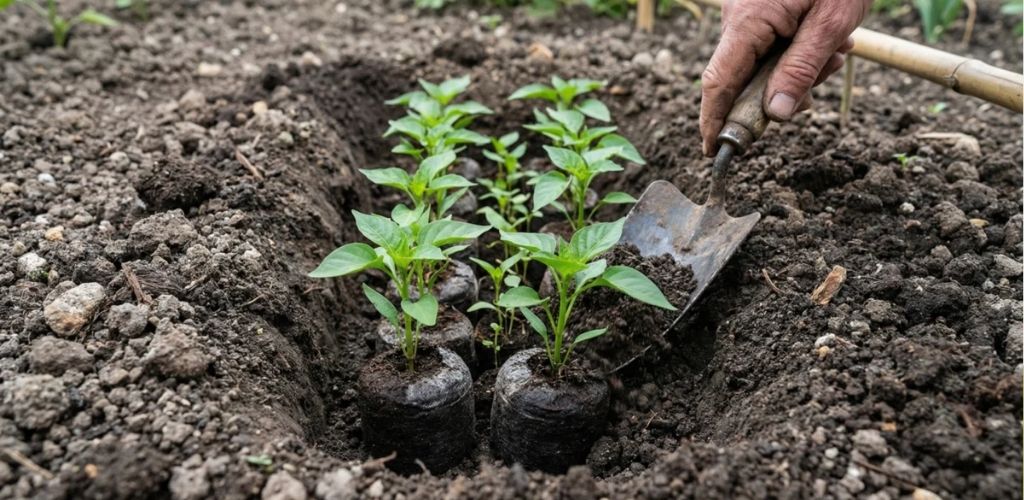
The pillar of this high-yield success is a method where three separate seedlings are planted into one large hole, arranged in an equilateral triangle. This geometry isn’t random; it provides each bush with its own root territory while creating a collective shield above the soil.
The Triangle Spacing Guide:
| Metric | Recommended Value | Purpose |
| Distance between plants | 15 cm (6 inches) | Allows leaves to interlace quickly |
| Planting Angle | 30 Degrees | Encourages adventitious root growth |
| Watering Volume | 4 Liters per hole | Ensures deep hydration for all three plants |
| Fertilization Cycle | Every 10 Days | Maintains consistent nutrient levels |
By spacing the three plants exactly 15 centimeters apart, their foliage connects within two weeks. This creates a “living mulch” of natural shade that keeps the soil cool and moist. Together, they form a robust unit that resists wind and storms much better than a solitary bush.
The 30-Degree Tilt: Doubling Your Root Strength
When placing your seedlings into the ground, apply this professional trick: do not plant them vertically. Instead, tilt each plant at a 30-degree angle. Aim the root ball toward the center of the triangle while the top of the plant points slightly outward. This slight incline forces the buried portion of the stem to develop adventitious roots.
The result is a root system twice as strong as a standard planting, capable of drawing water from deeper soil layers during droughts. Because the roots are concentrated in a shared central zone, the plants can assist each other in nutrient distribution. The entire group begins to behave like a single, powerful organism with a massive energy reserve, which is immediately visible in the thickness of the stems.
Soil Preparation and Elite Varieties: California Wonder and Alba Regia
A perfect harvest starts with soil that can breathe. Ideally, prepare your planting holes with a mix of high-quality compost or aged manure and wood ash. The ash provides essential phosphorus and potassium, which are the primary fuels for flower production and fruit ripening. If you missed autumn preparation, you can enrich the holes two weeks before planting with a handful of complex fertilizer mixed thoroughly with the earth.
For this intensive triangle method, compact and sturdy varieties perform best. California Wonder is a world-class choice, famous for its giant, blocky fruits and thick, juicy walls. Alba Regia is another excellent option for those who prefer lighter-colored peppers that are highly resistant to leaf diseases and fruit deformation. Both varieties react to this increased care with an explosive increase in fruit weight.
Pruning and Care for 180g+ Peppers
To achieve peppers weighing over 180 grams, you must learn to guide the plant’s growth. The most important step is to remove the “King Flower”—the very first bud that appears in the first fork of the stem. This forces the plant to stop focusing on one premature fruit and instead invest its energy into building a massive, healthy bush.
Once the subsequent fruits reach the size of a walnut, consider pinching off the tops of the main shoots. Limit each plant to about 7 or 8 fruits at a time to ensure they all reach their maximum size potential. Also, remember to prune the “suckers” (side shoots) and remove the bottom leaves up to the first fork to improve ventilation and prevent fungal diseases.
Did this professional planting secret change your gardening game? We are dedicated to helping you grow the most productive garden of your life! Please SUBSCRIBE to our page for more expert tips, give this post a LIKE, and SHARE it with your fellow gardeners. Have you tried planting in groups before? Let us know your results in the comments below!