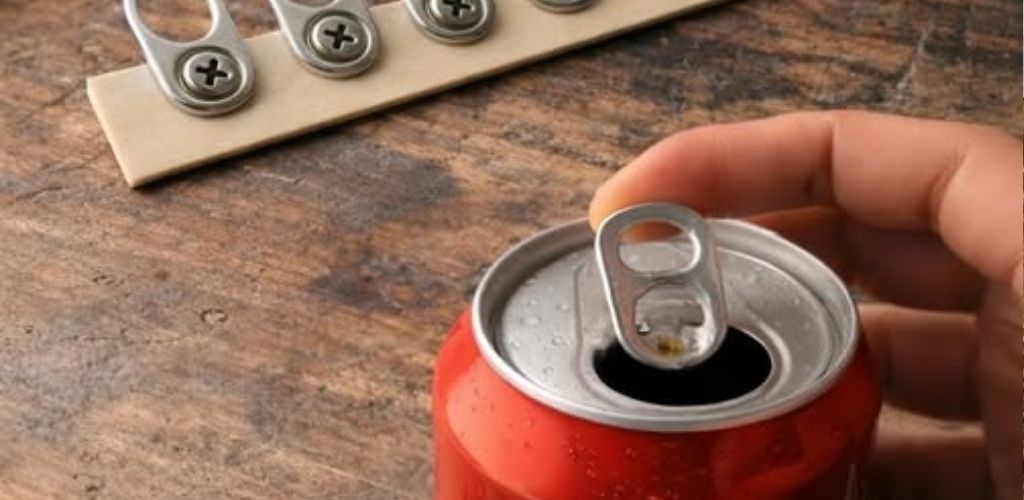
🧪 What are can tabs made of?
The rings are made primarily of anodized aluminum, the same material as the can, but with a surface treatment that increases its resistance to corrosion.
- Typical composition:
- 92-99% aluminum
- Traces of magnesium, manganese or silicon (5xxx or 3xxx series alloys)
- Advantages of aluminum:
- Light 🪶
- It does not rust easily.
- It is non-toxic (safe for food use)
- 100% Recyclable ♻️
🧰 Why that shape?
The shape of the rings is not accidental; there is functional engineering behind it:
- Oval or teardrop design: improves the distribution of effort when pulling.
- Central hole with curved tab: allows you to insert your finger and easily pry it open.
- Double support point: the ring is riveted in two areas, allowing the can to be opened with less force.
- Controlled curvature: the upward-folded part prevents it from breaking when tension is applied.
💪 How much can they withstand?
- Average tensile strength: between 15 and 30 N (approx. 1.5 to 3 kg) before deformation.
- Typical thickness of aluminum: 0.7 to 1 mm
- Despite their size, they withstand considerable tension thanks to their shape and material, optimized so that the lid breaks, not the ring.
📊 Key technical data:
| Parameter | Approximate value |
| Material | Anodized aluminum (5xxx series) |
| Tensile strength | 90–130 MPa (megapascals) |
| Thickness | 0.7–1 mm |
| Breaking point | >30 N |
| Weight of a ring | 0.4 – 0.7 grams |
🧠 Curiosity:
The modern design of pull tabs was optimized in the 1980s to ensure they remain attached to the can, preventing environmental contamination. That’s why many pull tabs today don’t detach completely.