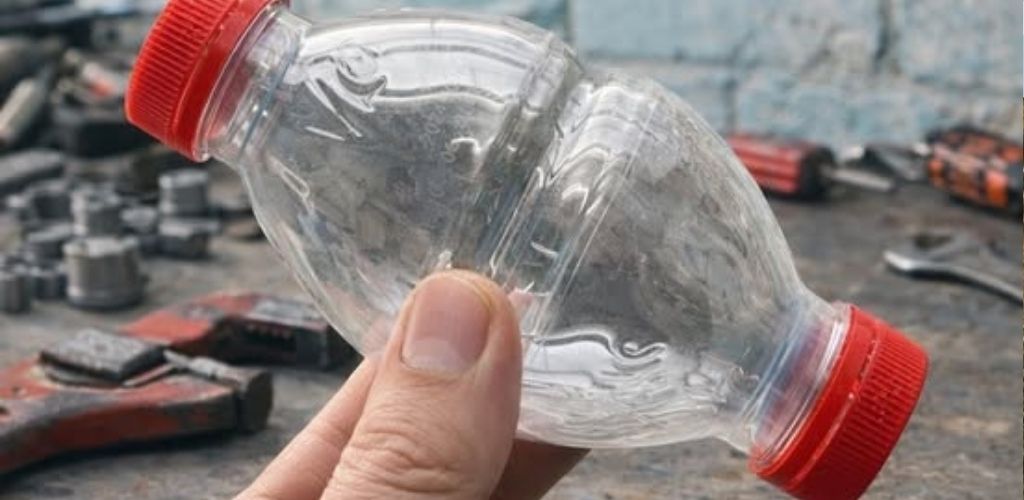
🌎 The Real Problem with Plastic (And Why This Trick Matters)
Before we get into the invention, let’s put the context on the table.
According to data from the United Nations Environment Programme (UNEP), more than 400 million tons of plastic are produced worldwide each year, and a large portion of it ends up as single-use waste. PET bottles, especially beverage bottles, are among the most commonly discarded items.
The interesting detail is that PET plastic:
- It is durable.
- It is flexible.
- It’s waterproof.
- It is easy to cut and shape.
In other words, it has technical qualities that can be used beyond its original function.
And that’s where ingenuity comes in.
🔧 The Invention: From Common Bottle to Useful Tool
The central idea presented by Tips Secret is to transform a plastic bottle into a practical household device, such as:
- A homemade dispenser.
- An improved funnel.
- A drip irrigation system.
- A functional organizer.
- Or even a tool guard.
The key is to strategically cut the bottle, reuse the thread, and take advantage of its conical shape.
It’s not just crafts. It’s design applied to everyday objects.
💡 Real Example: Homemade Drip Irrigation System
4
One of the smartest uses is to turn the bottle into a slow watering system for plants.
How does it work?
- The lid is slightly perforated.
- The bottle is filled with water.
- It is placed upside down on the ground.
- The water is released slowly.
Why is it useful?
- Ideal if you travel.
- Reduce water waste.
- It maintains constant humidity.
- You don’t need to buy expensive systems.
Compared to commercial drip irrigation systems, this homemade version:
| Commercial System | Recycled Bottle |
| More precise | Sufficient for domestic use |
| More expensive | Zero cost |
| Installation required | It assembles in minutes. |
| New material | Reuse plastic |
It doesn’t replace a professional system, but for a small terrace or garden it’s surprisingly effective.
🧰 Another Ingenious Use: Improved Anti-Drip Funnel
If you work from home, do maintenance, or simply cook, you know that small funnels are often a problem.
By cutting off the top of the bottle, you get:
- A wide funnel.
- With a firm nozzle.
- With a thread compatible with many containers.
You can even screw it directly onto another container to prevent spills.
This is where the invention stops being “curious” and becomes practical.
🧠 The Interesting Thing: It’s Not Just Saving, It’s a Change of Mindset
These kinds of ideas work because they force us to change the way we see objects.
We usually think:
Empty bottle = trash.
But it could actually be:
- An irrigation accessory.
- A screw organizer.
- An outdoor socket protector.
- A used oil collector.
- A mini greenhouse.
The difference isn’t in the object. It’s in the way you look at it.
📊 Is Reusing Bottles Really Eco-Friendly?
A critical analysis is worthwhile here.
Reusing plastic doesn’t eliminate the global problem, but:
- Reduce immediate consumption.
- Reduce unnecessary purchases.
- Extends the material’s lifespan.
- Promotes a culture of reuse.
However, it’s important to keep in mind:
- Do not use heavily degraded bottles.
- Do not expose them to high temperatures for long periods of time.
- Do not reuse them indefinitely for food consumption.
The goal is not to romanticize plastic, but to use it intelligently before discarding it.
🏠 Real-World Home Application: Small Solutions, Big Impact
Imagine this scenario:
It’s a Saturday morning. You’re tidying up the workshop or the yard. You see several empty bottles. Normally you’d throw them away.
But you decide to try the invention.
One becomes a funnel. Another a watering system. Another a screw organizer. Another a protector for outdoor sockets when it rains.
In one hour, you went from having waste to having practical solutions.
That generates something interesting: creative satisfaction.
And that feeling is powerful.
🔍 Comparison: Buy vs. Create
We live in a culture where for every problem there is a new product.
- Need to water? Buy a system.
- Do you need a funnel? Buy a funnel.
- Need an organizer? Buy a box.
But often you already have the materials at home.
Create instead of buying:
- Reduce consumption.
- It stimulates creativity.
- Teach children about reuse.
- Strengthens manual skills.
It’s not about stopping buying everything. It’s about questioning before you buy.
⚠️ Important Practical Recommendations
For these kinds of inventions to truly be worthwhile:
- Use appropriate tools when cutting.
- Sand edges to avoid accidents.
- Do not use bottles that have contained hazardous chemicals.
- Wash thoroughly before reusing.
- Do not use for drinking water if the bottle is badly damaged.
Creativity should not sacrifice safety.
📖 A Short Storytelling
I remember as a child seeing older people saving everything: cans, bottles, boxes. At the time it seemed like an exaggeration. Today I understand that it wasn’t hoarding: it was a vision of reuse.
The internet didn’t invent creative recycling. It just made it go viral.
And perhaps that’s why these videos resonate so much: they remind us that innovation can be simple.
🧩 Beyond the Trick: What Does It Teach Us?
This type of invention teaches us several lessons:
- Not everything disposable should be thrown away immediately.
- Creativity arises from necessity.
- Sustainability starts at home.
- Simple solutions are often the most lasting.
And above all:
Innovation isn’t always about what’s new. Sometimes it’s about reinterpreting what’s old.
💬 Generating Conversation
Here’s the interesting question:
How many things do we throw away without asking ourselves if they could have a second use?
Maybe the bottle won’t change the world. But it can change the way you think about consumption.
And when many people change small habits, the impact ceases to be small.
🔚 Final Reflection
The real secret isn’t in the bottle.
It’s in the mindset.
We live in an age dominated by speed and disposability. But every time you transform an ordinary object into something useful, you’re breaking that cycle.
It’s not just about saving money. It’s not just about recycling. It’s about regaining the ability to create solutions with what we have.
The next time you have an empty bottle in your hand, stop for a second.
Don’t see it as garbage. See it as raw material.
And there, exactly there, the real invention begins.