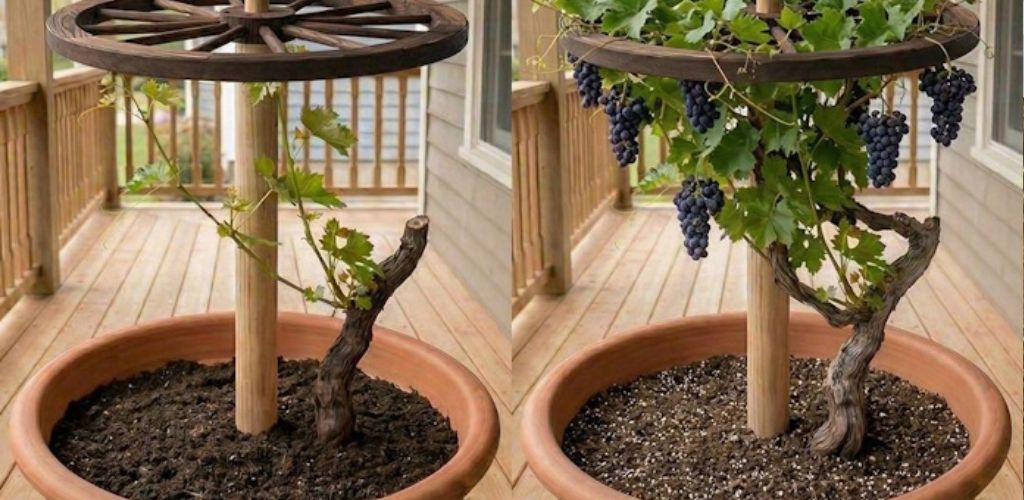
Grapes seem like a complicated crop to many: the vines get tangled, grow quickly, need support, pruning, and constant attention. But in fact, they are a much simpler plant than it might seem at first glance. If you give them the right place, good support, and basic care from the very beginning, grapes can reward you generously with beautiful, juicy clusters.
It can be grown not only for its harvest, but also for its coziness and beauty in the yard. The vine looks great next to a fence, gazebo, or pergola, and the moment when you pick the first ripe berries from your bush is truly a special pleasure.

Why is it worth planting grapes at home?
Homegrown grapes have many advantages. They are not only delicious berries, but also a plant that can grow for years and become a real decoration of the plot.
Among the main advantages:
- fresh berries straight from the bush
- the opportunity to choose your favorite variety
- control over growing conditions
- beautiful decorative effect
- long-term fruiting with proper care
If done right, grapes can become one of the most rewarding crops in the garden.
1. Start with the right variety
Before planting a vine, you need to choose a variety that is truly suitable for your climate and your goals.
What to pay attention to?
The climate of your region
Not all varieties tolerate winter and summer equally well in different areas. It is important to choose grapes that will withstand your conditions without any problems.
Why are you growing it?
It is worth immediately understanding what exactly you want:
- Table grapes are better suited for fresh consumption
- technical varieties are more often used for juice, wine or processing
Disease resistance
Some varieties are better at resisting common problems, such as fungal diseases. This is especially important if you don’t want to be overly fussy about maintenance.
2. Choose the perfect location
The planting location often determines half of the success. If the vine grows where it lacks sun or air, the harvest will be weaker and the berries less sweet.
Grapes like:
Lots of sun
The vine needs at least 7–8 hours of direct sunlight per day . It is sunlight that helps the berries gain sugar and become more delicious.
Good drainage
Grapes do not like stagnant water. If the soil is heavy and clayey, it is better to lighten it with compost or other organic matter.
Free air movement
Don’t plant grapes too close to a solid wall or in a shady, stuffy spot. Good ventilation helps the leaves dry faster after rain and reduces the risk of fungal diseases.
3. Landing and support are a must
Grapes are vines. They naturally tend to climb upwards, so they won’t grow normally without support.
What do you need to prepare?
Sturdy construction
Even before planting, it is advisable to have a ready support, for example:
- wallpaper
- strong fence
- pergola
- tensioned wire system
A mature vine with a harvest weighs a lot, so the structure must be truly reliable.
Spacious planting hole
The hole should be about twice as wide as the seedling’s root system , but not too deep. This helps the young roots settle in more quickly.
Sufficient distance
If you are planting multiple vines, it is best to leave about 1.8–2.5 meters between them . Grapes need space.
4. Watering and fertilizing
Grapes’ needs change with age. Young plants require more attention, while mature bushes become much more hardy.
Watering young vines
In the first year, it is advisable to water the grapes deeply about once a week so that the root system can form well.
Watering adult bushes
Once the vine is well established, it is much more drought tolerant, and watering is usually only needed during long dry spells.
⚠️ Important: excess water before harvesting can make the berries less flavorful.
Refueling
Grapes do not require excessive amounts of fertilizer. In most cases, one balanced feeding in early spring is sufficient.
If you overfeed a vine, it will begin to actively grow leaves, but there may be fewer fruits.
5. The Golden Rule — Pruning
If there is one truly key secret to good grapes, it is proper pruning. Many beginners are afraid to cut the vine, but without it, there will be no good harvest.
When to prune?
The main pruning is done at the end of winter – usually in February or March , while the plant is still dormant.
What kind of shoots do grapes grow on?
Berries appear only on one-year-old vines . That is, it is the shoots that grew last year that will produce this season’s harvest.
Old, thick wood does not form fruit.
How much should you cut?
Yes, you need to be brave here. A healthy vine is often pruned very decisively, removing up to 80–90% of excess growth .
Only a few strong shoots from last year are left, and everything weak, chaotic, and unnecessary is removed.
Summer cleaning
In the summer, you can remove some of the leaves if they are shading the bunches too much. The sun on the berries helps them ripen better.
6. How to protect the crop?
When berries start to sweeten, they become attractive not only to you.
What can interfere?
Birds
Birds can spoil the harvest very quickly. When the clusters start to change color, the vine can be covered with a special net.
Insects and caterpillars
It is a good idea to inspect the underside of the leaves once a week. Many pests can be removed by hand or washed off with a strong stream of water.
Trash under the bush
Fallen leaves and rotten berries need to be removed. Otherwise, pests can overwinter there and diseases can develop.
7. How do you know when grapes are ripe?
The color of the berries isn’t the only sign of ripeness. There are a few other simple ways to check if it’s time to harvest.
The best signs of ripeness:
Try the berry
The most reliable way is to simply taste the grape. It should be sweet and easy to pull off the bunch.
Look at the seeds
If the variety has seeds, pay attention to their color:
- brown seeds usually indicate ripeness
- green – that the berries still need a little time
Don’t tear it off with your hands.
When the bunches are ready, it is best to cut them with pruners or scissors. If you pull with your hands, you can damage the vine.
Useful little things that also matter
To make your grapes feel better, it’s worth remembering a few more simple things:
- don’t thicken the bush
- Inspect the vine regularly.
- do not overwater the soil
- monitor the support so that it can withstand the weight of the shoots and clusters
- Don’t be afraid of pruning – it often solves everything.
Conclusion
Growing good grapes at home is quite possible if you give the vine the right start and do not ignore the basic rules of care. A sunny place, strong support, moderate watering, reasonable fertilization and bold pruning – this is the foundation on which a good harvest is based.
At first, grapes may seem capricious, but once you understand their logic, caring for them becomes much easier. And when the first sweet clusters appear on the vine, it becomes clear: this work was definitely not in vain. 🍇✨
Write in the comments whether you have tried growing grapes at home and what is the most difficult for you – pruning, shaping the vine or bringing the berries to real sweetness 👇😊