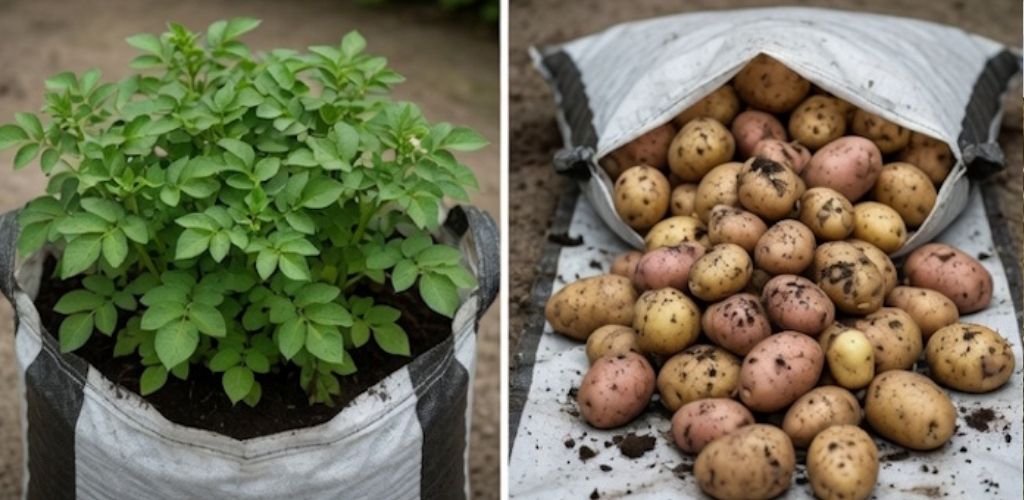
Growing potatoes at home can be one of the most enjoyable gardening experiments. Many people think that a large plot of land is needed for a good harvest, but this is not at all true. In fact, with just a few sturdy fabric bags and a little proper care, you can get a surprisingly generous harvest even on a balcony, terrace or in a small yard. This method is convenient, saves space and at the same time really works well 🌱✨
If you’ve long wanted to try growing potatoes yourself, this method may be a pleasant surprise.
Why fabric bags?
Fabric grow bags are good for potatoes because they provide better air access to the roots. Unlike plastic containers, they help prevent moisture stagnation and create more favorable conditions for the plant to develop.
Another advantage is good drainage. Potatoes do not like waterlogging, and excess water easily escapes through the fabric. In addition, such bags are lightweight, making them easy to move from place to place – for example, closer to the sun or under cover during heavy rain.
Which potato variety is better to choose?
It is best to use seed potatoes for planting rather than regular store-bought potatoes. They are better for growing and usually have a lower risk of disease problems.
There are early, medium and late varieties. If you don’t have much space or want to get results faster, it’s better to pay attention to the early or medium-early varieties. They ripen faster and do well in containers.

How to prepare potatoes for planting
Before planting, it is advisable to sprout the potatoes a little. To do this, place them in a bright, cool place for about 1–2 weeks to produce short, strong sprouts. This helps the plant to get off to a faster start after planting.
If the tubers are large, they can be cut into several pieces, the main thing is that each piece has at least one or two healthy sprouts. After cutting, it is advisable to leave the pieces to dry for a day.
How to prepare bags
It is best to use fabric bags with a volume of approximately 30–40 liters . The larger the volume, the more space there will be for the tubers to form.
Fill the bottom of each bag with about 10–15 cm of loose, well-drained soil. A mixture of garden soil, compost and a small amount of sand or coconut substrate for better structure works well.
Place 2–3 potato slices on the surface , evenly spaced apart. Top with about 10 cm of soil and water lightly.
The main secret to a good harvest is gradual hilling.
One of the most important conditions for a good harvest is to gradually add soil to the bag as the plant grows. When the stems reach about 15–20 cm , add more soil around them, leaving only the top leaves outside.
This stimulates the formation of new tubers along the covered part of the stem.
Every time the plant grows 15–20 cm , the procedure is repeated. This is done until the bag is almost full. This method significantly increases the yield.
Sun and watering
Potatoes like a lot of light, so it’s best to place the bags where the plants will receive at least 6–8 hours of direct sun per day .
Watering should be regular, but not soggy. The soil should remain moderately moist. In hot weather, fabric bags can dry out more quickly, so you may need to water more often in the summer. But it’s always best to check the soil moisture first.
What to feed for better results
Potatoes respond well to nutritious soil, so adding compost at the planting stage is a very good decision.
During growth, you can periodically use a balanced organic fertilizer. At the same time, you should not overdo it with fertilizers with excess nitrogen, because then the plant may go into tops instead of forming tubers.
Natural options, such as well-rotted compost or mild organic infusions, usually work very well.
Protection from pests and diseases
Growing in bags reduces the risk of many soil problems, but that doesn’t mean the plants don’t need to be monitored.
Check the leaves occasionally for pests. It is also important to ensure good air circulation around the bags to reduce the risk of fungal problems.
Healthy planting material and clean substrate are half the success.
When to harvest
Early varieties can be started digging about 8–10 weeks after planting, especially when the bushes begin to bloom.
If you want to wait for full ripening, focus on the tops: when they start to turn yellow and wilt, it’s time to harvest. Before that, it’s better to reduce watering or stop for a while.
To harvest potatoes, simply pour the contents of the bag onto a plastic bag or clean surface and carefully sift the soil with your hands. This is one of the most enjoyable parts of the entire process, as the results are often a pleasant surprise 🥔
What to do with the soil after harvesting
After harvesting, the soil can be used for other crops. However, you should not immediately plant potatoes in it again to avoid the accumulation of possible diseases.
It’s better to plant something else – for example, greens, legumes, or herbs.
Conclusion
Growing potatoes in fabric bags is a convenient, compact and very practical way to get a good harvest even without a large garden. With the right approach, regular hilling and careful care, you can grow a really large amount of potatoes even in a very small area.
This method is suitable for both experienced and novice growers. Most importantly, it proves that sometimes all you need for a bountiful harvest is a sunny spot, a few bags, and a little desire 🌿🥔
💬 Have you tried growing potatoes in bags or containers? Let us know in the comments if you liked this method.