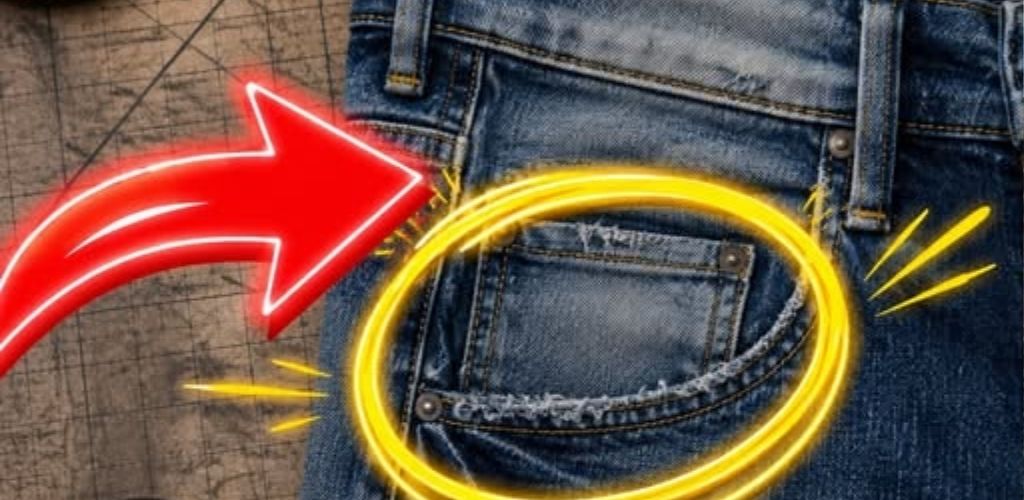
The small pocket was born out of a need that almost no one has today.
When we see a modern pair of jeans, it’s easy to think that all their features were designed for fashion. But in reality, many originated from pure utility. The small pocket officially appeared in 1873 thanks to the work of Jacob Davis and Levi Strauss, who were seeking to create durable pants for workers in the American West.
Back then, a pocket watch was one of the most important items for a worker. There were no cell phones, smartwatches, or digital devices. Keeping accurate time could make all the difference in mines, railroads, or industrial jobs. The problem was that these watches were delicate and expensive.
That’s why a small, snug, and reinforced pocket was designed specifically to protect the watch from bumps and sudden movements. It wasn’t decorative. It was a practical solution.
What’s interesting is that the exact size of the pocket was designed to fit perfectly with the most common watches of the late 19th century. In other words, even the dimensions had a functional logic.
Something similar happens today with certain modern designs. For example, many phones retain details inherited from previous generations even though the technology has completely changed. Some computers still use digital sounds inspired by old physical mechanisms. Objects often hold “traces” of the past even when we no longer need them.
And that makes this pocket a kind of everyday fossil that we continue to use without thinking too much about it.
World War I changed everything… but the wallet survived
One of the most interesting facts is that the pocket watch lost its original function a very long time ago. During World War I, wristwatches quickly began to replace pocket watches because they were more practical for soldiers and workers.
That technological change should have doomed the small pocket of the jeans. But it didn’t.
Instead of disappearing, people began to use them for other purposes. Some stored coins. Others matches. Some small nails or tools. In certain rural areas, they were even used to store small seeds during agricultural work.
Here’s something very curious about everyday objects: often people keep details not for their usefulness, but out of visual and emotional habit.
It’s similar to what happens with some antique furniture at home. Some families keep certain tables, clocks, or lamps even when more modern options exist. It’s not always for efficiency. Sometimes it simply “feels strange” to remove them.
The same thing happened with jeans.
Over time, the small pocket ceased to be merely functional and became part of the pants’ visual identity. And brands understood that far too late.
The mistakes some brands made in the 1970s demonstrate something interesting about people.
In the 1970s, several brands tried to simplify designs to reduce costs and modernize clothing. Some companies thought that eliminating the small pocket made sense because it no longer served its original purpose.
On paper it seemed logical.
Less fabric. Less sewing. Faster production.
But something unexpected happened: many people felt the jeans “looked incomplete.” Although hardly anyone actually used the watch pocket, removing it made the pants look odd.
That detail is very interesting because it demonstrates how the human brain associates certain elements with authenticity. Sometimes it doesn’t matter if they currently serve a purpose. If they disappear, we feel that something is wrong.
It’s similar to what happens with some physical buttons in modern cars. Many brands tried to replace them completely with touchscreens, but then discovered that many people preferred to continue using physical controls because they were more familiar and comfortable.
The small pocket on the jeans ended up becoming a kind of silent symbol. It no longer represented technical utility, but historical continuity.
And that probably explains why it survived even after so many decades.
The most curious detail: almost everyone calls it a “fifth pocket”… but it isn’t
One of the most striking facts in the video is that many people refer to this compartment as “the fifth pocket.” But technically, that name isn’t correct.
In several classic jeans designs, the small pocket was actually part of another front pocket. It wasn’t a separate pocket in the modern sense.
These kinds of historical errors are quite common. Over time, people simplify names and create explanations that are easier to remember, even if they aren’t entirely accurate.
The same is true for many household objects. Some tools retain old names even though they no longer function the same way. Even certain popular expressions originated in contexts completely different from today’s.
What’s interesting is how small details end up building culture without us noticing.
Today, the small pocket no longer holds pocket watches like it did in 1873. But it’s still there because it represents tradition, familiarity, and recognizable design.
And that probably explains why it still appears in almost every pair of jeans in the world, even in modern models that were never intended for heavy-duty work.