The idea step by step (and why it works)
The proposal has three key moments:
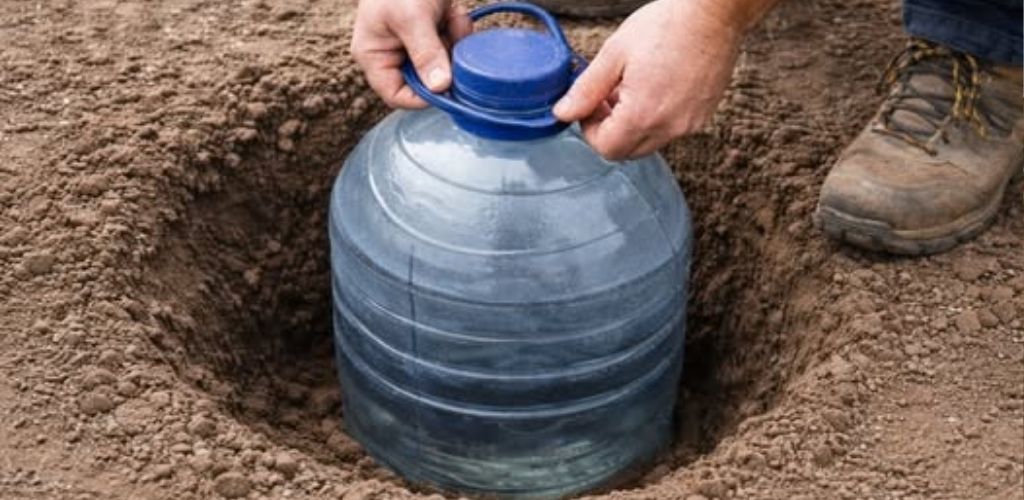
- Dig a hole approximately the size of a 5-liter bottle.
- Prepare a cement mixture and use the bottle as a mold inside the hole.
- Insert a wooden stick or strip while the cement is fresh, to create a firm base.
- Place a horizontal board and attach recycled bottles (like soda bottles) to turn them into aligned planters.
The large bottle acts as a cylindrical mold. As the cement hardens, it forms a solid base that supports the vertical post. It’s a homemade technique similar to the use of formwork tubes in lightweight construction.
In practical terms, it’s a domestic version of a point foundation .
Why is this idea more interesting than it seems?
Many only see the aesthetic result. But there are three layers worth analyzing:
1. Real reuse (not decorative)
In the world of recycling there is a lot of “eco-aesthetics”: objects that seem sustainable, but don’t solve anything.
Here there is a functional use:
- The large bottle serves as a structural mold.
- Small bottles are transformed into flowerpots.
- Purchases of new flowerpots are decreasing.
- The use of expensive metal bases is avoided.
It’s not just “crafts,” it’s minimal infrastructure using household waste .
2. Ideal for small spaces
In cities where space is limited —small patios, narrow terraces or even side areas of a house— this structure allows for vertical cultivation.
Let’s compare it with other options:
| System | Cost | Difficulty | Durability | Space required |
| Traditional flowerpots | Half | Low | High | Half |
| purchased vertical garden | High | Average | High | Low |
| System with bottles and cement | Very low | Average | Medium-High | Very low |
The main advantage is the cost-benefit ratio .
3. Accessible home micro-farming
This system works especially well for:
- Aromatic herbs (basil, parsley, mint)
- Small ornamental plants
- Succulents
- Shallow-rooted plants
It is not suitable for large tomatoes or heavy plants, but it is suitable for light crops.
The technical aspect that almost no one mentions
If you’re going to replicate it, there are key details that aren’t always explained in viral videos.
📌 The cement mixture
For a sturdy base:
- 1 part cement
- 2–3 parts sand
- Add water until you achieve a thick, not runny, consistency.
It should be firm, not runny. If it’s too runny, the post will move.
📌 Depth of the hole
Ideally:
- Between 30 and 40 cm deep
- Compact the soil before pouring the cement
This prevents future tilting.
📌 Wood protection
The stick or post must:
- Be treated against moisture
- Or at least have the base covered with sealant.
Wood buried without protection rots in months.
📌 Drainage in the bottles
Very important:
- Make small holes in the base
- Add a layer of gravel before the soil
Without drainage, the roots rot.
A real-life example: the small patio that changed
Imagine a side yard, dry earth, a forgotten space. Nothing grows there. It’s a place where leaves accumulate.
With a cement base, a strip of wood, and five recycled bottles, you can transform that corner into:
- A vertical green line
- A small aromatic garden
- An attractive visual point
You don’t need professional tools. Just patience.
That is the true power of this idea: it democratizes the garden .
Comparison with other vertical systems
Gardens with pallets
Advantages:
- More cultivated land
Disadvantages:
- Heavier
- They require wall anchoring.
PVC towers
Advantages:
- Greater capacity
- Professional design
Disadvantages:
- More expensive
- Less actual recycling
System with bottles and cement base
Advantages:
- Very economical
- Modular
- Easy to repair
Disadvantages:
- It does not support heavy plants
- Aesthetics depend on the finish
Context: Why are these ideas growing?
In Latin America, the interest in:
- Urban gardens
- Basic self-sufficiency
- Practical recycling
It has increased in recent years. Not only for economic reasons, but also due to environmental awareness and a desire to reconnect with manual processes.
While cement isn’t the most environmentally friendly material, when used in small quantities it can extend the lifespan of recycled structures. The goal here isn’t to build a slab, but rather a minimal support point.
It is a small intervention with a visible impact.
Common mistakes you should avoid
- Do not level the base.
- Use untreated wood.
- Do not drain the bottles.
- Putting too much weight on the board.
- Do not let the cement dry for at least 24–48 hours.
One detail: if you live in an area of heavy rainfall, it is advisable to reinforce the board with galvanized screws.
Is it just for show or is it actually useful?
The answer depends on how you use it.
If you only plant decorative flowers, it will be primarily visual.
But if you sow:
- Cilantro
- Oregano
- Peppermint
- Small lettuce
You are creating a productive system.
It doesn’t replace a large garden, but it does bring constant freshness to the kitchen.
The Hidden Value: Practical Education
This type of project teaches without explicitly stating it:
- How a foundation works.
- How the soil drains.
- How to reuse plastic.
- How to distribute weight in a structure.
It is tangible learning.
And that, in an age of rapid content consumption, is valuable.
Could the idea be improved?
Yes. Some possible improvements:
- Paint the bottles with UV resistant paint.
- Use nylon rope for added support.
- Add a second row of planters.
- Integrate homemade drip irrigation with a perforated bottle at the top.
There the project evolves from a viral craft to a micro-agricultural system.
What almost no one thinks about
Genius isn’t about burying the bottle.
It’s about changing your perspective.
A 5-liter bottle can be trash… or it can be a structural mold.
A soda bottle can be waste… or a container of life.
The difference isn’t the object. It’s the intention.
Final thought: building small is also revolutionary
We live surrounded by ready-to-buy industrial solutions: prefabricated gardens, imported flowerpots, metal structures.
But sometimes real innovation happens when someone looks at their trash and thinks, “What if this can be used for something else?”
The project shared by Creation Daily isn’t just a flashy gimmick. It’s a quiet invitation to experiment, to make mistakes, to get your hands dirty, and to discover that creativity doesn’t need permission.
Perhaps millions didn’t know.
But now you do.
And the next time you see an empty bottle, maybe you won’t see it the same way.