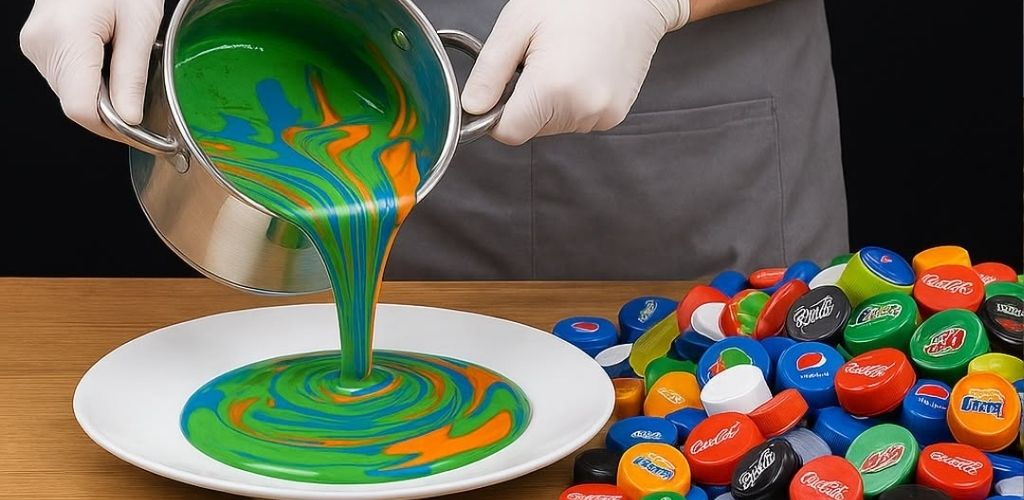
Plastic bottle caps often end up in the trash without a second thought. They’re so small they seem insignificant, but millions of tons of this material are discarded worldwide every year. What many people don’t know is that these seemingly useless pieces can be transformed into practical and decorative objects with a little creativity and basic tools that everyone has at home.
Reusing plastic bottle caps not only helps the environment, but also saves money, fosters creativity, and teaches children about the importance of recycling. Below, we explore why it’s worth saving these small pieces and how to turn them into useful everyday projects.
Why reuse plastic lids?
Bottle caps are mostly made of polypropylene (PP) or high-density polyethylene (HDPE). These materials are extremely strong, lightweight, and durable, but they also take hundreds of years to decompose. Unlike bottles, many caps are not recycled through traditional channels because they are too small for standard industrial processes.
Therefore, giving them a second life at home becomes a direct solution to the problem. Every lid we reuse is one less in the landfill or the ocean. Furthermore, their circular shape, uniform size, and durability make them ideal for a wide variety of craft projects.
Practical ideas for transforming plastic lids
There are countless ways to use this material. Some take only a few minutes, while others lend themselves to more elaborate projects. Here are some of the most useful options:
Organizers for small items
By gluing several lids onto a wooden board or flat surface, you can create an organizer for screws, nails, buttons, beads, or sewing supplies. Each lid acts as an individual compartment, perfect for keeping things tidy in the workshop or craft room.
Garden markers
Bottle caps can be used as labels to identify plants in a vegetable garden or flower garden. Simply write the plant’s name on the cap with a permanent marker and stick it onto the end of a wooden stick or skewer. It’s a durable, waterproof, and completely free solution.
Educational toys
For children, bottle caps are an excellent resource. They can be used to teach counting, color sorting, letter formation, or create memory games. Painted or decorated, they become game pieces for homemade board games or pieces for assembling colorful mosaics.
Bumpers and protectors
A cap attached to the base of a piece of furniture can act as a stopper to prevent it from hitting the wall. They also serve as protectors on the legs of chairs, tables, or heavy boxes, preventing scratches on the floor.
Miniature flowerpots
For germinating seeds or growing very small succulents, lids are ideal containers. Simply make a small drainage hole in the bottom, add soil, and place the seed or cutting. They’re perfect for starting an urban garden in small spaces.
Decorative projects with lids
Beyond their functional uses, plastic bottle caps also lend themselves to artistic creations. Glued in large quantities onto flat surfaces, they can form murals, pictures, mats, coasters, or even decorative curtains. Their variety of colors allows for the creation of eye-catching designs without the need for painting.
Some schools and communities have undertaken collaborative projects where thousands of bottle caps are collected to build benches, tables, or public sculptures. These kinds of initiatives demonstrate the potential of a material that is usually considered trash.
Tips before you begin
To ensure projects turn out well and last longer, it’s important to follow some basic recommendations:
- Wash the lids thoroughly before using them to remove any drink residue or dirt.
- Dry them completely , especially if you are going to glue or paint them.
- Use glue suitable for plastic, such as hot glue or epoxy adhesives.
- Sort them by color and size to make decorating projects easier.
- Work on protected surfaces if you are going to paint or cut the lids.
A small gesture with a big impact
Recycling plastic bottle caps at home may seem like a small thing, but it’s part of a broader culture of responsible consumption. When we stop seeing trash as waste and start seeing it as a resource, we open the door to creative, economical, and sustainable solutions.
The next time you open a bottle, think twice before throwing away the cap. With a little imagination, that small piece can become a useful tool, a toy for your children, a flowerpot for your garden, or a work of art. The key is to look at everyday objects with fresh eyes and discover their hidden potential.