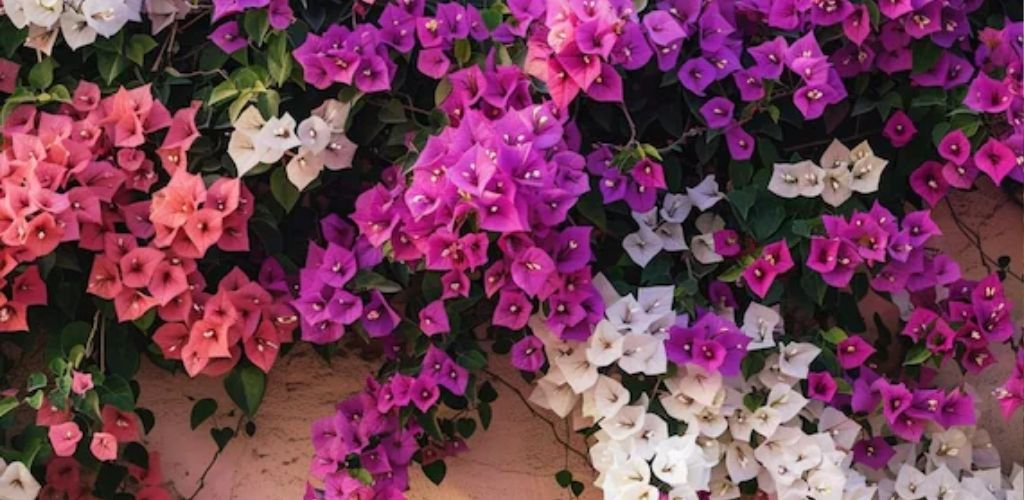
Bougainvillea , also called bouganvillea or bougainvillea , is a beautiful climbing plant that you can use to cover fence walls or form a splendid flowering hedge , but the good news is that you can also grow it in a pot and keep it on the balcony. Its name was chosen in 1768, in honor of the French explorer and admiral Louis Antoine de Bougainville , who discovered this plant belonging to the Nyctaginaceae family in Brazil .
It’s an evergreen plant that blooms in a wide variety of colors , from pink to fuchsia , magenta to purple , red to orange . There are more than 300 varieties , many of which are the result of hybridization or spontaneous mutations. Coming from South America, you might imagine that bougainvillea thrives in sunny, warm climates. For this reason, in winter you’ll need to take extra care of it to help it survive the low temperatures, and you can do so with the advice I’ll give you.
Bougainvillea
1
How to grow bougainvillea in a pot
1.1 When does it bloom?
2
How to care for bougainvillea: watering, fertilizing, pruning
2.1 Watering
2.2 Fertilization
2.3 Pruning
2.4 Where to place it in winter?
3
How to make her climb
4
Parasites and diseases
1
How to grow bougainvillea in a pot
How to grow bougainvillea in a pot
As I mentioned, the climbing habit of bougainvillea makes it ideal for climbing pergolas or creating hedges. However, there are certain varieties , particularly shrubby ones, that are also suitable for growing in pots , making them perfect for adding a splash of color to your balcony. Let’s look at the most important tips for caring for these plants.
DON’T MISS THIS ARTICLE
This secret about the mother-in-law’s tongue plant will surprise you: really useful!
Bougainvillea can be grown from seed , by repotting the seedling , or by cutting, which means that you can start growing bougainvillea in a pot by taking a small branch of about ten centimeters.
Once you have identified the most suitable mother plant for the operation, remove a small branch and immediately place it in a pot with soil composed of a mixture of sand and peat , well-drained , and with a bottom made up of clay pellets: this is because bougainvillea fears stagnation , which normally leads to root rot.
As I was saying, bougainvillea is a climbing plant, but to make it climb you’ll need to give it a little help, planting it near the structure on which you want it to grow and wrapping it around it, so that it continues to grow on the support.
Bougainvillea thrives best in full sun. This plant is native to the tropics , characterized by a mild, warm climate . It therefore tolerates temperatures above 40°C (in Italy, the plant is widespread in southern Italy and coastal areas). In winter, it should be sheltered if temperatures tend to drop below 10°C, and especially protected from colder winds.
When does it bloom?
It takes at least three weeks for the plant to develop roots and be able to move to a permanent location, whether in a larger pot or in the garden. Cuttings , like sowing seeds or repotting, should all be done in spring , when the weather is best suited to supporting this plant’s life cycle.
How to care for bougainvillea: watering, fertilizing, pruning
Watering
Although bougainvillea tolerates long periods of drought well, regular watering is essential for proper plant development, especially in summer, when its vegetative growth is at its peak. Just be careful to avoid standing water , which can cause root rot or suffocation. How can you tell? Make sure the bougainvillea is blooming and hasn’t started losing its leaves.
Fertilization
Bougainvillea requires fertile, well-drained soil with a low level of limestone and good moisture. As for fertilizer, choose an organic product specifically formulated for flowering plants with a good supply of nitrogen, phosphorus, potassium, and micronutrients. A good solution is to purchase a liquid product from specialized stores and nurseries, dilute it in the watering water and apply it every two or three weeks.
The flowering bougainvillea offers bright colors.
Pruning
Precisely because of its summer flowering, the plant tends to be pruned at the end of winter, in February . This helps thin out the foliage by eliminating dead branches and encouraging the growth of more vigorous branches and new leaves on the plant.
Bougainvillea suffers greatly from cold climates and, in particular, winter frosts.
If you’re growing bougainvillea in a pot, be sure to remove any dead branches and trim the tips to give it a regular shape. If the plant is in the ground, such as on a pergola or climbing plant, you’ll need to trim back any weaker or irregular branches by about a third of their length , using cuts that are slightly oblique to the branches themselves.
Where to place it in winter?
Although bougainvillea is a plant that tolerates the coldest temperatures, in winter it should be sheltered if temperatures tend to drop below 10°C and, above all, protected from colder winds.
How to make her climb
Whether you grow it in a pot near a wall or plant it in the garden, make sure to place your Bougainvillea in a sunny spot . It thrives in warm, sunny climates, but it’s very sensitive to frost: it can’t survive below 5°C (41°F). This way, in addition to choosing the right amount of water and the right fertilizer, your Bougainvillea will be able to grow as a climbing plant.
Parasites and diseases
Hardy and resistant to pests, bougainvillea is susceptible to aphid attacks , parasites that feed by sucking the plant’s sap, thus reducing growth. If aphids then unleash the mosaic virus , which causes spots and yellowing of the leaves, the plant risks no longer flowering and declines. Furthermore, the presence of aphids leads to the production of honeydew , a sugary substance that attracts ants and can cause mold growth.
The attack of the lice can be effectively countered by using a broad-spectrum insecticide , which can also be useful in the presence of scale insects , other insects that feed on the sap of the plants, causing damage to its growth.