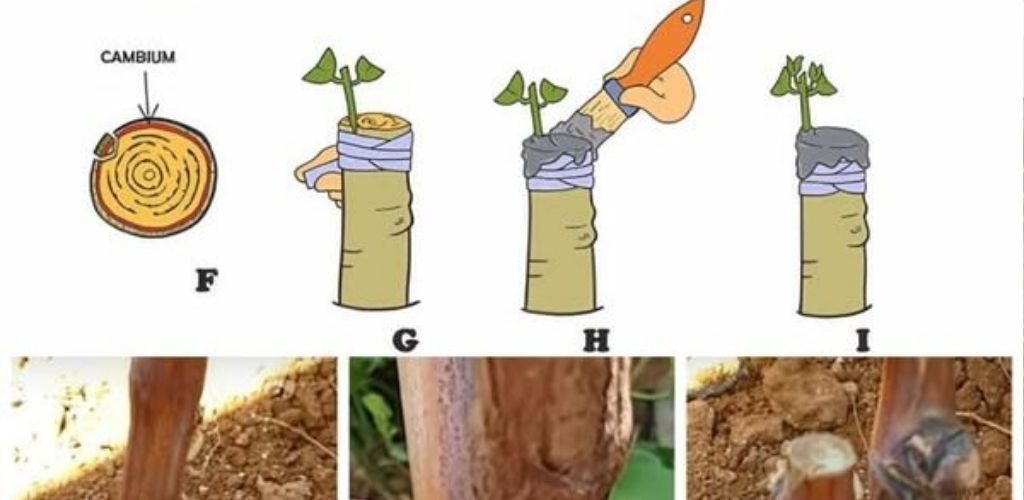
I will explain each step to you.
Step A: The rootstock (the tree or plant into which the graft will be inserted) is cut cleanly and horizontally.
Step B: A young branch or shoot is selected as the grafting point (the desired type of grafting) and cut with a chamfer so that it tapers to a point.
Step C: Carefully make a slit in the center of the rootstock (a vertical cut in the wood) to insert the graft union.
Step D: The graft union is inserted into the slit in the rootstock. Ensure that the cambium (the layer directly beneath the bark) of the graft union and the rootstock is in contact.
Step E: The grafting point is firmly seated in the slot.
Step F: Cross-sectional diagram showing the cambium, which is crucial for connection and healing.
Step G: Wrap the graft union and rootstock with tape or raffia to secure and protect the graft. Phase H: Treat the graft union with wax or a sealant to prevent the entry of pathogens and moisture loss. Phase I:
Once the graft union has healed and taken, it will form an extension of the rootstock and produce new leaves and shoots.
This method is widely used for fruit trees and is employed to propagate high-quality or resistant varieties.