- Autumn is the best time to plant fruit trees: the soil is still warm, it rains more frequently, and the roots develop before winter.
- Choosing the right rootstock, the correct planting distance and a precise first cut guarantee a rich harvest in the first few years.
 Advantages of autumn planting
- Active roots and fresh air → stress-free growth.
- By spring, the tree is already well established and blooms earlier.
- Less watering: Rainwater naturally replenishes soil moisture.
 Selection of species and documents
- Apple M9 → small, early ripening, requires support and fertile soil.
- MM106 → moderately vigorous growth, good drought resistance.
- Pear BA29 or Pyrodwarf → smaller, early ripening.
- Gisela cherry 5/6 → compact, high-yielding.
- Wangenheimer/St. Juliener Plum A → variable tolerance to moisture and soil.
- Crown seedlings = faster growth; cuttings = more economical and easier to train.
 Ideal location and soil
- Sunny, well-ventilated and sheltered location.
- Deep, loose, humus-rich soil without waterlogging.
- Low groundwater level (at least 1.2 m).
- Optimal pH value: 6.2–7.0.
- For heavy soils, create mounds or a drainage layer of gravel.
 Planting time depends on climate
- Cooler regions: Late September to mid-October.
- Lowlands: Mid-October to the end of November.
- Do not plant just before severe frost.
 Recommended planting distance
- Apfel M9: 3–3,5 × 1–1,2 m
- MM106: 4–4,5 × 2–2,5 m
- Pear BA29: 3.5–4 × 1.5–2 m; on heavy rootstock: 5–6 × 3–4 m
- Plum/cherry on low rootstock: 4–4.5 × 2–3 m
 Planting instructions
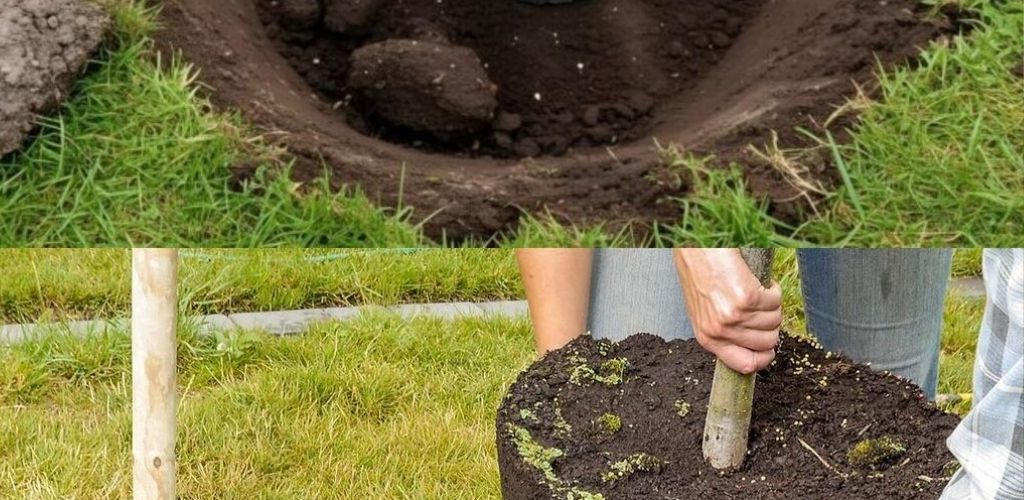
- Drive the stake (2–2.5 m) into the ground on the leeward side before planting the tree.
- Planting hole: 60–80 cm wide, 40–50 cm deep.
- Mix the soil with mature compost and sand if the soil is heavy.
- Optional: Sprinkle the roots with mycorrhizae.
- The root collar should be 2–3 cm above the soil surface.
- Fill with soil, press down lightly and water with 10–20 liters of water.
- Form a small watering rim around the base of the trunk.
Anchoring and protection
- Tie the tree in a figure-eight pattern using a soft ribbon (without damaging the bark).
- Protect the trunk with a rodent net or wire spiral.
- Protect from frost damage with white paint or lime.
- Apply mulch (5–8 cm), taking care not to touch the bark (leave 5 cm free).
 First cut: Important tips for shaping
- Seedlings without a crown: Cut back to 80–90 cm to encourage branching.
- Seedlings with crown: Leave 3-4 main branches, cut back to one third and remove the central bud.
- Stone fruit (cherry, plum): Best pruned in spring.
 Fertilization and initial care
- Do not use fresh manure or nitrogen-rich fertilizer when planting.
- Add compost or a mild plant extract in the spring.
- Only apply lime if the soil is acidic (4–6 weeks after adding compost).
 Common mistakes
- Planted too deep → covered crown = rot.
- Missing support post → risk of being uprooted by wind.
- Mulch sticks to the trunk → excessive moisture and voles.
- Waterlogging without drainage → root suffocation.
 Last check before winter
- The support post is firmly in place, but the adhesive tape is loose.
- Protective measures against wild animals are in place.
- The mulch is dry and detached from the bark.
- The irrigation basin is ready to collect winter rain.
 Result: A tree planted well in autumn awakens vigorously in spring, grows evenly and bears healthy, sweet fruit for years.