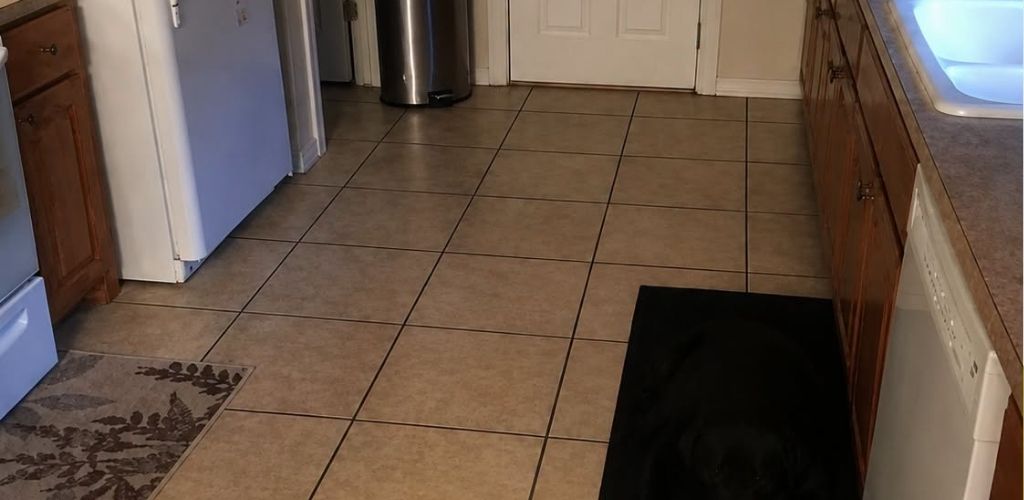
We walk into the kitchen, take a quick look at the counter, check if the floor is clean, and continue with our routine. But what if we told you that, in the middle of such an ordinary scene, there’s something rather large that you probably didn’t notice? That’s precisely what an optical illusion that went viral on social media suggests: hidden in a photograph of an ordinary kitchen is a large dog that most people overlook at first glance.
This isn’t a digital trick or a hoax. The animal is right there, in plain sight. Yet our brains stubbornly refuse to acknowledge it. The way we perceive our surroundings is far from perfect, and images like this demonstrate that with astonishing clarity.
Why the brain doesn’t see the obvious
When we enter a kitchen, our minds already have a clear expectation of what should be there: furniture, appliances, perhaps some utensils on the counter. Paradoxically, this preconceived expectation is what works against us when we actually see the image.
The human brain has a natural energy-saving mechanism: it interprets scenes quickly, prioritizing familiar shapes and patterns. Anything that doesn’t “fit” the expected context, like a huge animal lying on the ground, tends to be ignored or mistaken for the background. Specialists call this phenomenon Gestalt perception : we first grasp the whole and only later, if we pause, do we notice the details.
The visual trick lies in the contrast.
In the viral image, the rug covering part of the kitchen floor is dark-colored. The dog is too. The floor has few contrasting elements, creating an almost perfect camouflage effect. In a matter of seconds, our brain makes a hasty decision: “that’s just the rug.”
However, there are subtle clues that can help you locate the hidden animal:
- Pay attention to the curved shapes that break with the straight geometry of the furniture and appliances.
- Look for two small dark circles : they could be the dog’s eyes.
- Identify slightly lighter areas that could correspond to the belly or snout.
- Look at the baseboard and the edges of the carpet: any break in the straight line could be a clue.
- Step back from the screen, lower the brightness, or squint. Sometimes, the image “reveals” what was there all along.
An ideal exercise for training attention
Turning this search into a game can be much more enriching than it first appears. You can suggest it to your friends, family, or even young children, stimulating visual reasoning and mindful observation.
Some ideas to take advantage of the challenge:
- Single mode: time how long it takes you to find the dog.
- Group mode: each participant describes what they see without mentioning the word “dog”.
- Advanced level: I printed the image in black and white, so the challenge becomes even more complex.
- Children’s version: ask the children what catches their attention in the scene and what element “doesn’t match” a kitchen.
Beyond the fun, this type of exercise stimulates sustained attention, patience, and the ability to look beyond the obvious—skills that are useful in many areas of daily life.
The solution: Where was the dog?
If after all your attempts and clues you still haven’t found the animal, take a deep breath and pay attention to the bottom right of the image. That’s where it’s hiding.
Look for two dark, fixed eyes and a clear, arc-shaped line that outlines part of its silhouette. Once you identify them, everything starts to make sense. The dog is lying down, its body partially curled and its snout pointing forward. Its fur blends almost perfectly with the dark carpet, creating a visual camouflage that fools even the most trained eye.
At the end of the day, the animal was there all along. The one who wasn’t seeing it was you, or rather, your brain, which decided for you which elements deserved attention and which didn’t. These optical illusions are a fascinating reminder that the reality we perceive doesn’t always coincide with the reality right in front of our eyes. And perhaps that’s the most valuable lesson: sometimes, to truly see, we need to stop, observe calmly, and be a little skeptical of our own mind’s hasty conclusions.