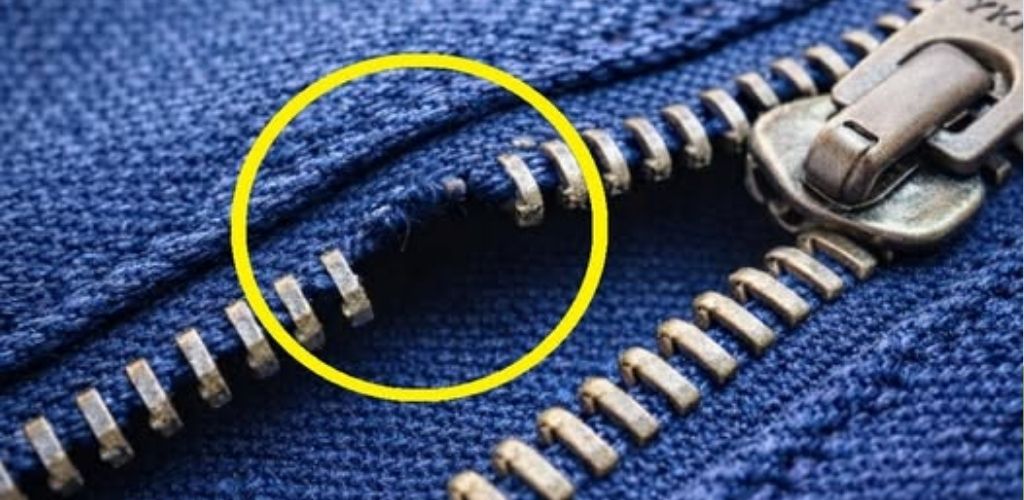
How a zipper really works (and why it fails)
Before discussing the trick, it’s worth understanding the mechanism.
A zipper has three key parts:
- Teeth (or chain): the pieces that fit together
- Cursor (carriage): the part that joins or separates the teeth
- Shooter: what you pull
Most failures come from the cursor, not the teeth.
Most common problem:
The cursor opens slightly with use, losing pressure. Result: the teeth do not stay together.
This explains something key:
👉 Many “broken” zippers are not actually broken, just misaligned.
The trick in the video: what it actually does
Although the video doesn’t always explain it in detail, the “hack” usually consists of:
👉 Apply pressure to the cursor (usually with a tool or even with your fingers)
This reduces the internal separation of the carriage and recompresses the teeth.
Why does it work?
Because you are temporarily restoring the original geometry of the mechanism.
It’s not magic. It’s basic physics.
The problem: it’s not always the definitive solution.
This is where critical analysis comes in.
The video promises a quick solution… but it omits something important:
❗ Not all failures are the same
There are at least 4 different scenarios:
1. Loose cursor (the ideal case)
✔️ The trick works very well
✔️ It can last quite a long time
2. Worn teeth
❌ The trick doesn’t work
❌ The zipper will continue to fail
3. Missing teeth
❌ There is no real solution without replacement
4. Deformed or damaged cursor
⚠️ This trick may worsen the situation
Comparison: Quick repair vs. replacement
| Method | Time | Difficulty | Duration | Result |
| Video trick | 1–2 minutes | Very low | Average | It works in specific cases |
| Cursor change | 10–20 min | Average | High | More robust solution |
| Total replacement | 30–60 min | High | Very high | Like new |
👉 The trick is useful… but it doesn’t replace a real repair.
A detail that almost no one mentions
Fun fact: Zippers are designed to fail over time.
Yes, it sounds strange, but it makes sense.
Manufacturers often use lightweight alloys (such as zinc or aluminum) in the cursor to:
- Reduce costs
- Avoid damage to the fabric
- Allow some controlled deformation
The problem is that this “flexibility” turns into wear and tear.
Real-life example: the case of a daily backpack
Imagine a backpack used every day.
- Constant opening and closing
- Uneven weight
- Lateral tension
Over time, the cursor opens slightly.
You apply the trick → it works. But after a few weeks → it fails again.
Because?
Because the metal has already lost its original shape. The adjustment is temporary.
When is it worth using this method?
This type of solution is ideal when:
- You need a quick repair
- You are away from home
- The garment is still in good overall condition.
- The problem is clearly the zipper that doesn’t fit properly.
In other words: 👉 As an immediate solution, it’s brilliant.
When is it better not to do it?
Avoid this method if:
- The cursor is too weak or old.
- The zipper is made of plastic (more fragile)
- The teeth are damaged
- The garment is delicate.
Because you could end up making the problem worse.
Lesser-known (but more effective) alternatives
This is where we can add real value.
1. Intelligent lubrication
Sometimes the problem is not mechanical, but friction.
You can use:
- Wax
- Dry soap
- Graphite (pencil)
This improves gliding without damaging the system.
2. Cursor only replacement
Few people know this, but:
👉 You don’t need to replace the entire zipper.
There are universal sliders that you can install without sewing.
It’s a more lasting solution than the trick in the video.
3. Gradual (not abrupt) adjustment
If you apply pressure, do so minimally and gradually.
Many fail because:
👉 Pressing too hard → deforms the cursor → makes everything worse.
Why this type of content goes viral
It’s not a coincidence.
This type of video mixes:
- Universal problems
- Simple solutions
- Feeling of a “hidden hack”
- Immediate result
But it also oversimplifies.
And that’s where the viewer must go beyond the “trick”.
The real value: learning to observe
The interesting thing is not just repairing a zipper.
It’s about developing something more valuable:
👉 Diagnostic capacity
When you understand how something works, you stop relying on generic solutions.
You start to see patterns:
- Is it loose or broken?
- Is it friction or wear?
- Is it worth repairing or replacing?
That’s the real “hack”.
Final reflection: between viral and useful
The “1 minute” trick isn’t fake. But it’s not complete either.
It’s just another tool, not the ultimate solution.
We live in an age where everything is reduced to seconds:
- quick solutions
- immediate results
- simple promises
But objects, like zippers, have a history, wear and tear, and logic.
And understanding that changes the way we use them… and repair them.
The question that remains
The next time something “stops working,” are you going to look for a trick… or are you going to try to understand why it failed?
Because that’s the difference between solving a problem… and learning not to depend on temporary solutions.