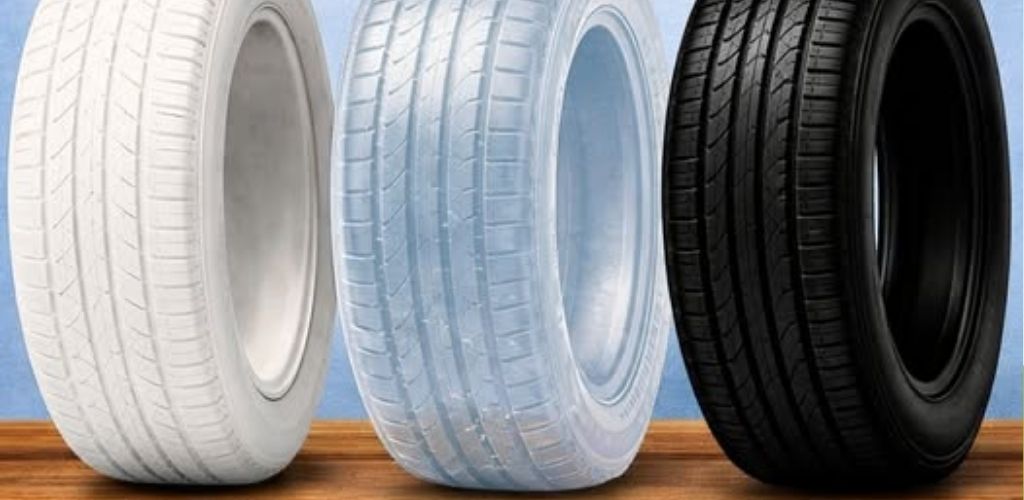
Before black: when tires were white
Yes, the tires were not originally black.
The first tires, in the late 19th and early 20th centuries, were a grayish-white color. This was because they were made almost exclusively of natural rubber, without any significant additives.
Pure rubber has several interesting characteristics:
- It is flexible
- It has good adhesion
- But… it degrades quickly
Herein lies the first key problem: extremely limited durability.
What was wrong with those tires?
- They cracked easily
- They wore out quickly
- They were very sensitive to heat
- They did not withstand UV radiation well.
In other words: they worked, but they weren’t reliable.
The key change: the introduction of carbon black
Everything changed when the industry began adding a material called carbon black.
This is the true protagonist of the story.
What is carbon black?
It is a fine material, almost like soot, obtained from the incomplete combustion of hydrocarbons. To the naked eye, it is intensely black. But its value lies not in its color, but in its physical properties.
Why did it start to be used?
Because it completely transforms the behavior of rubber.
By mixing rubber with carbon black:
- Increases wear resistance
- Improves durability
- Reduces UV damage
- It dissipates heat better
- It strengthens the internal structure.
In other words, it transforms a fragile material into one suitable for the real world.
It’s not just color: it’s advanced engineering
Saying that the tires are black because of the carbon black is correct… but incomplete.
In reality, the modern tire is a highly optimized composite system.
What you’re really seeing
The color black is only the visible result of a complex mixture that includes:
- Natural and synthetic rubber
- Carbon black (key reinforcement)
- Oils
- Sulfur (for vulcanization)
- Specific chemical additives
Each one serves a purpose. But carbon black is what defines the strength.
Key comparison: tires with and without carbon black
Imagine two tires:
Tire without carbon black
- Lighter (gray/white)
- It wears out quickly
- It overheats
- It loses structural properties
Tire with carbon black
- Intense black
- High abrasion resistance
- Improved heat dissipation
- Much longer lifespan
The difference is not marginal: it is critical for safety.
The thermal factor: the invisible enemy
One of the lesser-known aspects is the role of heat.
When you drive, the tire:
- It constantly deforms
- It generates friction
- It accumulates heat
Without good thermal control, the tire can fail.
Here, carbon black plays a key role:
- Distributes heat
- Avoid overheating spots
- It reduces the risk of degradation
This is especially important in:
- Heavy vehicles
- High speeds
- Warm climates (like many areas of Latin America)
Why not make colored tires today?
Good question. And the answer isn’t just technical… it’s also practical.
Yes, colored tires exist.
But:
- They are less durable
- They are used in very specific contexts (decoration, display, bicycles, etc.)
Main problem
Eliminate or reduce black carbon:
- It weakens the tire
- It reduces its useful life
- The risk increases
Although there are alternatives such as silica, these do not completely replace all the functions of carbon black.
Silica: the “modern rival”
In newer tires, especially high-end ones, silica is used as an additive.
What does silica provide?
- Better grip in wet conditions
- Lower rolling resistance
- Greater energy efficiency
So… why doesn’t it replace carbon black?
Because:
- It does not offer the same complete structural resistance
- It’s more expensive
- It works best in combination, not as a total replacement.
Real-world example: high-performance tires
In sports or racing cars:
- Very specific mixtures are used.
- Grip vs. durability is optimized
- Carbon black remains essential
Even in Formula 1, where everything is pushed to the limit, the color black is non-negotiable.
Beyond the car: other applications
Carbon black is not only used in tires.
It is also present in:
- Industrial hoses
- Mechanical seals
- Electrical components
- Reinforced plastics
This reinforces a key idea: it is not just a dye, it is a structural material.
One interesting detail: color as an indirect advantage
Black also has secondary benefits:
- Protects against UV radiation
- It conceals dirt and wear.
- It maintains a uniform appearance.
It wasn’t the main reason… but it ended up being an advantage.
Practical recommendations (what you can actually apply)
Understanding this isn’t just general knowledge. It has real-world implications:
1. Don’t be swayed by aesthetics
A “pretty” or colored tire isn’t necessarily better. Engineering matters more than appearance.
2. Take care of the temperature
- Avoid overloading the vehicle
- Maintain the correct pressure
- Check alignment
All of this reduces heat stress.
3. Don’t underestimate wear and tear
Black hides damage. Check it out:
- Cracks
- Deformations
- Depth of drawing
4. Invest in quality
Cheap tires usually have:
- Lower quality of compounds
- Worse thermal performance
- Less durability
A story that reflects industrial evolution
The interesting thing about all this is that the black color was not an aesthetic decision, but a solution to a real technical problem.
It’s a perfect example of how:
- Materials science is changing industries
- Small changes generate big impacts
- The everyday hides profound innovation
Closing: What’s invisible is what truly matters
The next time you see a tire, it will probably still look the same: black, common, with no mystery.
But now you know that color isn’t accidental. It’s the result of decades of experimentation, failures, improvements, and technical decisions that made something as commonplace as safe driving possible.
In a world where many things are designed to look good, tires are a reminder of the opposite: what’s most important isn’t always visible… but it holds everything else together.
And perhaps that is the most interesting lesson of all.