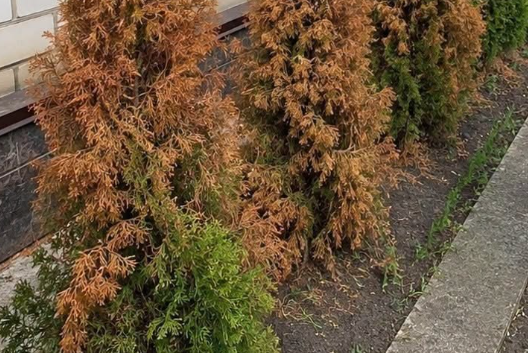
When a thuja starts to brown in July or August, many people think that the plant has already died. In reality in most cases the reason lies not in disease, but in care mistakes or strong heat. If you react in time, the thuja is capable of fully recovering.
First of all find out what exactly is drying
Examine the tree carefully. If only individual inner twigs have become brown, this may be the natural renewal of the needles. But if the top, whole branches or one side of the crown is yellowing or drying — this is already a signal that the plant needs help.
Check the soil
Most often the problem arises because of lack of moisture. Heat quickly dries out the ground, especially if the thuja grows in open sun.
Dig a small hole 10–15 cm deep. If the soil is dry and crumbles in the hands — the tree lacks water.
Water not a little every day, but abundantly — approximately 20–40 liters of water under an adult thuja one or two times a week. The water should penetrate to the roots, and not remain only on the surface.
Mulch the trunk circle
A layer of bark, chips or peat 5–7 cm thick will help retain moisture longer, protect the roots from overheating and reduce the number of waterings.
The main thing is not to pour the mulch right up against the trunk.
Examine the crown
If there is cobweb on the branches, small light dots or the needles fall off from a light touch, spider mite infestation is possible.
In such a case the plant needs to be treated with a special acaricide according to the instructions. Simple spraying with water will not solve the problem.
Remove dry branches
Do not leave completely dried shoots inside the crown. They worsen ventilation and can become a place for the development of fungal diseases.
Cut only those parts that have already completely lost the green colour.
Do not hurry to feed with nitrogen
In the second half of summer nitrogen fertilizers only stimulate the growth of young shoots that may not manage to strengthen by autumn.
If feeding is necessary, it is better to use fertilizers with a predominance of potassium and phosphorus — they help the plant more easily tolerate stress.
And the most important thing — do not make hasty conclusions. Even if part of the crown has lost the green colour, with proper care the thuja often starts to recover already in a few weeks. Patience, sufficient watering and timely care often save the tree even after the hottest summer.